Michael Review: Jaafar Jackson Shines in a Sanitised Biopic
Michael review: Antoine Fuqua’s Michael Jackson biopic is at its best when Jaafar Jackson is performing, and at its weakest when the film has to decide what kind of biography it wants to be. The result is a polished, often electrifying music film that stops in 1988, before the most disputed chapters of Jackson’s life, and therefore feels deliberately incomplete rather than fully revealing.

This Michael review starts with the film’s scope, because Michael is not a cradle-to-grave biography. It covers the Jackson 5 years, Michael’s break from his father’s control, the making of his solo superstardom and the ascent through Off the Wall, Thriller and Bad. It ends before the allegations that emerged in the 1990s. Jackson denied allegations of child sexual abuse, and a jury acquitted him on all counts in a separate 2005 criminal trial.
Movieshala is an independent film guide. We are not affiliated with Lionsgate, the Michael Jackson estate, any streaming platform or the filmmakers, and we do not sell tickets or subscriptions.
Michael review: quick verdict
Movieshala rating: 2.5 out of 5. This Michael review finds a film with two very different strengths. As a concert-sized recreation of Jackson’s rise, it can be thrilling. As a biography that promises to reveal the person behind the fame, it is too selective and too carefully controlled to feel complete.
- Best element: Jaafar Jackson’s physical performance, especially in the major stage recreations.
- Biggest weakness: the script reduces conflict mostly to Michael versus his father, Joe Jackson.
- Runtime: 127 minutes.
- Director: Antoine Fuqua.
- Writer: John Logan.
- Key cast: Jaafar Jackson, Colman Domingo, Nia Long, Juliano Krue Valdi and Miles Teller.
- Current India streaming: JioHotstar, subject to regional availability changes.
Lionsgate lists the film at 127 minutes and rates it PG-13 in the United States. Its official home-entertainment material also confirms Fuqua as director and Logan as writer. In India, current streaming trackers list Michael on JioHotstar, so viewers should check the platform before subscribing.
Michael review: what is the film actually about?
This Michael review treats Michael as the first half of Michael Jackson’s public story. It starts with the Jackson family in Gary, Indiana, follows the Jackson 5’s rise, then shifts into Michael’s effort to become an independent solo artist. The film builds toward the Bad era and stops before the 1990s controversies that later reshaped his public image.
For this Michael review, that structure gives the movie a clear dramatic spine. Joe Jackson, played by Colman Domingo, becomes the force Michael must escape. John Branca, played by Miles Teller, enters as a professional ally. Quincy Jones and Motown figures appear along the way, while the soundtrack does much of the emotional work.
The approach is easy to follow, yet it narrows the man into a familiar biopic pattern. Childhood pain leads to control, breakthrough and global triumph. Since Michael Jackson’s life became far messier than that pattern allows, the ending feels less like closure and more like a strategic stopping point.
Michael review: Jaafar Jackson is the reason to watch
The strongest argument for seeing the film is Jaafar Jackson. This Michael review agrees with the broad critical consensus on one point: his stage work is remarkably convincing. He captures the posture, timing, footwork and controlled stillness that made Michael Jackson magnetic before a beat even dropped.
This Michael review finds his performance works best when the film lets movement speak. The Motown 25 recreation, the choreography sequences and the concert staging all benefit from Jaafar’s instinct for rhythm. Those moments create the sensation the movie keeps promising elsewhere: not simply imitation, but an understanding of how Michael used precision to create spectacle.
The off-stage scenes are harder. Jaafar often has to play a version of Michael written as gentle, wounded and almost permanently misunderstood. That gives him limited emotional range. Even so, he finds flashes of steel beneath the softness, especially when Michael starts separating his career from Joe’s control.
Michael review: Colman Domingo gives the film its clearest conflict
This Michael review gives Colman Domingo credit for the film’s clearest conventional dramatic role as Joe Jackson. The screenplay presents Joe as harsh, ambitious and controlling, then uses that relationship to explain much of Michael’s later drive. It is blunt writing, but Domingo gives it weight because he never plays Joe as a simple cartoon villain.
The problem is proportion. Once the father-son conflict becomes the movie’s main explanation for Michael, nearly every later struggle gets filtered through it. That makes the film emotionally tidy, even when the life it depicts was anything but tidy.
Nia Long brings warmth as Katherine Jackson, although the script gives her less room to shape the story. Miles Teller is efficient as John Branca, while the wider family frequently feels more like historical scenery than a set of people with independent lives.
Michael review: why the music works better than the biography
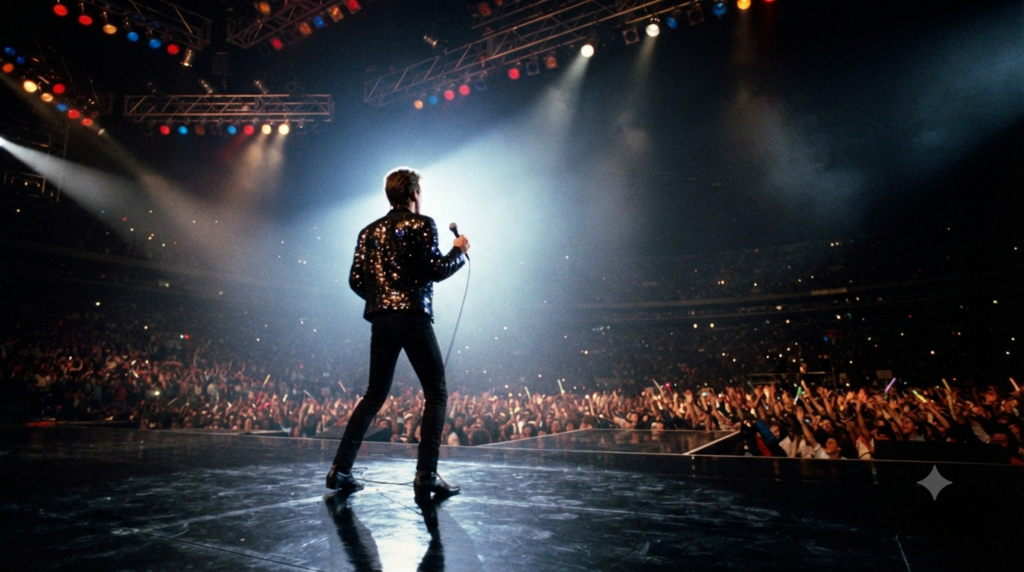
On spectacle, this Michael review has little complaint: Fuqua understands scale. The major performance scenes have the lighting, crowd energy and visual rhythm needed for a theatrical biopic. When the film moves into “Billie Jean,” “Beat It,” “Thriller” or the Bad era, it finally stops explaining greatness and starts showing why audiences responded to it.
Those scenes also expose the central weakness. The music has tension because every beat depends on timing. The drama often does not, because Michael rarely faces an internal contradiction the film is willing to examine for long.
So the movie keeps returning to achievement. Recording breakthroughs become montages, while business battles become victory beats. Personal wounds become motivation. The pattern creates momentum, yet it also turns a complicated life into an orderly rise narrative.
Michael review: is the film really a hagiography?
The word “hagiography” is harsh, but it explains why this Michael review has reservations. The film is not inaccurate simply because it celebrates Jackson’s talent. The problem is that it repeatedly selects material that supports admiration, sympathy or triumph, while leaving far less space for ambiguity, contradiction or self-inflicted damage.
Several major reviews reached a similar conclusion. Time Out called the film a soft-focus treatment of Jackson’s controversies. Variety was more positive about the entertainment value, yet still noted the absence of the later allegations. Rotten Tomatoes currently shows a sharp critic-audience split: 38% from critics and 97% from verified audience ratings.
That split is useful because it shows what the movie does well. Fans looking for musical recreation, nostalgia and a strong lead performance can have a very good time. Viewers looking for a probing biography may feel the film has chosen celebration over examination.
Michael review: what does the film leave out?
This Michael review stresses one timeline point: the film ends around the Bad era, before Michael Jackson faced his first public child sexual abuse allegation in 1993. That means the movie does not address the allegations that later dominated discussion of his legacy. It also does not cover the 2005 criminal trial, in which a jury found Jackson not guilty on all counts.
This distinction matters. Saying the film “proves” anything about those later allegations would be wrong, because it does not dramatise them at all. Likewise, treating the allegations as established criminal guilt would be inaccurate. The more defensible criticism is about scope: a film marketed as a major life portrait stops before the period that made its subject most contested.
Reports around the production indicate that earlier versions went further into the 1990s before legal complications led to rewrites and reshoots. Whatever happened behind the scenes, the finished film asks to be judged on what appears on screen. On that basis, the cutoff makes the portrait dramatically safer.
Michael review: does the 1988 ending hurt the movie?
This Michael review says yes, because the ending solves a production problem more neatly than it solves the story. A biopic can absolutely focus on one period of a person’s life, but it needs that period to form a complete dramatic argument. Michael instead closes at the peak of triumph and then signals that the story continues.
The choice makes the film feel like part one of a franchise. That is now more than a theory. Lionsgate executives have discussed development of a follow-up, and Jaafar Jackson has said a second film is expected to move into the later controversies and allegations.
That future film may change how this one is viewed. For now, however, audiences have to judge the first chapter as a standalone release. On its own, it gives us the ascent but not the reckoning.
Michael review: how accurate is the biopic?
This Michael review treats accuracy carefully: Michael recreates many recognisable milestones, but a music biopic is still a drama rather than a documentary record. Scenes compress time, dialogue is reconstructed and complex relationships get simplified. The film’s strongest claim to authenticity comes from performance detail, not from providing a complete historical account.
The safest way to watch is to separate three layers. First, the broad career milestones are public record. Second, private conversations and motives are dramatized. Third, the film’s omissions are editorial choices, not evidence that omitted events were unimportant or settled.
That last point is especially important here. Estate involvement does not automatically make every scene false, yet it gives viewers a reason to notice which conflicts the film embraces and which ones it postpones.
Michael review: critics versus audience response
This Michael review also has to address a striking response gap. Few recent music biopics have produced one this large. Rotten Tomatoes lists the film at 38% among critics and 97% among verified audience ratings.
The pattern behind those numbers is clear in this Michael review. Critics repeatedly praised Jaafar Jackson while criticizing the screenplay’s sanitised approach. Audience responses were far warmer, especially toward the songs and performance recreations.
| Measure | Current figure | What it suggests |
|---|---|---|
| Rotten Tomatoes critics | 38% | Mostly negative reviews |
| Verified audience score | 97% | Very strong viewer approval |
| Worldwide box office | About $1.03 billion | Major global commercial success |
| Runtime | 127 minutes | Feature-length first chapter |
The box-office result matters because it confirms that critical skepticism did not stop audiences from turning up. Box Office Mojo currently reports more than $1.02 billion worldwide. If you want context for what a gross figure actually means, Movieshala’s guide to how movies make money explains why worldwide gross is not the same as studio profit.
Michael review: where to watch the movie legally
For readers using this Michael review to decide where to watch, current listings show Michael streaming on JioHotstar in India. In the United States, Starz lists the film in its streaming catalogue. Digital rental and purchase options vary by country, so check the official platform in your region before paying.
Streaming rights can move without much notice. That means an old “watch here” link can become wrong even when the review itself remains useful. For more context on why movies move from theatres to digital at different speeds, see Movieshala’s guide to the theatrical vs OTT release window.
Use legal platforms because availability, subtitles, dubbing and picture quality can differ by territory. Avoid pages promising free downloads or unofficial streams, since those listings are often misleading and can expose devices to malware.
Michael review: who should watch it?
This Michael review recommends the film most strongly to viewers who want the songs, choreography and rise-to-fame story. Jaafar Jackson’s performance gives those scenes real value, and the production has enough polish to work as a large-screen or home-theatre experience.
It is a weaker fit for viewers who want a full accounting of Michael Jackson’s life. The film ends too early for that. It also avoids the kind of sustained moral ambiguity that gives the best biopics their depth.
So the decision is simple. Watch it as a performance-driven first chapter, not as the final word on Michael Jackson. That expectation makes the movie easier to appreciate without pretending its omissions do not matter.
Michael: what most reviews miss
This Michael review goes beyond the usual “great music versus sanitised biography” argument, because there is a second problem. The movie’s structure turns Michael’s ambition into something almost purely reactive. Joe hurts him, so Michael pushes harder. Industry doubt drives records, while press intrusion drives retreat.
That framing leaves surprisingly little room for artistic decision-making as conflict. We see what Michael achieves, but less often why one creative choice mattered more than another. A stronger film would have spent more time inside the tension between control, perfectionism and vulnerability.
There is also an odd irony in the film’s scale. The bigger the recreations become, the smaller the inner life can feel. The concert scenes expand Michael Jackson into a global icon, while the screenplay keeps shrinking him back into a wounded son seeking freedom from his father.
Michael review: final verdict
The final verdict in this Michael review is mixed, and this Michael review keeps the distinction between spectacle and biography clear. Michael succeeds as a showcase for Jaafar Jackson and as a glossy recreation of several career-defining performances. It also gives Colman Domingo enough dramatic material to create a strong father-son conflict.
Yet the film stops exactly where the biography becomes most difficult. That decision keeps the first chapter accessible, but it also makes the portrait feel protected. The $1 billion box office and 97% verified audience score prove that many viewers did not mind. Critical reaction shows that many reviewers did.
For now, 2.5 out of 5 feels fair. Watch for Jaafar Jackson, the music and the spectacle. Do not mistake the film’s carefully chosen first half for a complete account of Michael Jackson’s life.
Michael review: frequently asked questions
Michael review: is Michael a good movie?
This Michael review finds Michael entertaining when it focuses on performance, but less convincing as a complete biography. Jaafar Jackson is the highlight, while the screenplay’s selective scope limits the drama. Viewers who mainly want the music may enjoy it much more than critics did.
Who plays Michael Jackson in Michael?
Jaafar Jackson, Michael Jackson’s nephew and Jermaine Jackson’s son, plays the adult Michael. Juliano Krue Valdi plays the younger Michael. Jaafar’s dance work and physical resemblance became the most widely praised part of the film.
How long is Michael?
The official Lionsgate home-entertainment listing gives Michael a runtime of 127 minutes, which is 2 hours and 7 minutes. Some listings round this figure differently, but 127 minutes is the studio specification.
Michael review: does the film cover the allegations?
No. The finished film ends before the allegations that emerged publicly in 1993, so it does not dramatise them. Jackson denied allegations during his lifetime, and a jury acquitted him on all counts in a separate 2005 criminal trial.
Why does Michael end in 1988?
The film is structured as the first chapter of Jackson’s life story and closes in the Bad era. Reports about the production also describe rewrites and reshoots connected to legal issues surrounding later material. The ending therefore leaves the 1990s and beyond for a possible sequel.
Will there be a Michael sequel?
A sequel is in active development, although final release details can still change. Lionsgate leadership has discussed a future production window, while Jaafar Jackson has said the later story should address the controversies and allegations that the first film does not cover.
Michael review: where can I watch the movie in India?
Current September 2026 listings show Michael streaming on JioHotstar in India. Platform rights can change, so confirm in the official JioHotstar app or website before subscribing. Rental and purchase options may also vary by device and region.
What is the Rotten Tomatoes score for Michael?
Rotten Tomatoes currently lists Michael at 38% from critics and 97% from verified audience ratings. Scores can shift as more reviews arrive, so treat them as a current snapshot rather than a permanent figure.