Vijay Perambur Election Result: Final Votes, Turnout & What Changed
Vijay Perambur election result is now settled in the official count: C Joseph Vijay of Tamilaga Vettri Kazhagam (TVK) received 120,365 votes and defeated DMK candidate RD Shekar by 53,715 votes. The Election Commission of India (ECI) lists Vijay at 58.89% of valid votes after all 23 EVM rounds. That final result replaces the election-day speculation that originally drove this page.
Movieshala is an independent entertainment publication. It is not affiliated with Vijay, TVK, the ECI, or any political party, and this article reports verified public records without endorsing a candidate or party.
Vijay Perambur election result at a glance
- Winner: C. Joseph Vijay, Tamilaga Vettri Kazhagam (TVK).
- Votes: 120,365, equal to 58.89% of valid votes.
- Runner-up: R.D. Shekar of the Dravida Munnetra Kazhagam (DMK) with 66,650 votes.
- Winning margin: 53,715 votes.
- Total valid votes listed by ECI: 204,384, including NOTA.
- Counting: ECI completed all 23 EVM rounds.
- Seat retained: Vijay later retained Perambur after also winning Tiruchirappalli East.
The cleanest source is the ECI constituency result page for Perambur. It gives candidate totals, postal votes, EVM votes, and vote shares. Therefore, those numbers should replace live-blog estimates or social-media screenshots.
What the final Perambur count actually shows
The Vijay Perambur election result was not a narrow finish. Vijay secured 120,365 votes, while RD Shekar received 66,650. M Thilagabama of the Pattali Makkal Katchi finished third with 8,561 votes, while S Vetri Thamizhan of Naam Tamilar Katchi received 5,114.
| Candidate | Party | Votes | Vote share |
|---|---|---|---|
| C. Joseph Vijay | TVK | 120,365 | 58.89% |
| R.D. Shekar | DMK | 66,650 | 32.61% |
| M. Thilagabama | PMK | 8,561 | 4.19% |
| S. Vetri Thamizhan | NTK | 5,114 | 2.50% |
| NOTA | None of the Above | 601 | 0.29% |
The first two candidates together accounted for more than nine-tenths of valid votes. However, that does not by itself explain why people voted as they did. Election results measure ballots, not voter motives, so claims about fandom, youth sentiment, or celebrity appeal require separate evidence.
Vijay Perambur election result: was turnout really 90%?
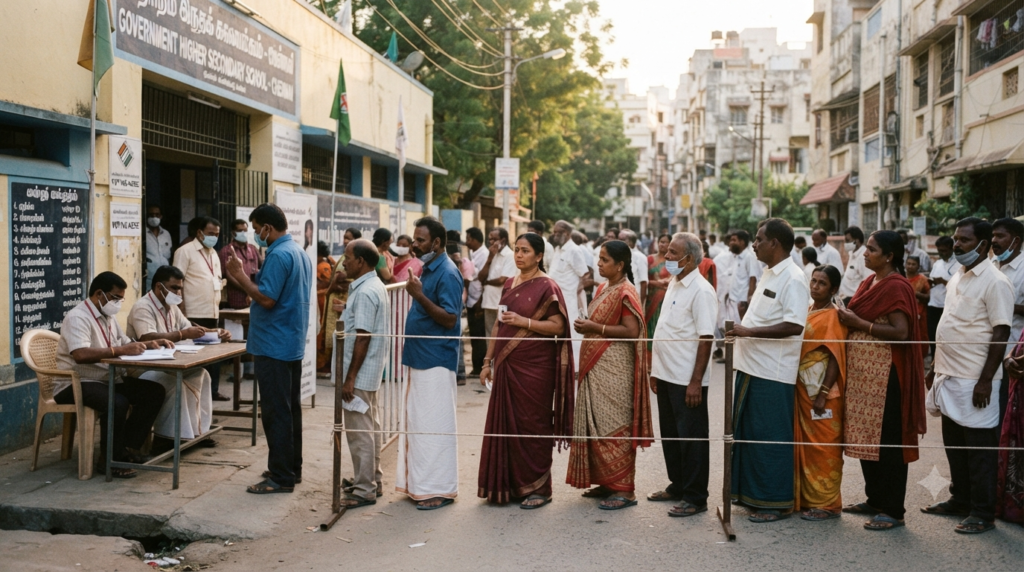
Yes, Perambur recorded unusually high polling during the 2026 Tamil Nadu Assembly election, but the exact figure needs careful wording. The New Indian Express reported a revised provisional turnout of 89.73% on 24 April, calling it the highest among Chennai constituencies. Some later election pages display 89.31%, while the final ECI result page focuses on votes and vote shares rather than publishing a turnout percentage.
That difference matters because the old version of this article treated “about 90%” as a settled record while officials were still compiling polling data. A better formulation is that late polling reports put Perambur at roughly 90% turnout. Readers who need the legally final turnout percentage should rely on the constituency’s final election record and Form 20, not an election-night estimate.
The broader state also saw very high participation. The New Indian Express reported a revised provisional Tamil Nadu turnout of 85.15% on 24 April. Therefore, Perambur’s surge happened within a statewide high-turnout election rather than in isolation.
Why turnout cannot prove that cinema fandom caused the vote
The earlier article made a leap from high turnout to celebrity influence. That is plausible as a discussion point, yet it is not something the turnout figure proves. People vote for many reasons, including party preference, local issues, alliances, candidate identity, government performance, and campaign organisation.
Vijay’s long film career clearly gave him unusually high public recognition before entering electoral politics. Still, recognition and causation are different things. The verified Vijay Perambur election result can show how many votes he received, while surveys or voter studies would need to establish why individual voters chose him.
This distinction is especially important on an entertainment site because fan activity is easy to observe online. Hashtags, fan-club mobilisation, and crowd size can all be real without mapping neatly onto ballots. Our explainer on fan culture in South Indian cinema shows how visible fandom can be powerful while still differing from electoral behaviour.
Vijay Perambur election result and the Pithapuram comparison
The original story compared Perambur with Pithapuram, where actor-politician Pawan Kalyan won the 2024 Andhra Pradesh Assembly election. The comparison is understandable because both contests involved major film stars with organised fan networks. However, the two seats belonged to different states, elections, alliances, local issues, and party systems.
Pawan Kalyan won Pithapuram in 2024 with 134,394 votes and a 70,279-vote margin. Perambur’s 2026 result gave Vijay 120,365 votes and a 53,715-vote margin. Those figures are useful as historical facts, but they do not prove that the same voter behaviour produced both outcomes.
Movieshala’s profile of the Pawan Kalyan fan following and political crossover provides background on that earlier case. The more useful lesson is methodological: writers can compare turnout and star recognition, but political conclusions should rest on constituency-specific evidence.
Vijay Perambur election result: what changed after polling day?
The biggest problem with the original page was timing. Movieshala published it on 24 April, immediately after polling, so it speculated about what a Vijay victory might mean. Counting later produced a clear answer, and the ECI formally recorded the result after all 23 EVM rounds.
Vijay also contested Tiruchirappalli East and won there. He subsequently resigned that seat and retained Perambur. The Tamil Nadu government’s official gazette records the resignation, while news reports on 10 May confirmed that Perambur would remain his Assembly constituency.
On 10 May, Vijay was sworn in as Chief Minister of Tamil Nadu. The official Lok Bhavan website records the oath ceremony. That development is relevant because the old article spoke only in future tense about what might happen after the vote.
How did TVK perform across Tamil Nadu?
The ECI’s final state tally shows Tamilaga Vettri Kazhagam winning 108 of Tamil Nadu’s 234 Assembly constituencies. The DMK won 59 and the AIADMK won 47, with the remaining seats divided among other parties. ECI certifies those seat totals; they are not an assessment of any party’s quality or mandate.
The statewide result also changes how Perambur should be read. Vijay’s constituency was part of a much broader TVK performance, so it would be misleading to explain the seat only through personal film fandom. Party organisation, candidate choices, local contests, alliances, and statewide voting patterns all form part of the context.
The ECI’s Tamil Nadu results dashboard remains the primary source for constituency and party totals. Because secondary databases can copy election data incorrectly, the official count should take priority whenever figures conflict.
What happened to the old “Most Wanted Hero” claim?
“Most Wanted Hero” was never an official election category. It was a headline device that blended a movie-star label with a political story. Keeping that wording as if it described a formal polling segment would confuse entertainment language with election terminology.
The old page also referred to Tamil film politics as “Tollywood.” That is inaccurate in this context because Vijay is primarily associated with Tamil cinema, commonly called Kollywood, while Tollywood usually refers to Telugu cinema. This refresh removes that mix-up and keeps the article focused on the verified election record.
It also removes an unattributed “political analyst” quotation and an unsupported claim that Jr NTR launched a voter initiative tied to this election. This refresh found no reliable source for those statements, so they should not remain in a factual article.
What the Vijay Perambur election result does not tell us
The Vijay Perambur election result tells us the winner, vote totals, vote shares, and margin. It does not tell us which campaign message changed minds, how many voters cited Vijay’s films, or whether fan clubs directly converted into votes. Those are research questions rather than facts contained in the count.
Likewise, a high turnout does not automatically favour one party. A large turnout can come from mobilised supporters on several sides, first-time voters, issue-driven voters, or stronger election administration. Therefore, readers should not treat turnout as a prediction tool after the fact.
This is why the final count is more useful than election-day social media. It replaces narrative with measurable outcomes while leaving motive questions open unless surveys or credible field studies answer them.
Current legal status of the Perambur result
Petitioners have challenged the Vijay Perambur election result in the Madras High Court. Filing a petition does not itself cancel an election result, and the ECI result continues to list Vijay as the winner. Court records in early September also show procedural orders in the pending litigation.
Because litigation can change, readers should separate three things: the certified ECI count, the allegations made by petitioners, and any later judicial ruling. The allegations remain claims unless a court determines them. This article will need another update if the High Court issues a decision that changes the legal status of the result.
For that reason, this refresh does not present the petitions as proof of wrongdoing. It simply records that challenges exist while the official election result remains the operative public record.
Why this story matters to a movie audience
The entertainment angle is not that a “hero” automatically turned fans into voters. It is that a major Tamil film star moved from screen celebrity into electoral office, giving researchers a clear case where fan culture, political organisation, and voter behaviour overlap. The overlap is real, yet each part needs different evidence.
For film readers, the useful takeaway is to resist using box-office logic for elections. Opening-day crowds, social trends, and fan clubs measure attention. Elections measure ballots under a formal legal process. Sometimes the two move in the same direction, but one cannot substitute for the other.
The Vijay Perambur election result is therefore best read as an election result first and a cinema-culture story second. That framing keeps the facts clear while still explaining why the contest drew extraordinary attention from entertainment audiences.
Key points before you share the story
- Use the final ECI numbers: Vijay 120,365; Shekar 66,650; margin 53,715.
- Describe Perambur turnout as roughly 90% in late polling reports unless citing a final Form 20 figure.
- Do not describe “Most Wanted Hero” as an official constituency or election segment.
- Do not say high turnout proves celebrity fandom caused the result.
- Use “Tamil cinema” or “Kollywood” for Vijay’s film background, not Tollywood.
- Note that Vijay retained Perambur after also winning Tiruchirappalli East.
Those corrections make the page more useful than the original live-election version. They also keep entertainment reporting separate from political inference, which matters when a celebrity becomes an elected office-holder.
Frequently Asked Questions
Who won the Vijay Perambur election result?
C. Joseph Vijay of Tamilaga Vettri Kazhagam won Perambur. The ECI records 120,365 votes for Vijay and 66,650 for DMK candidate R.D. Shekar, producing a winning margin of 53,715 votes.
What was Vijay’s vote share in Perambur?
Vijay received 58.89% of valid votes in the Perambur Assembly constituency. The ECI lists 204,384 total valid votes, including 601 votes for NOTA.
Was Perambur turnout really 90%?
Late polling reports put Perambur at roughly 90%. The New Indian Express reported a revised provisional figure of 89.73%, while some later databases show 89.31%, so writers should tie the exact turnout to the source they cite.
Did high turnout prove Vijay’s fans decided the election?
No. High turnout shows participation, not voter motivation. Vijay’s fan base may be relevant to campaign mobilisation, but the result itself cannot establish why individual voters chose a candidate.
Did Vijay also contest another seat?
Yes. Vijay also won Tiruchirappalli East in the same Assembly election. He later resigned that seat and retained Perambur as his Assembly constituency.
How many seats did TVK win in Tamil Nadu?
The Election Commission of India’s final state tally lists 108 seats for Tamilaga Vettri Kazhagam. The same dashboard lists 59 for the DMK and 47 for the AIADMK.
Is the Perambur election result being challenged in court?
Yes. Election petitions challenging Vijay’s Perambur win have been filed in the Madras High Court. A petition is an allegation before the court, not a reversal of the result, so the ECI count remains the relevant official result unless a court orders otherwise.
Why was the old “Most Wanted Hero” framing removed?
“Most Wanted Hero” was a headline phrase, not an official election term. The refreshed page uses the searchable Vijay Perambur election result wording because it matches the actual information readers now need: final votes, margin, turnout context, and later developments.