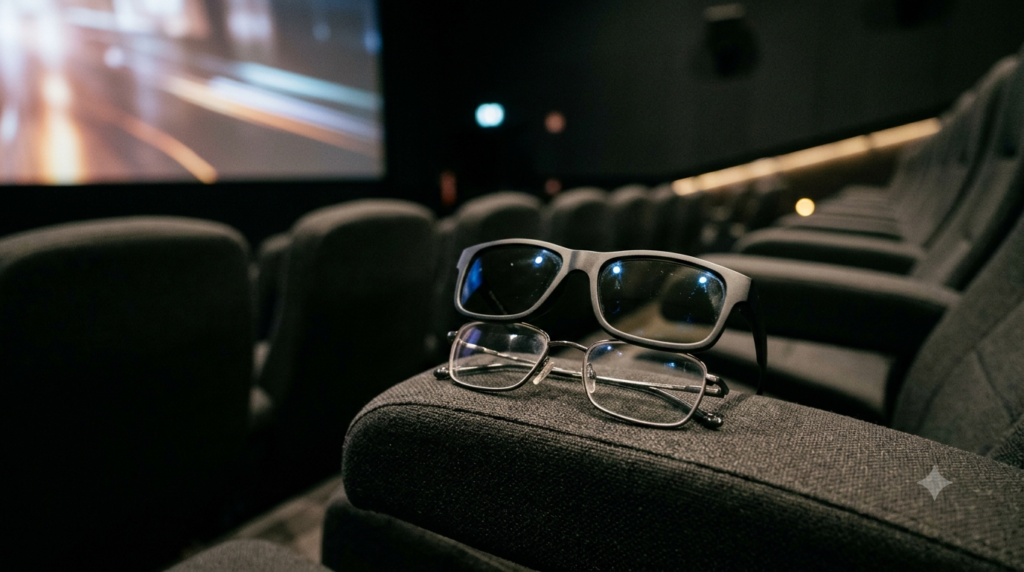
3D Glasses With Prescription Glasses: Cinema Fit Guide
Using 3D glasses with prescription glasses at the cinema is often possible, but the fit and projection format both matter. The extra frame may sit well over your everyday spectacles, or it may press against your nose and ears. Before buying a ticket, check what the exact screen supplies and whether another fit option exists.
In India, the answer also depends on the cinema’s glasses policy. BookMyShow’s official 3D glasses help page says cinemas may charge a refundable or non-refundable amount and may ask for the glasses back. That is a reason to check the venue, not a standard price or return rule.
Independence note: Movieshala is an independent cinema guide, not a theatre operator or booking partner. We do not supply glasses, sell tickets or handle refunds.
3D Cinema Glasses: The Quick Answers
- Prescription spectacles: Many cinema 3D frames can sit over regular glasses, but the fit is not universal.
- Alternative fit: Some operators offer clip-on 3D lenses. Ask the actual branch rather than assuming they stock them.
- Screen format: RealD, Dolby 3D and different IMAX 3D systems do not guarantee interchangeable eyewear.
- Glasses supplied: Ask when and where the theatre hands them out, including whether an extra payment applies.
- After the show: Confirm whether you must return the pair, may keep it, or can reuse it later.
- Problem at entry: Tell staff before the film begins so they can check suitable venue-approved options.
In short, 3D glasses with prescription glasses involve three separate checks: a comfortable fit, the correct screen system and the venue’s conditions.
Can You Wear 3D Glasses With Prescription Glasses?
Yes, many people wear cinema 3D glasses over their regular prescription spectacles. A published American Academy of Ophthalmology answer explains that most 3D glasses are designed to fit over ordinary prescription spectacles. However, that general design does not guarantee comfort with every frame, face shape or cinema-supplied pair. The branch must confirm what it can offer.
Keep your normal distance prescription on if you need it to see the screen sharply. Ordinary 3D cinema lenses mainly separate the left-eye and right-eye images; they do not replace your vision correction. Removing your spectacles may leave the picture blurred even when the depth effect works.
Try the combination gently before entering the auditorium. If it slides, scratches your frames or blocks the lens edges, ask for another option instead of forcing the fit. That is especially useful for wide spectacles and thick temples.
How to Check the Fit Without Damaging Your Glasses
The best test is a short, careful fit check with the actual cinema glasses. A generic photo online cannot show whether two frames will sit securely on your face. Fit matters more during a long film because small pressure points can become distracting.
- Wear your normal spectacles first. Adjust them as you would for daily use before adding the outer pair.
- Place the cinema pair lightly on top. Do not press the bridge down to make it stay in position.
- Check the temples and ears. The outer arms should not squeeze your own spectacle arms painfully.
- Look straight ahead and turn slowly. Watch for slipping, blocked corners or lenses touching each other.
- Ask for a different size or option. Only accept an alternative that the venue says works with its screen.
When testing 3D glasses with prescription glasses, also check whether the outer lenses cover your full view of the screen. A pair that technically fits can still feel awkward if its frame cuts across the picture. If staff cannot offer a workable fit, consider changing to a 2D screening before your booking becomes difficult to change.
Which 3D Glasses Can Work With Your Cinema Screen?
Not every 3D presentation uses the same optical system. RealD 3D uses circularly polarised eyewear, while Dolby describes a distinct colour-separation approach for its 3D systems. Dolby also says some laser-system glasses must match the projector. Therefore, the words “3D glasses” do not establish compatibility.
Cinemark’s RealD information identifies circularly polarised glasses and a specific clip-on service at its RealD locations. Meanwhile, Dolby’s cinema equipment page explains why its own projection and glasses form a matched system. Neither source authorises using one operator’s eyewear at another screen.
| Screen or option | What matters | What to ask |
|---|---|---|
| RealD 3D | Compatible polarised lenses | Are over-glasses or clip-ons available? |
| IMAX 3D | The specific auditorium’s 3D system | Which glasses does this IMAX screen require? |
| Dolby 3D | Eyewear matched to its projection system | Do you supply a fit for prescription wearers? |
| Other 3D screens | The operator’s installed technology | Will you confirm the approved pair? |
The safe rule for 3D glasses with prescription glasses is to match glasses to the screen, not merely to the movie title. Even two theatres showing the same Telugu or Hollywood film may use different 3D equipment.
Best Ways to Use 3D Glasses With Prescription Glasses
There is no single best arrangement for all spectacle wearers. The practical choice depends on frame width, comfort, vision needs and the equipment the cinema approves. Start with the supplied option because staff can confirm whether it matches the projector.
| Viewing option | Main benefit | Check before booking |
|---|---|---|
| 3D pair over spectacles | Keeps usual prescription | Frame width and nose comfort |
| Venue-approved clip-ons | Avoids a second full frame | Stock and fit with your spectacles |
| Contacts plus 3D pair | Less frame stacking | Your own comfort and eye-care advice |
| Prescription 3D eyewear | May combine two functions | Exact screen compatibility and venue permission |
| 2D screening | No 3D eyewear required | Suitable language and showtime |
Cinemark says it provides clip-on 3D lenses at no extra cost at its locations showing RealD 3D. That is a Cinemark-specific policy, not proof that PVR INOX, Cinépolis or a local Indian cinema offers the same service. Ask your chosen branch about stock before relying on clip-ons.
Can You Bring Your Own 3D Glasses?
You may be able to bring compatible personal eyewear, but do not assume the cinema will accept it. The operator needs to confirm both the lens technology and its rules for outside glasses. A pair marked “3D” is not enough information to establish a match.
Using 3D glasses with prescription glasses successfully at one venue does not prove the same pair suits another screen.
For example, glasses kept from one RealD show should not automatically become your IMAX or Dolby pair. Some systems use different filters or glasses specifications. An unsuitable pair can cause a dim, doubled or incorrect image rather than a reliable 3D effect.
If you own a prescription 3D pair or custom clip-ons, describe the model and intended format to the venue. Ask staff whether you may use it in the exact auditorium. Carry the supplied glasses as a fallback if the cinema requires them.
3D Glasses With Prescription Glasses: Supply and Charges
Indian cinemagoers should separate the ticket price from the eyewear arrangement. BookMyShow says a 3D pair will be provided for a 3D film, but its support page also warns of possible charges. These may be refundable or non-refundable, and the cinema may require you to submit the glasses afterward.
That guidance does not confirm the price, deposit or stock at a particular branch. It also does not settle whether a child-size pair or clip-on costs more. Ask the venue to state its current conditions before you pay for tickets.
Charges for 3D glasses with prescription glasses still follow the venue’s general eyewear conditions. Be precise when calling or using official cinema support. Ask whether the charge covers the glasses themselves, whether you get a refund on return, and where you must hand them back. Avoid relying on old social posts that quote a flat charge across India.
Do You Return, Reuse or Keep the Cinema 3D Glasses?
The answer depends on the operator and sometimes on the format. A pair may belong to the cinema, form part of a refundable-deposit arrangement or be sold for the customer to keep. Follow the instructions at your chosen venue rather than guessing from the packaging.
The differences are clear in Cineworld’s official support pages. Its IMAX 3D guidance says supplied glasses must be handed back after the film. Its RealD 3D guidance, however, explains that customers can purchase those glasses. These are examples of Cineworld’s UK policies, not rules for Indian multiplexes.
Return rules for 3D glasses with prescription glasses depend on the same operator policy as any other pair. Do not drop a returnable pair in a general rubbish bin or take it home as a souvenir. Instead, find the staff collection point and ask how the return works. If the cinema sells you a reusable pair, store it carefully and still confirm format compatibility next time.
What to Ask the Cinema Before Booking a 3D Show
A short set of questions can prevent an uncomfortable visit. Contact the exact cinema branch through its official listing or support route, since the brand name alone may not establish the screen’s setup. Keep the movie, language, date, showtime and auditorium format handy.
- Confirm the actual format. Ask whether the session uses RealD 3D, IMAX 3D, Dolby 3D or another system.
- Explain your glasses. Mention whether your prescription frames are wide, thick or unusually shaped.
- Ask what the venue supplies. Check for over-glasses models, sizes or compatible clip-ons.
- Check any charge. Ask whether it is included, extra, refundable or non-refundable.
- Confirm the return policy. Find out whether the glasses stay with you or go back to staff.
- Ask about a fit failure. Check whether staff can change the pair or offer another approved solution before the show.
Ask about 3D glasses with prescription glasses by name rather than simply asking whether the cinema screens 3D films. If your plans depend on the film’s finish time, also check the schedule and interval. Movieshala’s cinema interval guide explains why runtime and actual exit time differ.
What If the Cinema Glasses Do Not Fit?
Trying 3D glasses with prescription glasses at the entrance is safer than discovering the problem after the film starts. A comfortable fit is not guaranteed, even when an operator normally supplies 3D eyewear. If the outer frame slips or hurts, speak to cinema staff promptly. Do not keep bending a plastic frame or forcing pressure against your own lenses.
- First, request another approved size. The venue may have a different frame, although availability is not guaranteed.
- Next, ask about compatible clip-ons. Staff should verify that the option suits the actual screen.
- Then, check the ticket choices. If no usable pair exists, ask whether a 2D show or other approved resolution is possible.
- Finally, use official support. Document what staff told you and review the applicable booking terms if you seek help.
A ticket change or refund is not automatic because eyewear feels uncomfortable. The venue’s rules and the booking channel determine the outcome. Movieshala’s Telugu cinema ticket cancellation guide explains how to check the official cancellation route.
Children, Wide Frames and Special Fit Needs
Children and adults with larger prescription frames may need different outer sizes. Some cinemas stock options for different faces, but local availability still needs confirmation. The best time to ask is before a busy screening, not while the lights are dimming.
Children should try the glasses with their normal spectacles and report any slipping or discomfort. In its own RealD movie guide, Cinemark says it offers adult and child glasses sizes. That establishes only Cinemark’s offering, not stock at any Indian cinema. A child who cannot see clearly through the setup may prefer a 2D screening.
For anyone using a specialist frame, ask the venue whether its available eyewear sits safely over it. If your glasses have a delicate coating or unusual shape, avoid pushing another frame directly against the lenses.
What If the 3D Picture Looks Doubled or Causes Discomfort?
A doubled image does not always mean the prescription itself is wrong. First check whether you have the correct cinema-approved 3D glasses and whether both lenses are clear. Ask staff for help if the view still looks wrong after you adjust the fit.
Some viewers experience headaches or motion sickness while watching 3D. The American Academy of Ophthalmology says taking a break usually relieves discomfort. Its guidance also notes that focusing or depth-perception difficulties can contribute to symptoms.
Eye comfort note: Stop watching if symptoms become uncomfortable. Seek professional eye-care advice for repeated difficulty, persistent symptoms or concerns about a child’s vision. A 2D screening is a reasonable alternative when 3D viewing does not feel right.
Three Mistakes That Spoil a 3D Cinema Visit
Assuming every pair works everywhere. A pair from a previous screening may look identical to today’s glasses, yet its optical system can differ. Confirm the format before packing personal eyewear.
Confusing “provided” with “free to keep”. A theatre may hand out glasses but still require a deposit, payment or return. BookMyShow specifically cautions readers about those possibilities, so ask at the counter.
Waiting until the film starts to test the fit. Two pairs can sit comfortably for a moment but slip when you turn your head. Test them before entering, while staff can still help. If you also carry a protective case or other items, Movieshala’s cinema baggage policy guide explains why entry conditions need a venue check.
Before You Enter the Auditorium
For most viewers, 3D glasses with prescription glasses are worth trying when the cinema supplies a suitable pair. The right frame should feel secure without pressing on your spectacles. More importantly, it must match the screen’s projection technology.
Ask the specific cinema about fit, charges and return conditions before booking. If the combination cannot work comfortably, consider an approved alternative or a 2D show. A small fit check is more useful than any promise that all cinema glasses are interchangeable.
Frequently Asked Questions
Can I watch a 3D movie while wearing my regular spectacles?
Yes, many 3D cinema glasses can fit over normal spectacles. Wear the prescription you need for clear distance vision, then check the outer pair’s comfort. However, large or unusual frames may not fit well, so ask the cinema about its options.
Do 3D glasses with prescription glasses work in IMAX?
They may work if the cinema supplies a compatible pair that fits over your prescription frames. IMAX 3D eyewear should match the particular auditorium, not just the IMAX name. Ask the theatre which glasses it uses and whether a suitable over-glasses option is available.
Does the cinema provide 3D glasses for free?
Not necessarily. BookMyShow says glasses are provided for 3D films, but a cinema may require payment or a refundable amount. Confirm the exact branch’s current charge and whether that payment covers keeping the glasses.
Can I use RealD glasses for a Dolby 3D screening?
Do not assume so. Dolby 3D uses a different optical approach from RealD, and Dolby describes glasses matched to certain projection equipment. The cinema should supply or approve the correct pair for the exact screening.
Can I keep the cinema 3D glasses after the movie?
Only if the operator’s policy allows it. Some glasses can be purchased and kept, while other pairs must be returned after the film. Follow the staff instructions at that venue, including any deposit or collection procedure.
Are clip-on 3D lenses available in Indian theatres?
Availability is not confirmed across Indian cinemas. Cinemark advertises clip-ons at its RealD locations, but that policy cannot establish stock at PVR INOX, Cinépolis or independent Indian theatres. Ask your exact branch whether it has compatible clip-ons for your screening.
What if 3D glasses press against my nose or ears?
Ask staff for a different approved frame or fit option before the film starts. Do not force the outer pair over delicate spectacles. If no comfortable option exists, check whether the venue can help with a different screening under its terms.
Should I remove my prescription glasses to watch 3D?
Not if you need them to see the cinema screen clearly. Standard 3D glasses create the viewing effect but do not normally correct your eyesight. Keep your regular spectacles on, unless an eye-care professional has given you different advice for your vision.
Can I get a ticket refund if the 3D glasses do not fit?
A refund is not guaranteed. Ask staff about another compatible pair first, then check any change or cancellation choices under the cinema’s terms. If you booked through an app, use its official support route alongside the venue’s help desk.