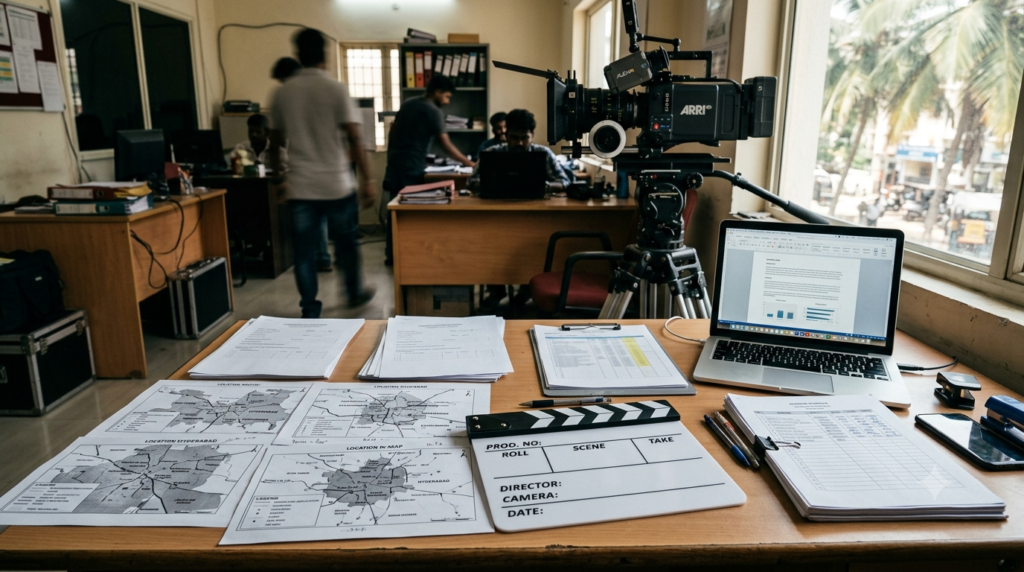
Telugu Film Shooting Permissions: Locations and Official Applications
Telugu film shooting permissions depend on where the camera stands, who controls the property and what the crew plans to do. So a permit for a public road does not automatically open a nearby fort, private building or railway platform. The safest production schedule therefore starts with an approval map, not a single application.
For Telugu productions in Telangana or Andhra Pradesh, the right starting route also depends on the state. Special locations can still demand separate clearances. This guide explains the difference and shows what to check before booking crew or equipment.
Independence note: Movieshala is an independent film-information website, not a government department or film-permission agency. We also do not accept applications, fees or bookings. Apply through the responsible official authority instead.
Telugu Film Shooting Permissions at a Glance
- Domestic projects: India Cine Hub accepts state-level applications, but direct applications to states and central departments are also possible.
- Telangana: The state Cinematography Department describes an online single-window system and separate location zones.
- Andhra Pradesh: The state film corporation publishes an online shooting-permission entry point.
- Private locations: Obtain clear written authority from the person or entity entitled to allow filming.
- ASI monuments: Use the Archaeological Survey of India permission process, now integrated with India Cine Hub.
- Special activity: Drones, trains, protected forests, street closures and animals can add their own approval requirements.
What Do Telugu Film Shooting Permissions Cover?
A shooting permit authorises specified filming activity, but only under conditions set by the issuing authority. So it is not a transferable right to film anywhere. India Cine Hub states that permits depend on dates and locations, and that the Ministry of Information and Broadcasting does not issue blanket permits.
That distinction matters when a location manager begins scouting. For example, one sequence might involve a public footpath, a restaurant and a protected heritage building. Although the scenes appear together on screen, the paperwork may involve three different decision-makers.
| Location or activity | Main authority to check | Possible additional clearance |
|---|---|---|
| State-controlled public site | Relevant state portal or department | Local police or site custodian |
| Private studio, house or land | Owner or authorised manager | Local rules, safety or public-access approval |
| ASI-protected monument | Archaeological Survey of India | Other local or activity-specific approvals |
| Public road or busy street | Responsible local authority | Police, traffic and road-use coordination |
| Forest, railway or drone shoot | Relevant specialist authority | State or property access permission |
Key rule: A single-window portal may coordinate decisions, but coordination is not the same as unrestricted access. Always read the location, date, time and activity conditions before you rely on the approval.
How Domestic Telugu Film Shooting Permissions Work
Domestic producers seeking Telugu film shooting permissions may use India Cine Hub’s domestic-project process for state and local requests. However, the government portal explicitly says this route is optional. Producers can also approach relevant state and central government departments directly.
India Cine Hub operates under the National Film Development Corporation of India (NFDC). Its digital route then sends a domestic application to the relevant state nodal officer. The nodal officer handles the state process and uploads the permission letter when approval arrives.
- Fix the exact locations. Name the site, district and custodian before you plan each scene.
- Define the activity. Also record dates, hours, crew size, vehicles, lights, generators, sets, drones and crowd impact.
- Choose the channel. Use the state system or register on the official India Cine Hub website where applicable.
- Upload what the portal requests. Supply production and applicant details, plus the documents the application requires.
- Track each decision. Then watch for questions, location restrictions, payment instructions and the final permission letter.
- Clear special sites separately. Confirm monument, private-owner or specialist approvals before sending the unit.
Keep copies so the location manager can show them at the gate. If the scene or date changes after submission, contact the appropriate nodal officer. India Cine Hub says submitted state applications cannot simply be edited through the original form.
Telugu Film Shooting Permissions in Telangana
Telangana also has a state online shooting-permission system. Its Cinematography Department says departments use nodal officers and process requests through an online single-window arrangement. The state’s published guidance then divides shooting locations into green, yellow and red categories.
These labels concern filming locations, whereas drone airspace uses a different map. Green locations have no stated day or time restriction under that classification. Yellow locations, however, carry limits on days or hours. Red locations do not allow shooting under the scheme, so crews need a different site.
The India Cine Hub Telangana workflow also describes review, location checks and a downloadable certificate. It identifies the Film in Telangana portal as the state route. If that portal is unavailable, check the state department and India Cine Hub for official guidance rather than using a third-party payment site. The state’s stated seven-day departmental window is not a promise that every complex shoot will become lawful within seven days.
What if a Hyderabad street scene needs traffic control?
Plan for local police and traffic review when the unit affects vehicle flow, pavements or public safety. Give the responsible authorities an accurate traffic and parking plan, since ordinary location access does not itself authorise a road closure. The shoot therefore remains subject to the exact permission conditions.
For example, a night chase demands a different review from a rented-room scene. Telugu film shooting permissions must reflect that change in public impact. The chase may also require road management, crowd barriers, extra staff and a revised slot. Budget for that difference before finalising the call sheet.
Telugu Film Shooting Permissions in Andhra Pradesh
The Andhra Pradesh State Film, Television and Theatre Development Corporation publishes online shooting-permission information and a production login and registration portal. Its website also links to location resources and departments such as archaeology, endowments and tourism.
Producers should check the official site before relying on rules for their district and location. The corporation’s page still displays older government orders and health-guideline links. Their presence alone does not prove every provision still applies, so confirm the current requirements.
First, think in terms of the site custodian. A beach, tourism property, temple area and municipal street may each have different custodians, so check separately. A state film-corporation application should therefore describe the precise place and proposed activity, rather than just the nearest city.
Does approval in Andhra Pradesh cover nearby locations?
No producer should assume permission for one site also covers another. India Cine Hub’s general rules treat shooting permits as location- and date-specific. When the camera moves into a different managed property, or an activity changes materially, ask the issuing office which new consent or amendment is needed.
That matters when planning multi-location schedules around Visakhapatnam, Vijayawada and rural districts. A scout’s assurance helps planning, but Telugu film shooting permissions still require the relevant authority’s written decision.
Telugu Film Shooting Permissions at ASI Monuments
The Archaeological Survey of India (ASI) also manages filming permissions for monuments under its protection. State permission or a manager’s agreement cannot replace ASI authority, so check before confirming the site. Production teams must first confirm whether a particular fort, cave, temple or archaeological area falls under ASI protection.
ASI issued a circular dated 6 August 2025 explaining how its circles process filming applications through India Cine Hub. The circular therefore directs applicants toward the ICH system. The linked manual shows a distinct New Application → ASI Permission workflow and review by the relevant ASI circle.
See the ASI circular and application workflow and India Cine Hub’s filming-at-monuments guidance. Apply early because monument-specific review can affect the production calendar. Permission can also face restrictions or require additional documents.
Is filming outside a monument the same as filming inside?
No. The rules can differ for exterior recording, commercial crews and filming inside protected premises, so check the details. Do not treat an ordinary tourist ticket or casual mobile recording allowance as permission for a professional production. Also ask ASI about the precise activity and equipment.
Tripods, tracks and crowd scenes also change risk. Telugu film shooting permissions for such heritage work must match the actual setup. Protecting the monument and its visitors comes first, even when the proposed shot looks simple. A denied interior scene needs a new lawful location, not an improvised workaround.
Private Property, Film Studios and Public Access
Private-location consent is therefore a separate layer. A studio booking or written property agreement should define the dates, accessible rooms, set construction, sound, power, restoration, liability and cancellation terms. The signer must also have authority to grant that use. Telugu film shooting permissions do not settle private ownership disputes.
However, private ownership does not cancel local safety law. A shoot spilling onto a public footpath can also trigger additional approvals. The same applies when generators, large parking areas or temporary structures affect neighbours or public access.
For context, Movieshala’s film crew roles guide explains how the production and location teams divide this work. The producer should therefore name one person to collect each written consent across departments.
Special Permissions That Producers Often Miss
Some scenes bring in a separate regulator, even when the landowner welcomes the unit. Telugu film shooting permissions must therefore be checked against these specialist requirements. These requirements depend on the actual activity, so a generic state permit cannot answer them all.
- Drones: Check Digital Sky airspace information and the applicable Directorate General of Civil Aviation (DGCA) rules. The Ministry of Civil Aviation explains Digital Sky and the move of certain regulatory forms to eGCA.
- Railways: Ask the responsible railway authority before filming on railway property, trains or platforms. See India Cine Hub’s railway guidance.
- Protected forests: Contact the appropriate wildlife or forest authorities. A scenic forest road is not automatically an open set, even for a small unit. Consult official forest-filming guidance.
- Animals and action scenes: Check the relevant animal-welfare and local safety requirements before scheduling performance, effects or stunts.
- Temples and religious sites: Confirm the custodian’s rules on access, rituals, restricted areas and equipment. ASI rules may also apply to protected monuments.
A useful distinction is that Telangana’s green, yellow and red shooting-location categories are not DGCA’s airspace zones. Both may matter for one aerial shot, although they answer different legal questions.
Documents and Costs: Build a Location-by-Location File
There is no verified single fee for Telugu film shooting permissions across all locations. Charges can also depend on the authority, site, schedule, staffing, deposit and type of filming. So confirm payable amounts only in the official application or the authority’s written demand.
India Cine Hub also displays a national application-fee notice on some pages. Do not assume that figure automatically applies to every domestic state-location request. Yet the domestic guide explains that Indian filmmakers can apply directly to states. Ask which fee belongs to your application before making any payment.
Then prepare an approval sheet with each custodian, request number, date, fee status and final permission. Keep the following documents ready where the official application calls for them:
- Production-house identity and the authorised applicant’s details.
- Film or project title, brief synopsis and relevant scene description.
- Exact dates, shooting hours, addresses and location map.
- Approximate artists, crew, vehicles and equipment details.
- Owner or custodian consent where applicable.
- Risk, traffic, drone, animal or special-site documentation when requested.
Never upload identity documents or transfer money to an unofficial intermediary when an official route is available. Keep approval numbers and receipts within the production’s secure records, rather than sharing them publicly.
When Telugu Film Shooting Permissions Are Delayed or Refused
Telugu film shooting permissions are never guaranteed merely because a crew submitted a form or paid a charge. The authority may find the site unavailable or restrict the hours, so plan alternatives. The safest fallback is to protect the schedule before costs become irreversible.
- Confirm the status. Check the official portal and contact the designated nodal office using the details available there.
- Correct the application. Supply missing plans or documents through the channel the authority specifies.
- Reduce the impact. Ask whether a smaller unit, shorter schedule or different activity could qualify; never assume approval.
- Use a cleared alternative. Shift the scene to a studio or another site only after its own permissions are complete.
- Reschedule honestly. If the critical approval will not arrive, move the shoot rather than using another permit as a substitute.
For example, suppose a producer has state approval for an exterior road scene but ASI has not cleared the adjacent protected structure. The lawful plan is to film only within the authorised area or substitute another location. The state letter still does not resolve the missing ASI decision.
What Small Productions Commonly Get Wrong
A small crew may face simpler logistics, but size alone does not create a blanket exemption. Check what the owner and relevant authorities require for that specific location. Professional equipment, blocked access or public disruption can also change the answer quickly.
Another mistake is treating a film certificate as permission to shoot. Script registration, trade-body membership and release certification serve different purposes. Movieshala’s script registration guide explains the intellectual-property side; it does not replace location access.
Lastly, producers often lock cast dates before securing restricted sites. Reverse that order for the most sensitive location. The Telugu film industry explainer gives the wider production context, while the approval map here handles the location risk itself.
Before You Lock the Shooting Schedule
First list every location and action that could affect the public, property or protected areas. Then identify who can legally approve each part. Use Telangana or Andhra Pradesh’s official route for relevant state locations, and use India Cine Hub where its domestic facilitation helps.
Never assume one permit covers a studio, public road, ASI monument and drone flight, even during one scene. Obtain the actual letters, check their conditions and build alternatives before committing the unit. This article is general information; obtain professional legal or production advice for disputed access or unusual high-risk filming.
Frequently Asked Questions
Where do I apply for Telugu film shooting permissions?
Start with the official state filming portal or India Cine Hub’s domestic-project guide. India Cine Hub says its route is optional for domestic filmmakers. Check each location’s controlling authority, since a special site can still need an additional clearance.
Is India Cine Hub mandatory for a Telugu film made in India?
No. India Cine Hub explicitly allows domestic filmmakers to approach the states and central departments directly. Its portal can help route applications to state nodal officers, but the relevant local and specialist requirements remain in force.
Can one permission cover shoots in both Telugu states?
Do not rely on one general letter for every site across Telangana and Andhra Pradesh. Each state and each location may have distinct conditions. Build separate entries for both schedules and obtain the relevant written approvals.
Does a location owner’s consent replace a government permit?
No. Owner consent addresses private access, while public safety, traffic, heritage or other rules may need separate attention. Check with the responsible authorities before filming affects land or activities beyond the owner’s control.
Do I need ASI permission for filming at a protected fort?
Commercial or professional filming at an ASI-protected monument needs the relevant ASI authorisation under its rules. ASI has integrated its filming workflow with India Cine Hub. Confirm the site’s protected status and apply for the specific proposed activity.
How much does a Telugu film shooting permit cost?
There is no reliable universal price. Fees and deposits depend on the authority, location, shooting plan and any specialist staffing. Check the official portal or a written payment demand for the current amount, and avoid unsolicited payment links.
How long does it take to get filming permission?
Timelines vary by authority and location. Telangana publishes a seven-day departmental processing framework, but that should not be read as a guarantee for every restricted or multi-agency shoot. Apply early and wait for all necessary clearances.
Can I use a drone after receiving a state shooting certificate?
Not automatically. Check DGCA rules, Digital Sky airspace information and any approvals that the proposed flight requires. You also need legitimate access to the filming site, so a state certificate alone does not answer the aviation question.
What should I do if permission is refused before shooting?
Read the reason and seek clarification from the issuing authority through its official channel. Consider a different date, smaller setup or alternative cleared location if allowed. Do not start shooting based on an unrelated approval.