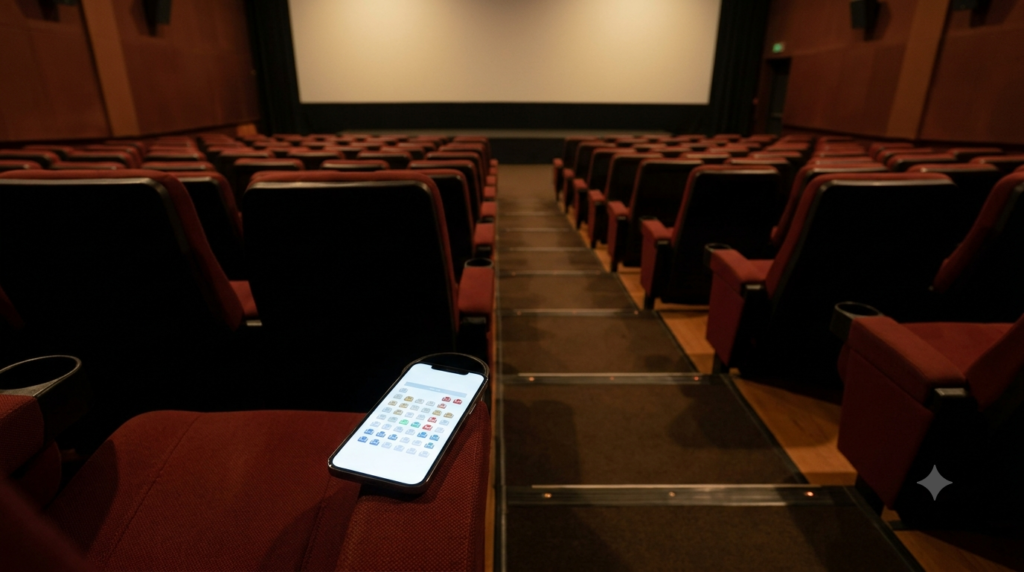
Cinema Seat Selection: Read Seat Maps and Sit Comfortably
Cinema seat selection gets easier when you read the screen marker before choosing a row letter. A seat that looks central on a booking grid may sit near an aisle, behind a gap or closer to the screen than you expect. The aim is comfort for your visit, not one supposedly perfect seat for everyone.
This guide explains the symbols, compares seating positions and shows what to check before payment. It also covers wheelchair spaces, companion seating and practical fallbacks when the map leaves questions unanswered.
Independence note: Movieshala is an independent cinema guide, not a theatre operator or ticket seller. We do not take bookings or guarantee seat availability; use the cinema’s authorised booking channel.
Cinema Seat Selection at a Glance
- Find the screen first: the screen marker tells you which side of the plan faces the picture.
- Read rows and numbers together: a row letter alone cannot tell you how far back you will sit.
- Look for gaps: blank strips may represent aisles, steps, walkways or breaks between seating blocks.
- Use the legend: colours and icons can mean different things on different booking platforms.
- Choose for your needs: viewing angle, easy exits, companions and mobility matter more than a universal ranking.
- Check the final ticket: tapping a seat does not by itself guarantee a successful booking.
Cinema Seat Selection: How to Read a Seat Map
A cinema seat map is a simplified plan of an auditorium. It shows seating blocks, row labels, seat numbers and often a screen marker. Some maps also show prices, aisles or accessible spaces.
You can therefore compare positions before committing. However, the plan may not reproduce exact distances, slopes or sightlines.
This distinction matters because the picture is only a guide. The actual room may have different row spacing, steps or screen distance than the small map suggests. So use the map to find a likely position, not to measure the room.
Find the Screen Marker Before You Read the Rows
Look for a bar or label reading SCREEN, SCREEN THIS WAY or a similar marker. Many apps place it above the seat grid, but you should check rather than assume. That marker sets the direction of the picture and helps you tell near rows from far rows.
If the plan has a balcony section, examine its label separately. A balcony row and a ground-floor row may use similar letters. Yet they can sit at very different heights and distances from the screen.
Rows, Seat Numbers and Aisles
Letters often identify rows, while numbers identify individual positions within each row. Still, read the whole layout before choosing. For example, G8 means seat 8 in row G, provided that is how the venue labels tickets. Some auditoriums skip letters, restart numbering or use named sections.
An empty vertical strip between groups of seats often marks a central aisle. A gap running across the hall may mark a cross-aisle or access path. However, a blank patch is not proof of a walkway. The map might omit blocked areas or structural details, so check the legend or ask the cinema.
Understand the Seat Colours and Symbols
Booking systems may distinguish available, selected, sold, blocked and special-access seats. Yet there is no colour code you should treat as universal. Read the legend shown on that particular screen before tapping anything.
| Map feature | What it may mean | What to check |
|---|---|---|
| SCREEN bar | Direction of the picture | Which rows face it |
| Letter and number | Row and individual seat | Final ticket matches |
| Blank strip | Aisle or separation | Whether it is a walking route |
| Coloured seat | Status or price category | Legend for that app |
| Wheelchair icon | Accessible position or space | Exact setup and companion place |
One more detail: a seat may appear selectable while another customer is also checking out. Availability can change. Good cinema seat selection therefore includes checking the final ticket, not just the highlighted icon.
Cinema Seat Selection: A Six-Step Method
Use this method when a booking page displays an unfamiliar auditorium. It keeps the important checks in the right order, especially when you are comparing several rows or trying to keep a group together.
- Confirm the exact showing. Check the cinema branch, screen, language, format, date and time before studying its layout.
- Locate the screen. Work out which edge is nearest to the picture. Check separately for balcony or premium blocks.
- Trace the aisles. Look for gaps beside and between seat groups. Consider how far you may need to walk.
- Choose a comfort zone. Start around the middle if you want balance, or closer to an exit if access matters more.
- Read every icon. Confirm seat status, type, category and any wheelchair or companion marking.
- Review the order. Match row and seat numbers, the total charge and the cinema details before paying through the authorised seller.
BookMyShow’s FAQ explains that seat choice depends on whether the venue offers seat selection. Therefore, do not assume every cinema or show will provide the same interactive map.
Cinema Seat Selection: Which Position Feels Comfortable?
There is no universally best cinema seat. A centred view may suit someone who dislikes looking sideways. Another viewer might prefer an aisle for easy exits, a rear row for distance or a specific accessible position. Screen size, room shape and personal comfort all change the answer.
| Position | Possible advantage | Possible trade-off |
|---|---|---|
| Middle rows, near centre | Balanced starting point | More people to pass on exit |
| Front rows | Large, immersive picture | More upward head movement |
| Back rows | More distance from screen | Picture appears smaller |
| Aisle seat | Easier to enter or leave | Nearby foot traffic |
| Outer edge | Fewer neighbours on one side | More off-centre viewing |
| Accessible position | May provide step-free placement | Location and type need checking |
Middle, Front or Back?
The middle section is a useful place to begin, not a compulsory target. For cinema seat selection, comfort is more useful than an exact row formula. Cinema operator Ster-Kinekor likewise suggests middle seats for a balanced view and aisle seats for easier access. Those are preferences, not promises about every auditorium.
Front seats can make a huge image feel exciting. They may also require more head movement, especially when the screen sits high. Farther back, viewers often have a gentler viewing angle, although the picture occupies less of their field of view.
When an Aisle Beats the Centre
An aisle can be valuable if you expect to leave during the screening or dislike squeezing past seated people. Parents, older visitors and anyone who needs more frequent breaks may value that convenience. So cinema seat selection should account for exit needs as well as picture alignment. However, people walking past can distract you.
Also check whether your chosen aisle is beside the seat or across another row. On a small phone screen, a narrow empty strip might look wider than it is. If easy access is essential, ask the cinema about steps and the route to the exit.
Why the Seating Diagram Cannot Promise Your View
A booking plan identifies seats more reliably than it predicts the view from eye level, because it simplifies the room. It usually cannot show every railing, step, wall edge, reclining angle or difference in floor height. The same seat number can feel different in a flat single-screen hall and a steep multiplex auditorium.
A symmetrical seating grid does not necessarily mean symmetrical sightlines. Actual row spacing, floor slope and screen distance may not be clear from the diagram. Nor can a premium label guarantee that a chair fits every body comfortably.
If a view matters greatly, ask the exact branch about the auditorium. You can also choose a different showing or venue if staff cannot clarify an important obstruction. Avoid relying on an unrelated auditorium photo as evidence of your chosen screen.
Cinema Seat Selection for Groups and Families
For group cinema seat selection, count physical seat icons rather than simply reading consecutive numbers. Seats G8 and G9 might sit together, yet numbering can run across an aisle in some venues. A visible gap between them should trigger a second check.
Keep children and anyone who needs assistance close to the adults travelling with them. Discuss the seating preference before checkout, since one person may favour the centre while another needs an aisle. So group comfort often means accepting a small viewing compromise.
Adjacent Seats, Premium Rows and Recliners
Seat categories may indicate price, location or a different chair type. So the category label alone cannot settle comfort. A recliner icon suggests a feature, but it does not confirm the amount of space or how the mechanism works. Some premium rows may also use a different numbering pattern.
Check the exact seat count before selecting a pair or sofa-style arrangement. If you see an unusual gap or shared seat shape, contact the cinema before paying. Compare the final amount rather than assuming that a higher price means a better view.
Cinema Seat Selection: Accessibility Questions to Ask
Accessible cinema seat selection begins with a closer look at the wheelchair symbol, not an automatic tap. It may mark a wheelchair space with no fixed chair, an adapted seat or another venue-specific arrangement. Companion seating can also have its own symbol and rules.
For an example of how these distinctions work, Event Cinemas’ official accessibility guide separates wheelchair spaces from companion seats. That operator’s labels do not establish the policy for an Indian cinema. Ask your chosen theatre to confirm what its icon means.
What to Ask the Theatre Before Paying
- Can someone reach the auditorium, chosen position and toilet without steps?
- Is the wheelchair symbol an open space or a seat that can be moved?
- Can a companion sit directly beside that position?
- Where does the position face the screen, and does a railing affect the view?
- Is the lift or accessible entrance working for the particular show?
- How should you request help if online seat selection does not explain the setup?
Use the venue’s official accessibility or customer-support route. If it cannot confirm an essential requirement, consider another accessible screen before paying. A seat-map icon alone cannot guarantee a safe or comfortable journey from entrance to seat.
Captions, Audio Description and Seating
Seat choice is only part of an accessible screening. Also, different formats may need different support. Ask whether your exact show offers the required captions, subtitles or audio description. Captions might appear on the screen or through an approved device, so positioning and equipment can matter.
India’s Ministry of Information and Broadcasting published cinema accessibility standards covering hearing and visual access. That policy does not prove that a particular show has the device or support you need. Confirm the actual screening with the exhibitor.
Movieshala’s guide to subtitles, captions and audio description explains why these features are not interchangeable. Check the film version and screening, not just the language printed beside the ticket.
Cinema Seat Selection for 3D and Longer Screenings
Cinema seat selection can feel different for large-format screens, 3D shows and recliner auditoriums. Some viewers prefer more distance from a very large picture. Others enjoy a stronger sense of immersion. Neither preference creates a fixed row recommendation across cinemas.
If you wear 3D glasses over prescription glasses, think about your viewing comfort before choosing a very close row. Check with staff about any seating or motion-related guidance for special formats. A standard seat-map symbol may not explain the full experience.
For a long Telugu film, also think about breaks and aisle access. Movieshala’s cinema interval planning guide explains why an interval is not the same at every venue. Do not assume that you can always rely on a scheduled pause.
What If Your Chosen Seats Disappear?
Cinema seat selection is not a guarantee of availability. An icon can change status while you compare rows, and an attempted purchase may fail before the seller issues a ticket. In some halls, the venue may use free seating rather than allocate numbered places.
If the cinema specifies first-come, first-served or free seating, your ticket may admit you to a section rather than a particular chair. Read the booking conditions carefully, since a seating illustration alone may not confirm that a numbered seat will be assigned.
Use These Fallbacks in Order
- Recheck your order status. If payment started, look in booking history before trying again. Avoid creating a duplicate purchase.
- Choose another suitable place. Try the neighbouring row or another aisle position if the original seats are unavailable.
- Compare a different showing. Changing showtime or auditorium may give your group more options, subject to live availability.
- Ask the official seller or cinema. For accessibility issues, unclear seating or failed checkout, use their support channel.
A successful charge without a ticket needs a payment-status check, not a guess that your chosen seats remain held. If you booked the wrong seats, read the original order’s policy. Movieshala’s Telugu cinema cancellation guide explains why changes and refunds depend on the seller and cinema.
Cinema Seat Selection Example: Read a Map Without Guessing
For a cinema seat selection example, imagine an illustrative auditorium with the screen marker above rows A to L. A narrow vertical gap divides the central seats from a side block. Two friends want to sit together, while one also wants easy access to the exit.
They first check whether A is nearest the screen rather than assuming. Then they compare a central pair with a pair beside the marked aisle. They inspect the seat numbers and legend before choosing the aisle pair if easier movement matters more.
This example does not depict a real theatre. Meanwhile, another map might place the screen below the grid, show balcony rows separately or omit aisle labels. The method transfers; the specific row choice does not.
Small Mistakes That Lead to Uncomfortable Seats
- Choosing by letter alone: row G means little without the screen marker and total row layout.
- Assuming every blank gap is an aisle: check the map legend or ask staff.
- Equating price with comfort: a premium category may not suit your viewing angle or access needs.
- Ignoring seat numbers: two consecutive numbers may not prove an unbroken pair.
- Treating the centre as compulsory: a side aisle can make a longer film easier for some viewers.
- Assuming an accessibility icon settles everything: confirm space type, companion position and the full route.
- Skipping the order summary: a selected icon is not the same as a confirmed ticket.
Before You Confirm Your Cinema Seat Selection
Good cinema seat selection finishes with a look at the whole booking, not just the coloured chairs. This is especially useful for opening-day Telugu screenings, large groups and viewers who need a specific access arrangement.
- Is the cinema branch and auditorium correct?
- Have you found the screen marker and checked the row direction?
- Are the selected numbers truly together, with no unnoticed aisle?
- Does the seat type match the comfort and accessibility needs of your group?
- Are the language, format, date, time and final price correct?
- Have you checked the seller’s cancellation conditions?
- After payment, does your official confirmation show the correct seats or free-seating terms?
Cinema Seat Selection: The Bottom Line
Read the screen marker first, then follow rows, aisles, seat icons and the legend. Choose the position that fits your viewing preference and movement needs rather than chasing an imaginary perfect row. If accessibility or an obstruction matters, ask the specific cinema before purchase. Only the official booking confirmation can settle which seats you have secured.
Frequently Asked Questions
Which cinema seat is best for comfort?
No single position suits every viewer. Middle rows near the centre can be a balanced starting point, while aisle or rear seats may better suit other needs. Check the exact auditorium before deciding.
Does row A always mean the front row?
No. Many maps use early letters near the screen, but numbering systems vary. First find the SCREEN marker and inspect the full plan rather than trusting the letter alone.
What does a gap between cinema seats mean?
It may show an aisle, step, access route or break between blocks. However, some diagrams also leave blank areas for other reasons. Use the legend or ask the venue if the gap matters to your choice.
Do seat colours mean the same thing in every booking app?
No. Apps can use different colours for availability, selection, sold seats and ticket categories. Always read the on-screen key before using a colour to judge your options.
Can I choose wheelchair and companion seats online?
Some cinemas provide accessible positions through an online map, but the method varies. Ask the exact venue about wheelchair space type, companion location and the step-free route. An icon does not confirm every requirement.
Are recliner or premium seats always more comfortable?
Not for everyone. Extra features may help, yet seat shape, distance and access still matter. Confirm the actual chair type and category rather than relying only on the ticket price.
Are the seats I select guaranteed before payment?
No. A temporary selection does not prove a completed reservation. Check the order status and official ticket confirmation, particularly if the app reports an error or another customer takes the seat.
What if the cinema uses free seating?
If a cinema offers free seating, you may be buying admission to a category without choosing a numbered chair. Read the seller’s terms and ask the venue how seating works for that show.
Can I change my seats after booking?
Only if the cinema or booking seller permits a change or cancellation for your order. There is no universal seat-swap guarantee. Check the official order conditions and contact the original seller promptly.