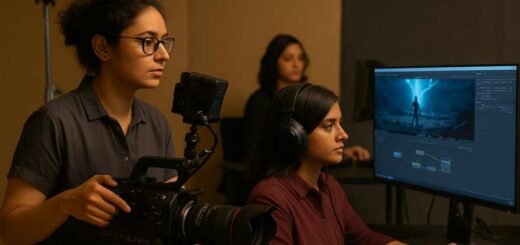
Gaming & Cinema Crossover – How South Indian Films Are Inspiring Video Games
gaming cinema crossover Explore how Telugu, Tamil, and Malayalam cinema is merging with gaming — from film-based games to game-inspired movies, cross-media storytelling, and the creative challenges ahead.
⚡ Quick Facts
- South Indian cinema is rapidly exploring gaming tie-ins — both movies inspired by games and games adapted from films.
- Tamil and Telugu films like 2.0, Baahubali, and KGF have released official mobile games on Android and iOS.
- Developers in Hyderabad and Chennai are now designing independent games inspired by cinematic storytelling.
- Industry reports suggest that game-based tie-ins can expand a film’s life cycle by up to 18 months. (statista.com)
🎮 1. The Rise of Film-to-Game Adaptations in South Indian Cinema
South Indian filmmakers are discovering that gaming is not just a promotional gimmick — it’s a new storytelling medium.
Notable Examples
- Baahubali: The Game (2017) — launched by Moonfrog Labs in collaboration with Arka Media, this became one of India’s most-downloaded strategy games. (thehindu.com)
- KGF: Chapter 2 – The Game (2022) — released by Google Play in partnership with Hombale Films; a fighting-action game featuring Rocky Bhai.
- Robot 2.0 VR Experience — a virtual-reality tie-in for the Tamil blockbuster 2.0, allowing fans to step into Chitti’s world.
These adaptations proved that cinematic IP could extend its reach into interactive formats, capturing younger demographics and overseas audiences.
🎬 2. Game-to-Film Adaptations: Reverse Crossovers Emerging
While film-to-game is well-established, the reverse — games inspiring South Indian films — is now emerging.
Case Studies
- Project K (2025) — Prabhas’s upcoming sci-fi film reportedly uses visual grammar borrowed from AAA gaming titles like Mass Effect and Cyberpunk 2077.
- Goodachari 2 (Telugu, in pre-production) integrates game-like stealth sequences and HUD-style overlays inspired by first-person shooters.
- Tamil indie directors are collaborating with local gaming studios to create short films based on original game IPs (like Raayan Interactive’s “Shadow City” project).
Trend insight:
South Indian cinema is adopting game aesthetics — dynamic camera movements, mission-driven story arcs, and player-like point-of-view storytelling.
🎮 3. Why the Fusion Works
| Cinema Element | Gaming Parallel | Effect |
|---|---|---|
| Narrative arcs | Level progression | Emotional investment |
| Hero’s journey | Player mission | Interactivity & ownership |
| Soundtrack cues | Audio feedback | Immersive experience |
| Visual world-building | Open-world design | Extended lore potential |
| Marketing trailers | Game trailers | Shared fan communities |
Both mediums share immersive storytelling DNA — one linear, the other interactive. South Indian cinema’s high-concept mythic narratives translate perfectly into game worlds rich with power dynamics and fantasy.
💡 4. Potential Benefits
-
Extended IP Lifecycle: Games keep a movie alive long after its theatre or OTT run.
-
Youth Engagement: Gaming captures Gen Z and Gen Alpha fans who prefer interaction over passive viewing.
-
Merchandising Synergy: Expands revenue streams — skins, collectibles, NFTs, and in-game currencies.
-
Cross-Platform Branding: Enhances brand recall through shared visual assets (logos, character art, theme music).
-
International Exposure: Games often reach wider global audiences than regional films.
⚙️ 5. The Technical & Creative Challenges
Despite promise, the crossover faces hurdles:
🎮 Production Cost
Developing a good game can cost as much as mid-budget film production (~₹5–10 crore).
🎬 Creative Dissonance
Not all directors understand game mechanics. Translating film emotion into playable action needs collaboration between cinematographers, designers, and coders.
💰 Monetization Gaps
While Bollywood enjoys strong brand partnerships, South Indian games lack comparable marketing muscle.
🕹️ Technical Limitations
Regional game studios face scalability challenges — optimization across devices, language localization, and server stability.
⚖️ Copyright & Licensing
Cross-media IP ownership remains legally complex between studios, game developers, and distributors.
🌍 6. The Future: A Unified Storytelling Ecosystem
Over the next 3–5 years, we can expect:
- Transmedia Universes: Franchises like Pushpa, Salaar, and Leo expanding into gaming and comics simultaneously.
- AR/VR Integration: Metaverse-style experiences for fans — walk-through sets, playable storylines.
- Fan-Mod Games: Community-built mods inspired by South Indian movie characters.
- Game-Engine Filmmaking: Unreal Engine and Unity powering live-action shoots (used in Project K and Kalki 2898 AD).
- Cinematic Gamification: Even OTT releases will have game-linked loyalty or interactive options.
South Indian cinema’s flair for spectacle and mythic storytelling aligns naturally with gaming’s world-building capacity.
❓ FAQs — Gaming & Cinema Crossover South Indian Films Video Games
Q1: Which South Indian films have official video games?
A: Baahubali, KGF, 2.0, and Robot have official game adaptations.
Q2: Are game-based films being made in South Indian languages?
A: Yes. Several Tamil and Telugu directors are developing films inspired by gaming aesthetics and virtual-reality storytelling.
Q3: How do gaming adaptations benefit filmmakers?
A: They expand audience reach, create cross-platform engagement, and generate new revenue streams through in-game purchases.
Q4: What technology enables this crossover?
A: Unreal Engine 5, Unity, motion-capture systems, and real-time rendering pipelines.
Q5: Will we see South Indian studios make original games soon?
A: Definitely. Studios in Hyderabad, Chennai, and Kochi are building original IPs based on regional mythology and action genres.
🌐 Useful Links
- The Hindu — Baahubali: The Game Is a Superhit Too
- Statista — Indian Video Game Market Report 2025
- IGN India — Gaming and Movie Collaborations in India
- Game Developer — How Film Studios Use Games to Build Fan Communities
- Music Composer-Directors: When a Film’s Soundtrack Maker Picks Up the Megaphone
The gaming–cinema crossover in South India signals a creative revolution — films are no longer confined to theatres or OTT screens. They’re entering playable universes, while games evolve into cinematic experiences.
As technologies like Unreal Engine, AI-assisted motion capture, and virtual production spread across Hyderabad and Chennai studios, South Indian filmmakers are poised to lead India’s transmedia storytelling era.
In the next decade, expect heroes like Pushpa, Kalki, and Vikram not just to rule theatres — but to become avatars in your console.
Author: Movishala Editorial Team –
© 2025 Movishala.com