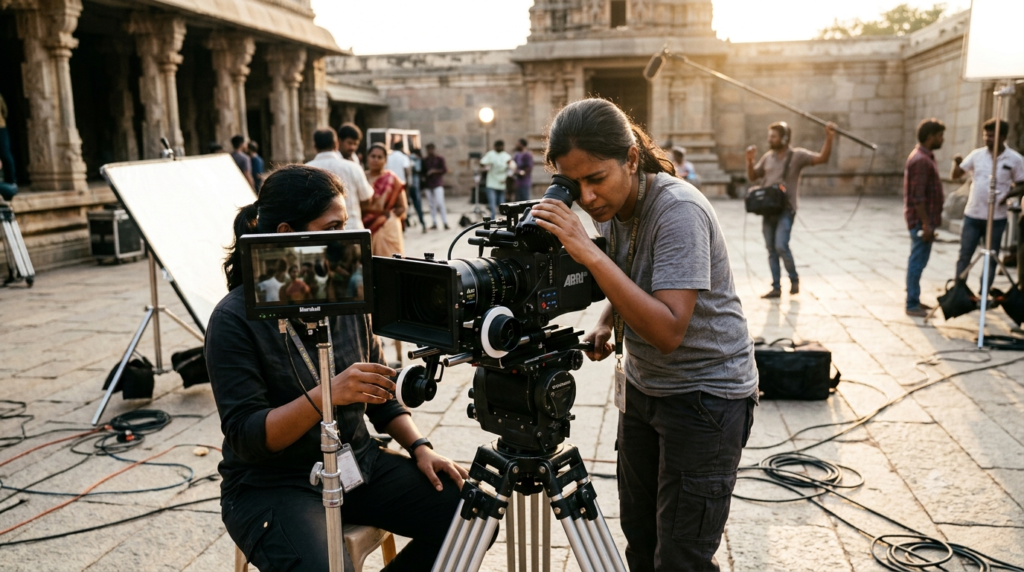
South Indian Women Technicians: From AD to VFX Lead
South Indian women technicians are quietly rewriting who gets to shape a film. The change now runs from the clapboard all the way to the render farm.
For years, the region’s cinema was praised for its stars and directors. The crews behind them stayed almost entirely male. That picture is finally shifting.
Yet the real numbers tell a more honest story than most articles admit. According to the O Womaniya 2025 report by Ormax Media and Film Companion Studios, women held just 13% of head-of-department roles across Indian films and series in 2024. That figure actually slipped from 15% a year earlier.
So the rise of South Indian women technicians is real, but it is neither smooth nor guaranteed. This guide maps where women stand behind the camera in Telugu, Tamil, Malayalam, and Kannada cinema. Because the topic attracts a lot of feel-good exaggeration online, every example and statistic here comes from verified reporting.
Key Takeaways
- Women held about 13% of head-of-department roles in Indian film and series in 2024, down from 15%, per the O Womaniya report.
- South Indian cinema trails Bollywood, since Telugu women HOD representation fell to roughly 3% while Hindi cinema sat near 21%.
- Streaming helps, because women hold a larger share of crew-lead roles in web series than in theatrical films.
- Cinematography and editing saw the sharpest recent declines, so progress is uneven across departments.
- Collectives such as the Indian Women Cinematographers’ Collective do much of the real support work.
What the Numbers Really Say About South Indian Women Technicians
Start with the honest data, because it corrects a common myth. Many blogs claim a steady, rising 12 to 15% share of women across South Indian crews. The verified figure is lower in the South, and it is moving the wrong way.
The O Womaniya study analysed 122 films and series released in 2024 across nine languages. It found women in only 13% of head-of-department roles. Those roles span direction, cinematography, editing, writing, and production design.
The regional breakdown holds the real story. An earlier edition showed Telugu women HODs dropping from 5% in 2021 to just 3% in 2023. Kannada cinema recorded almost none.
Tamil and Malayalam held steady near 6% each, while Bollywood reached about 21%. So South Indian women technicians climb from a lower base than their Hindi-industry peers. That makes each breakthrough here harder-won. You can read the full findings at the report’s official site.
One bright spot stands out. Women held around 22% of head-of-department roles in streaming series in 2024, and 18% in streaming films. Because OTT commissions reward fresh voices, they have become an unexpected on-ramp for new crew talent.
Not every craft moved together, either. Editing and cinematography posted the steepest recent drops, each falling several percentage points. Writing and production design held up better by comparison. So a newcomer’s odds now depend heavily on which department she chooses.
How South Indian Women Technicians Rise Through the Ranks
Most careers behind the camera begin in the assistant grades, and that is exactly where many women enter. The path usually runs from assistant director or camera assistant toward a full department-head credit. It is slow, demanding work, yet it builds real on-set authority.
From Assistant Director to the Director’s Chair
The assistant director role is the industry’s classic training ground. It blends scheduling, logistics, and close contact with every department. Women who master it often move into direction.
Sudha Kongara is a clear example. She rose through the writing and technical grades before commanding a set, then broke through with the Tamil hit Soorarai Pottru. Her success matters, because it shows younger crew a route that once seemed closed.
Cinematographers Changing the Lens
Cinematography has long been the most male-coded craft on a film set. So the women breaking into it carry real symbolic weight. Preetha Jayaraman is one of the first four women inducted into the Indian Society of Cinematographers.
She shot Mani Ratnam’s Vaanam Kottattum. A gold medallist from the Film and Television Institute in Chennai, she learned the trade assisting her uncle, the cinematographer PC Sreeram. Her story has been profiled in The Hindu.
History was made earlier by Anjuli Shukla. She became the first woman to win the National Film Award for Best Cinematography, for the Malayalam feature Kutty Srank in 2010.
Fowzia Fathima also stands out. She shot Mitr, My Friend, then founded the Indian Women Cinematographers’ Collective. Priya Seth, known for the action drama Airlift, rounds out this small but growing group. Younger names such as Yamini Yagnamoorthy now follow the same trail into Telugu and Tamil productions.
Editing and Sound: The Quiet Crafts
Editing is the invisible art of cinema, and it is one place where women have earned major honours. Priya Krishnaswamy is a two-time National Award winner, trained in editing at the Film and Television Institute of India. She wrote, edited, and directed the Tamil thriller Baaram.
That film won the National Award for Best Tamil Feature Film. Her path shows how an editor’s sense of rhythm can grow into full authorship. Among South Indian women technicians, editors like her prove the craft can be a launchpad, not a ceiling.
Sound is the other craft where women steadily gain ground, though named credits stay rarer. Studios in Chennai, Hyderabad, and Kochi now run advanced mixing and Dolby Atmos suites. Women engineers increasingly work across sync sound, foley, and post-production audio.
The field rewards precise technical skill over physical presence on set. Because of that, it has opened doors that camera and lighting work were slower to offer. Sync mixing, in particular, has become a strong entry point.
Women in VFX and Digital Post
The region’s move into heavy visual-effects storytelling created a genuinely new frontier. Films such as Baahubali and Kalki 2898 AD demanded huge digital pipelines, so studios in Hyderabad and Chennai scaled up fast.
Makuta VFX, the Hyderabad house that worked on Baahubali, sits near the centre of that growth. Listed players such as PhantomFX in Chennai have expanded too. Both draw talent from a widening pool of art and engineering graduates.
VFX and animation feel more merit-driven than the traditional set hierarchy, since the work is judged frame by frame at a workstation. Women now contribute across compositing, rotoscoping, matchmove, and colour grading on major projects.
That said, leadership numbers still lag participation. A woman is far more likely to be a compositor than a VFX supervisor today. So closing that gap is the sector’s next real test.
Challenges South Indian Women Technicians Still Face
Progress has not erased the barriers, and pretending otherwise does no one any favours. The most stubborn problems are structural rather than about talent. They surface again and again in interviews with women across departments.
- Punishing hours: Shoots run long and unpredictable, so scheduling clashes with caregiving expectations that still fall mostly on women.
- Thin networks: Many jobs get filled through informal referrals, and women often sit outside those hiring circles.
- Equipment bias: Physically heavy camera and lighting roles still carry an unspoken assumption that men handle them better.
- Location safety: Remote outdoor shoots raise real concerns about transport, accommodation, and after-dark logistics.
There is a recognition gap too. Technical crafts rarely draw press coverage, so women in these roles stay largely invisible to fans. When credit is scarce, the next generation has fewer role models to follow. That quiet erasure is its own kind of barrier.
The declining HOD numbers suggest these pressures are not easing on their own. A few high-profile hires cannot fix a whole pipeline. So the industry needs consistent policy, not one-off gestures.
Collectives, Mentorship, and Real Support
Lasting change tends to come from organised groups, not individual goodwill. Two bodies do much of the heavy lifting here, and both are worth knowing.
The Indian Women Cinematographers’ Collective was founded by Fowzia Fathima. It connects dozens of camerawomen across the country and helps newcomers find mentors and work. You can browse its member directory online.
In Kerala, the Women in Cinema Collective has pushed hard on pay equity and workplace safety since its formation. Industry unions such as the Film Employees Federation of South India also shape hiring norms. Pressure applied there can ripple across thousands of jobs.
Representation feeds on itself in the best way. Seeing a woman lead a film crew or supervise a pipeline is the strongest recruitment tool the sector has. That is why visibility for South Indian women technicians matters beyond any single film.
The Future for South Indian Women Technicians
The next few years will decide whether this is a genuine shift or a plateau. Several trends point toward slow, real gains, but only if the support structures survive.
- Streaming momentum: OTT crews already show better gender balance, and that work keeps expanding.
- Virtual production: LED-volume stages and real-time rendering reward coding and digital-art skills, where women are entering in strength.
- Film-school pipelines: Institutes in Chennai and Hyderabad graduate more women into technical streams each year.
- Data transparency: Annual reports keep the numbers public, so backsliding is harder to hide.
The honest forecast is cautious optimism. The talent and the training already exist, so the remaining question is simple. Will the industry keep the doors open?
If it does, the payoff will show up on screen. The next pan-India blockbuster may owe as much to women behind the frame as to the stars in front of it.
The Bottom Line
South Indian women technicians have moved from near-invisibility to a genuine, if fragile, presence. Their work now spans camera, cut, sound, and screen. The verified data keeps the story grounded, since representation is real but low, and it recently declined rather than climbed.
The most useful thing a reader can do is follow the collectives above. Judge the industry by its pipeline, not its headlines. Change here gets measured in careers built patiently over years, not in press releases.
FAQs About South Indian Women Technicians
Who are some well-known women technicians in South Indian cinema?
Verified examples include cinematographers Preetha Jayaraman, who shot Vaanam Kottattum, and Fowzia Fathima, who shot Mitr, My Friend. Anjuli Shukla was the first woman to win the National Award for Best Cinematography. Priya Krishnaswamy is a two-time National Award-winning editor and director.
What percentage of film crew heads are women?
Women held about 13% of head-of-department roles across Indian films and series in 2024. That was down from 15% the previous year, per the O Womaniya report. In South Indian cinema, the share sits lower, with Telugu figures dipping near 3% in recent counts.
Is representation for women behind the camera improving?
The answer is mixed. Streaming crews show clear gains, yet theatrical head-of-department numbers actually fell in the latest report. So the trend is uneven rather than a steady climb, which is why sustained policy support matters.
Which department has the most women technicians?
Production design and writing tend to show relatively higher female representation. Cinematography and editing saw the steepest recent declines. VFX and digital post attract many women at the artist level, although leadership roles there still skew male.
Are there training programs or collectives for women technicians?
Yes. The Indian Women Cinematographers’ Collective connects and mentors camerawomen nationwide. The Women in Cinema Collective in Kerala advocates for pay equity and safety. Film institutes in Chennai and Hyderabad also run technical courses that increasingly enrol women.
Why does South India lag Bollywood on this measure?
Reports show Hindi cinema hiring women HODs at roughly 21%, against low single digits in Telugu and Kannada films. The gap reflects smaller professional networks and fewer visible role models. Slower policy adoption plays a part too, though streaming is starting to narrow it.
How does having more women technicians affect the films themselves?
Crew diversity broadens the range of perspectives shaping a story’s look, pace, and sound. Individual style still varies by artist. Even so, a wider talent pool tends to enrich visual and narrative choices, and it strengthens the industry’s craft base for the long term.