Gaming Cinema Crossover: South Indian Films & Games — What’s Real
The gaming cinema crossover has become one of the most talked-about trends in South Indian entertainment. Yet most of what circulates online about it is only half true. Fans read that KGF, RRR, and 2.0 all have official video games. In reality, only one South Indian film ever launched a genuine, studio-backed game.

This guide separates the real crossovers from the myths. It verifies which titles actually exist, and it shows where films and games are truly merging in 2026. If you want the accurate picture instead of recycled hype, you are in the right place.
The gaming cinema crossover at a glance
- Only Baahubali: The Game (2017) is a fully official South Indian film-to-game title, built by Bengaluru studio Moonfrog Labs with Arka Media Works.
- Popular claims about official KGF and RRR games are false. Those are fan-made or promotional projects, not studio releases.
- The strongest gaming cinema crossover today sits in production tech, not merchandise. Game engines like Unreal now power films such as Kalki 2898 AD.
- India counted roughly 511 million gamers and about $1.04 billion in video-game revenue in 2025, according to Niko Partners.
What the gaming cinema crossover in South Indian films actually looks like
South Indian filmmakers have flirted with gaming for nearly a decade. The results, though, are uneven. Some crossovers are real and successful. Others exist only as internet rumour.
Because the difference matters to fans and studios alike, let us start with what genuinely exists.
The one official title that worked
Baahubali: The Game is the real success story. Bengaluru-based Moonfrog Labs developed it in partnership with Arka Media Works and Graphic India. Director S.S. Rajamouli backed the project directly.
Consequently, it launched in April 2017 to ride the wave of Baahubali 2: The Conclusion. The game is a real-time strategy title, clearly modelled on Clash of Clans. You play a Senapati defending the kingdom of Mahishmati. It crossed 10 million downloads, and it shipped in English, Hindi, Tamil, and Telugu. Because the makers built it as an original strategy experience rather than a movie replay, it kept players engaged long after the film left theatres.
The promotional games most people forget
Rajinikanth’s 2.0 (2018) also got a tie-in, though a modest one. A lightweight mobile runner called Chhota Rajini Robot 2.0 arrived around release, developed by a small Bangalore studio.
It was a promotional endless-runner. It was not the immersive “VR experience” that many blogs describe. So while the film-to-game link is real, its scale was tiny compared with Baahubali.
The gaming cinema crossover myths worth correcting
Here is where misinformation spreads fastest. Several widely shared claims simply do not hold up when you check the sources.
- “KGF: Chapter 2 has an official game released by Google Play.” This is false. Google Play is a store, not a game publisher, and no official KGF game exists. Only unofficial fan builds float around on hobby platforms.
- “RRR: Rise of the Warriors by XYZ Studios launched in 2026.” No such game exists. “XYZ Studios” is a placeholder name that leaked into several articles, so treat it as fiction.
- “Project K became a 2025 game.” Project K was just the working title for Kalki 2898 AD. That film released in cinemas on 27 June 2024, and it is not a game at all.
These corrections matter because fans make viewing decisions based on them. When a blog invents a studio or a launch date, it erodes trust across the whole gaming cinema crossover conversation.
How to spot fake gaming cinema crossover news
Because false claims spread so easily, a quick sniff test helps. Use these checks before you share any “new movie game” story.
- Name the studio. Real games list a genuine developer, such as Moonfrog. A vague “XYZ Studios” is a red flag.
- Find the store link. If there is no Google Play or App Store listing, the game likely does not exist.
- Check the publisher, not the platform. Google Play distributes games; it does not make them. That phrasing usually signals a fabricated report.
- Cross-check the date. Confirm whether a title refers to a film, a working title, or an actual game before you believe it.
Why most gaming cinema crossover games have not stuck
If the audience is huge and the films are massive, why do so few movie games survive? The answer comes down to economics and timing. Most film tie-in games launch in a rush to match a theatrical window, so quality suffers.
Furthermore, a decent mobile game can cost as much as a mid-budget short film. Because of that risk, studios rarely commit real money to it. When the film’s buzz fades after a few weeks, the game usually fades with it.
Baahubali worked precisely because it broke that pattern. Its makers treated it as a standalone strategy product with its own updates. It was never a throwaway promo. That is the single biggest lesson for any future gaming cinema crossover: build a real game, or do not bother.
Why the gaming cinema crossover works creatively
Set the business aside for a moment, and the creative fit is obvious. South Indian cinema loves scale, mythology, and larger-than-life heroes. Games love world-building and player agency. When those instincts meet, the overlap feels natural.
| Cinema element | Gaming parallel | Shared effect |
|---|---|---|
| Narrative arcs | Level progression | Emotional investment |
| Hero’s journey | Player missions | A sense of ownership |
| Soundtrack cues | Audio feedback | Deeper immersion |
| Visual world-building | Open-world design | Expanded lore |
| Trailer hype | Game reveals | Shared fan communities |
Both mediums run on immersive storytelling. One is linear, while the other is interactive. South Indian films already build mythic worlds full of power struggles and fantasy. As a result, those worlds translate cleanly into playable settings.
The real gaming cinema crossover is happening in production
The honest headline is this. The deepest crossover is not on your phone’s app store. It is on the film set. Regional filmmakers are increasingly borrowing tools straight from the video-game industry to shoot their movies.
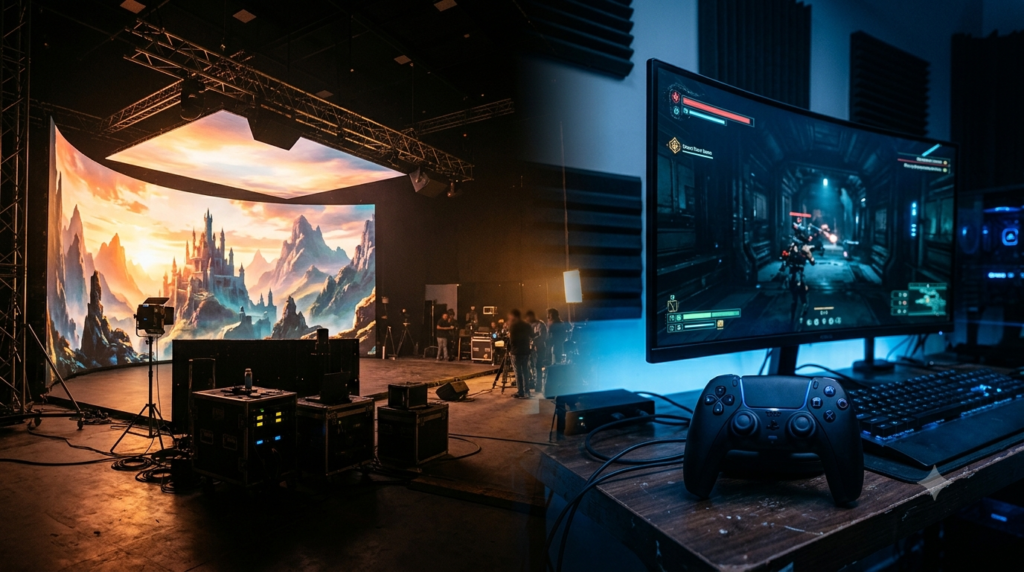
Real-time engines such as Unreal Engine and Unity now drive virtual production, LED-volume shoots, and previsualisation. Studios in Hyderabad and Chennai use them daily.
Kalki 2898 AD is the clearest example. India’s most expensive film, at a reported ₹600 crore budget, leaned heavily on virtual sets and game-engine workflows to build its dystopian city of Kasi. Its animated prequel, Bujji & Bhairava, streamed on Prime Video ahead of the film. So the technology that once made games is now making blockbusters, which is a far more consequential crossover than any tie-in app.
This shift also changes how directors work. With a game engine, a filmmaker can walk through a digital set before a single camera rolls. As a result, teams catch problems early and spend less on reshoots. That practical edge, more than any tie-in app, is why the crossover keeps growing.
What the numbers say about India’s gaming boom
To understand why studios keep circling this space, look at the market. India is now one of the largest gaming audiences on Earth. Better still for developers, the money is finally starting to follow the eyeballs.
According to Niko Partners, India generated about $1.04 billion in video-game revenue in 2025. That marked 14.8% growth year on year. The country had roughly 511 million gamers, a figure the firm expects to near 707 million by 2030.
Meanwhile, a separate “India’s State of Play” report from Naavik, powered by Sensor Tower data, counted close to 8 billion mobile game installs in 2025. That total trails only China.
Shooter titles like Free Fire MAX and BGMI still drive around 43% of in-app spending. Yet strategy and simulation are growing fast. Because Hyderabad and Bengaluru host most of the country’s game-development talent, South India sits right at the centre of this expansion.
For filmmakers, the takeaway is simple. A well-built game can reach players who never buy a cinema ticket. It can also keep a franchise alive between releases.
Challenges facing the gaming cinema crossover
None of this is easy, and the hurdles are real. An honest picture has to name them.
Production cost
A polished game can cost as much as a mid-budget film, often several crores. Few producers want that risk for a promotional tie-in.
Creative dissonance
Not every director understands game mechanics. Translating cinematic emotion into playable action needs cinematographers, designers, and coders working as one team. That rarely happens smoothly.
Monetisation gaps
Bollywood enjoys stronger brand partnerships, so Southern film games often lack marketing muscle. Without a launch budget, even a good game sinks.
Technical limits
Regional studios still wrestle with device optimisation, language localisation, and server stability. These are solvable problems, though they take time and money.
Copyright and licensing
Cross-media IP ownership stays legally messy between studios, developers, and distributors. Until those contracts get cleaner, ambitious crossovers will stall.
The future of the gaming cinema crossover
Where does this head over the next three to five years? A few shifts already look likely, based on current investment and technology trends.
- Transmedia universes: franchises such as Pushpa, Salaar, and the Kalki Cinematic Universe could expand into games and comics at once.
- Game-engine filmmaking: Unreal and Unity will power more live-action shoots, exactly as recent big-budget Telugu films have shown.
- AR and VR fan experiences: expect walkthrough sets and interactive teasers tied to major releases.
- Original studio games: Hyderabad, Chennai, and Kochi studios may finally build original IPs rooted in regional mythology.
The spectacle instinct of South Indian cinema aligns naturally with gaming’s appetite for world-building. If studios treat games as products rather than posters, the next decade could be genuinely exciting.
The bottom line
Strip away the hype, and the gaming cinema crossover in South India is smaller than the internet claims. It is also more interesting than it looks. Only Baahubali delivered a true official game, and most viral “movie game” stories are inventions.
Instead, the real momentum lives in production technology, where game engines now shape how films are made. For fans, the smart move is to verify before you share. And keep an eye on the studios in Hyderabad, because that is where cinema and gaming are quietly becoming one craft.
FAQs about the gaming cinema crossover
Which South Indian film actually has an official video game?
Baahubali: The Game is the only fully official one. Moonfrog Labs built it with Arka Media Works in 2017, and it crossed 10 million downloads. Other films have only fan-made or small promotional games.
Does KGF or RRR have an official game?
No. Despite widespread claims, neither KGF nor RRR has a studio-released official game. Any titles you find online are unofficial fan projects, not backed by the filmmakers.
Was Project K turned into a game?
No. Project K was the working title for Kalki 2898 AD, which released as a film on 27 June 2024. There is no official Kalki game, though the movie itself used game-engine production tools.
How big is India’s gaming market?
It is one of the world’s largest by players. Niko Partners reported about 511 million gamers and $1.04 billion in video-game revenue for 2025. Strong growth is expected through 2030.
What technology connects films and games today?
Game engines such as Unreal Engine and Unity now shape both mediums. Motion-capture and virtual production add to that shared toolkit. This overlap is the strongest link between cinema and gaming right now.
Will South Indian studios make original games soon?
Possibly. Development hubs in Hyderabad, Bengaluru, Chennai, and Kochi have the talent. If funding follows, original IPs based on regional mythology are a realistic next step.
For more on the directors driving this ambition, read our profile of SS Rajamouli, whose Baahubali franchise sparked the original film-to-game push. You can also explore how OTT platforms reshaped Indian cinema. It helps to understand what the pan-India film model means for these transmedia bets.
External references: The Hindu on Baahubali: The Game, the India’s State of Play gaming report, and the Statista Indian video game market overview.