Cinema Food Allergies: What to Ask Before Buying Snacks
Cinema food allergies deserve a check before you reach the popcorn counter, not a guess after the lights dim. Ask what a snack contains, how staff handle it and whether shared tools could transfer an allergen. A familiar name on the menu cannot answer all three questions. If you need a reliable choice, ask about each one.
Independence note: Movieshala is an independent cinema guide, not a theatre operator or food seller. We do not approve snacks, tickets or outside-food requests.
Health note: This is general information, not personal medical advice. Follow your allergist’s avoidance and emergency plan. No cinema snack, seating choice or staff assurance can promise zero allergy risk.
Cinema Food Allergies at a Glance
- Ingredients: Ask for the current product label or allergen information for the exact item and flavour.
- Cross-contact: Ask about scoops, serving tubs, seasoning stations, fryers, gloves and preparation surfaces.
- Unclear answer: Do not treat a guess or a vague reassurance as confirmation.
- Outside food: Request the exact theatre’s current policy; do not assume an allergy exemption.
- Emergency plan: Carry prescribed medication and know how to reach staff and emergency services.
The practical rule is simple: a snack’s ingredient list and its preparation history answer different questions. You need both before deciding whether it fits your own allergy plan. Food Allergy Research & Education (FARE) explains why even invisible food residue can cause reactions after cross-contact.
What Makes Cinema Food Allergies Different?
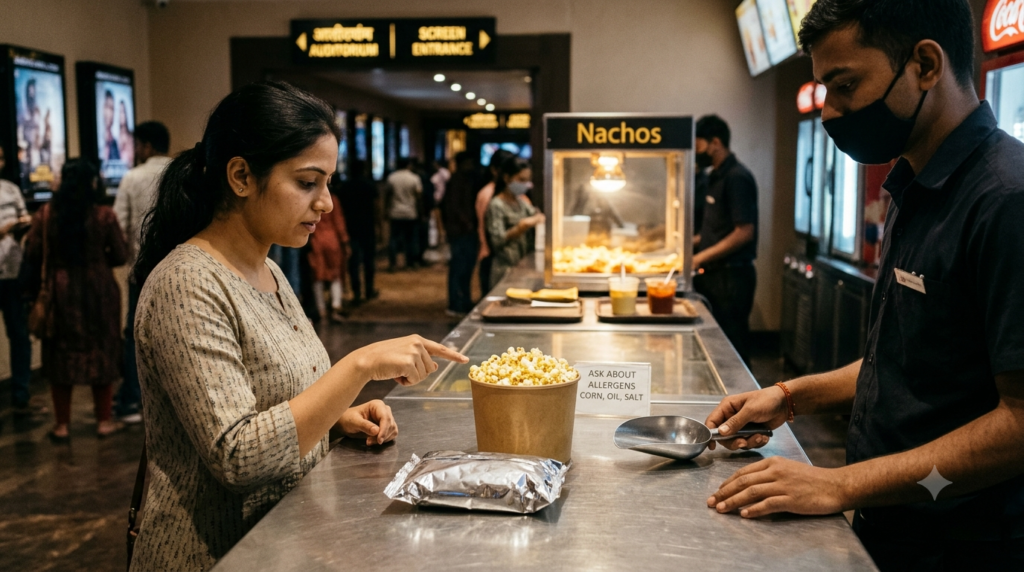
Cinema food allergies involve the same immune reactions as allergies elsewhere. The setting adds a particular problem: a busy concession counter often handles several foods beside each other. An ingredient-free recipe, therefore, does not prove that staff kept it apart from other food proteins.
Think of a scoop moving between popcorn flavours. A dispenser nozzle can also touch a topping or cup. These are possible contact routes, not proof that a specific cinema has contaminated food. You need answers about the actual counter.
Film timing adds pressure for people managing cinema food allergies. People order quickly before trailers, then return during an interval when queues can grow. For a viewer with allergies, a rushed decision can be harder to check. Plan ahead rather than waiting until the last minute.
Cinema Food Allergies: Questions to Ask Before Ordering
Start by naming the exact food allergen, such as milk, peanuts, wheat, egg, soy or sesame. Then ask a manager or trained concession employee to check the product details. An answer about general hygiene is not the same as an answer about allergens.
- Which ingredients are in this exact snack? Ask about seasoning, sauces, oils, glazes and added flavours, not just the base food.
- Can I see the ingredient label or allergen sheet? Check that it matches the brand, size and flavour on sale today.
- Have suppliers or recipes changed? A familiar item can have a different ingredient list at another branch or date.
- What touches the snack before serving? Ask about shared scoops, counters, warmers, blenders, gloves and topping pumps.
- Are fryers or cooking oils shared? This matters if a snack shares equipment with food containing your allergen.
- Can anyone verify the answer? If the counter worker cannot, request a supervisor rather than accepting a guess.
This approach to cinema food allergies follows FARE’s advice to check ingredients and preparation. Its guide to calling food venues also recommends talking to a manager before arriving. A cinema may have fewer preparation options than a restaurant, so answers can still be limited.
The UK cinema chain Cineworld warns that it cannot guarantee the absence of allergen traces in concession products. That notice illustrates a general risk, not a policy for Indian cinemas.
A Short Question You Can Use at the Counter
Try: “I have a food allergy to milk. Could you check the current ingredients in this popcorn and seasoning? I also need to know whether the scoop, topping equipment or preparation area touches milk products.” Replace milk with the precise allergen you avoid.
Ask before paying, so you can change the order or skip it without pressure. If staff say they cannot confirm the information, treat that uncertainty as useful information. It is a reason not to rely on the item.
Popcorn, Nachos and Drinks: Where to Look Closely
When dealing with cinema food allergies, no universal snack suits everyone. Recipes, brands and service methods differ across venues. Also, a supplier may change without a new menu board. This table lists useful checks rather than declaring any food safe or unsafe for every visitor.
| Snack type | Ingredient question | Cross-contact question |
|---|---|---|
| Popcorn | Which oil, flavouring and topping? | Shared scoop, warmer or seasoning area? |
| Nachos | What is in the chips, dip and cheese sauce? | Shared pumps, tongs or counter? |
| Fries or hot snacks | What is in the coating and seasoning? | Shared fryer, oil, tray or grill? |
| Ice cream or desserts | Which mix-ins, cones and sauces? | Shared scoop, blender or topping station? |
| Packaged sweets | Does today’s pack list your allergen? | Any advisory statement or damaged seal? |
| Dispensed drinks | Any flavour mix or additive to check? | Shared nozzle or preparation equipment? |
Is Plain Popcorn Automatically Free of Allergens?
No. Plain-sounding popcorn can include cooking oil, added flavouring or toppings whose composition varies. Even popcorn prepared without your allergen could encounter shared tools or serving areas. Check the current ingredients and handling steps at that particular concession counter.
Do not infer that “salted” means milk-free or that “butter flavour” always contains dairy. Those labels describe taste, not a complete ingredient statement. Ask about any oil or seasoning put into the machine before the kernels arrive.
Do Sealed Snacks Solve the Problem?
A factory-sealed pack usually gives you a label to inspect, which can make ingredient checks more direct. It still needs careful reading, because ingredients and manufacturing warnings can change. A sealed wrapper does not make a product suitable for every allergy.
Look for your allergen in the ingredient list and any precautionary warning. FARE notes that the absence of a “may contain” statement does not guarantee an allergen’s absence. If you cannot understand or verify a label, do not choose the snack on the strength of its packaging alone.
Cinema Food Allergies and Cross-Contact at Snack Counters
Cross-contact means an allergen moves unintentionally from one food or surface to another. For example, a scoop may touch a cheese-flavoured snack and then a different popcorn tub. The second snack might not contain cheese in its recipe, yet the equipment could transfer residue. This is why ingredient lists cannot settle every question.
For cinema food allergies, possible contact routes also include reused gloves, a shared fryer, topping pumps or crumbs on a serving counter. The risk depends on actual practices, not on whether a snack looks clean. Therefore, appearance alone cannot answer the question. FARE warns that cooking does not reliably eliminate allergen proteins introduced through cross-contact.
Ask how workers clean or separate tools. A quick dry wipe is not the same as thorough cleaning. The UK’s Food Standards Agency also advises food businesses to clean utensils and separate allergen-containing ingredients. Its guidance is useful for understanding the process, though UK rules do not govern Indian cinemas.
Why a Fresh Scoop May Not Be Enough
A fresh scoop addresses only one possible contact point, so ask about the rest of the process. Popcorn may still pass through a shared warmer or seasoning zone before staff use that scoop. Likewise, a fresh cup does not answer questions about a shared drink nozzle or blender.
Ask about the full path from storage to service. If the cinema cannot explain that path, it may be impossible to assess cross-contact. No special instruction given at the till automatically changes the way a counter operates.
Cinema Food Allergies in India: Allergen Information
Indian readers researching cinema food allergies should know that the Food Safety and Standards Authority of India (FSSAI) regulates allergen disclosures for certain food service establishments. Its April 2024 clarification covers establishments with a central licence or ten or more outlets. For those covered, allergen information belongs on menu cards or boards.
That does not establish that every individual cinema concession falls under the same requirement. Nor does a displayed allergen listing prove the absence of cross-contact. If you cannot find the details, ask the cinema to identify its source for the product’s current ingredients.
Read the FSSAI clarification on food service information for the regulatory scope. A vegetarian symbol, by itself, does not mean a food contains no milk, nuts or other allergens.
Cinema Food Allergies and Outside-Food Rules
Do not assume that a medical need automatically permits outside snacks inside a theatre. Entry rules depend on the venue, and this guide cannot grant an exception. BookMyShow’s outside-eatables help page advises customers not to bring food into cinema halls.
That general advice does not settle a particular allergy request. Before booking, contact the specific theatre through its official website or customer-support channel. Describe the need briefly and ask whether it has a process for reviewing requests involving food allergies or essential supplies.
- Check the venue’s written terms. Do not rely on a friend’s experience at another branch.
- Ask for a direct reply. Find out what staff permit, whether any conditions apply and who can confirm at entry.
- Separate medication from snacks. Ask how to carry prescribed emergency medication without assuming food permission follows.
- Plan if permission is denied. Consider eating at a suitable place before the screening or choosing another theatre.
Managing cinema food allergies does not guarantee outside-food approval or a refund after an entry dispute. Movieshala’s cinema baggage policy guide explains why bags and their contents require separate checks. Ask about both if your visit depends on carrying specific supplies. For booking consequences, see Movieshala’s Telugu cinema ticket cancellation guide; any refund depends on the actual ticket rules.
Planning a Film Visit Without Relying on Concession Food
For some moviegoers, the best plan is to watch the film without buying snacks. That decision can remove one uncertain food purchase, though it does not eliminate other allergy exposures. Discuss individual needs with your clinician if your condition makes planning more complex.
Choose a screening time that allows a suitable meal beforehand. You can then focus on the film rather than negotiating ingredients during a busy interval. For long Telugu films, Movieshala’s interval guide explains why breaks differ by theatre and show.
Keep your prescribed emergency medicine accessible according to your action plan. Also, identify the nearest aisle and how to reach a staff member. If someone in your group is a child, agree who will check labels, manage medication and speak to staff.
Cinema Food Allergies: When Staff Cannot Confirm Ingredients
Even when cinema food allergies are explained clearly, the counter may lack a full ingredient sheet or details of every shared process. Some food arrives ready-made from another supplier. The cinema employee may know the menu name but not every component, so a confident-sounding answer may still lack evidence.
Use the following fallback order rather than deciding under pressure:
- Pause the purchase. Ask a manager to check the product pack, supplier sheet or approved allergen information.
- Ask about preparation separately. If ingredients are clear but cross-contact remains unknown, the question is not resolved.
- Skip the uncertain item. Choose another item only if you can assess its own ingredients and handling.
- Watch without buying food. Arrange a suitable meal before or after the show instead.
- Reconsider the venue. If you need an accommodation that cannot be confirmed before entry, try another screening or cinema.
Do not taste a little to test an uncertain food. Nor should you scrape off a topping and assume any allergen residue has disappeared. FARE’s cross-contact guidance explains why trace transfer matters.
Recognising and Responding to an Allergic Reaction
A reaction can start during the film, so decide in advance how to get help. Before the show, tell a companion where you keep your action plan. Severe symptoms can include breathing trouble, throat tightness, faintness or symptoms affecting more than one body system. Do not wait for the film to end when a reaction may be serious.
Follow your prescribed emergency action plan. The American College of Allergy, Asthma & Immunology identifies epinephrine, also called adrenaline, as the first-line treatment for anaphylaxis. Use your prescribed device promptly when your plan calls for it and seek emergency medical help.
Alert cinema staff, ask someone to call the local emergency service and clearly state your location. Antihistamines are not a substitute for adrenaline in anaphylaxis. For medical instructions tailored to your history, consult your allergist rather than relying on generic advice online.
Read the ACAAI guidance on epinephrine and keep a copy of your action plan handy. A companion can help explain the situation if the auditorium is noisy or dark.
Cinema Food Allergies: Common Snack Counter Mistakes
- Using a brand name as proof: The same cinema chain may change ingredients, suppliers or handling by location.
- Trusting menu labels alone: Ingredients and cross-contact are separate checks.
- Equating vegetarian with allergen-free: Vegetarian foods may still contain milk, nuts, wheat or soy.
- Assuming small amounts cannot matter: Some reactions follow trace exposure.
- Asking only at the interval: The queue leaves little time for a careful answer.
- Expecting an outside-food exemption: Ask the named cinema before paying for tickets.
Another mistake when managing cinema food allergies is treating every employee’s answer as equally informed. A worker may be helpful but lack the supplier sheet or access to kitchen procedures. Ask for someone who can verify the information, and accept “we don’t know” as an answer.
Before the Trailers Begin
Cinema food allergies call for two separate checks: what the snack contains and what it may touch before serving. Ask both questions while you still have time to change plans. If the answers stay uncertain, skipping the snack is a sounder choice than guessing.
Confirm any outside-food request with the exact theatre rather than expecting a blanket exception. Carry prescribed medication and follow your clinical action plan. The goal is an enjoyable film outing built on verified information, not a promise that any counter can make food allergy-safe.
Frequently Asked Questions
Can I eat cinema popcorn if I have a milk allergy?
Only decide after checking the exact popcorn’s ingredients and how staff prepare and serve it. Oil, flavours and toppings vary, while equipment may be shared. The word “plain” or “salted” does not prove milk is absent.
Can popcorn and nachos share allergy risks?
Yes, they may have overlapping ingredients or share preparation surfaces and serving tools. Ask separately about both recipes and the way each item reaches the customer. Do not assume one menu category tells you about the other.
What is cross-contact in a cinema?
Cross-contact occurs when allergen proteins accidentally transfer between foods or surfaces. At a concession counter, shared scoops, gloves, fryers or serving stations can be possible routes. You need venue-specific handling details, not a general claim of cleanliness.
Must a cinema let me bring allergy-friendly food?
Do not assume it must or that permission will be automatic. Check the exact theatre’s current policy and request a direct answer about your circumstances before booking. A food allergy does not make this article an authorisation to bring outside food.
Are packaged cinema snacks safer than loose snacks?
Packaging can make ingredient details easier to read, but it cannot guarantee suitability. Check the exact pack for allergens and warnings, including after a product redesign. Ask the manufacturer when essential information remains unclear.
Can I trust a “may contain” warning?
Take such warnings seriously when they name an allergen you avoid. The lack of a warning does not prove zero risk, since precautionary labels differ across products and countries. Follow the approach your allergist recommends for your allergy.
Does vegetarian or vegan popcorn mean it is allergy-safe?
No. Vegetarian food may contain milk, and vegan food may still contain nuts, wheat, soy or other allergens. Either may also encounter shared equipment. Check your particular allergen and the preparation steps rather than trusting the category label.
What if the cinema does not have an allergen chart?
Ask whether a manager can access labels or supplier information and explain how staff handle the food. If those details remain uncertain, do not buy that item. You can still enjoy the film without concession food.
Should I leave the screening if an allergic reaction starts?
Do not delay emergency care to finish the film. Follow your prescribed action plan, seek staff help and contact emergency services for a suspected severe reaction. Use prescribed adrenaline promptly when your plan indicates it; antihistamines cannot replace it for anaphylaxis.