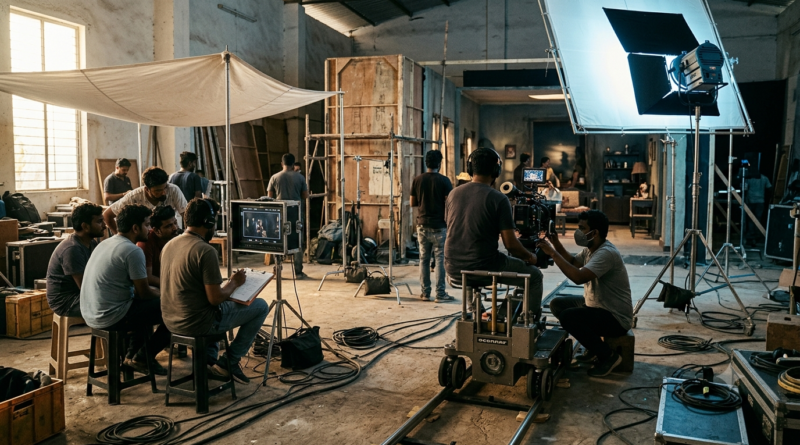
Film Crew Roles Explained: Every Job on a Film Set
Most film crew roles never make it into a trailer, yet they decide whether a scene lands or collapses. A single Telugu feature runs on dozens of specialised jobs, and the Telugu Film Industry Employees’ Federation alone brings together 24 separate worker unions.
Fans know the hero, the director and usually the music director. Almost nobody can explain what a chief associate director actually does, or why the first assistant director shouts louder than anyone else on the floor. So this guide walks through every department, using the titles you will really hear called out on a Hyderabad set.
Independence note: Movieshala is an independent entertainment publication. We are not affiliated with any studio, production house, union or film body. We do not recruit crew, collect fees, or take payments for film work of any kind. Always verify a job offer directly with the production house concerned.
Film Crew Roles at a Glance
- Above the line: producer, director, writer and lead cast, whose deals are locked before the shooting budget is drawn.
- Below the line: everyone else, from the cinematographer down to the spot boy, budgeted as production cost.
- The big Indian difference: Telugu sets run a chief associate director and several associate directors, a layer most Hollywood charts skip entirely.
- Most confused pair: the first assistant director runs the floor, while the production manager runs logistics.
- Realistic entry point: Hyderabad enforces union membership more loosely than Mumbai or Chennai.
- Red flag: no genuine production ever asks a newcomer to pay for a crew position.
Above the Line and Below the Line: How Film Crew Roles Are Split
Every budget sheet carries one horizontal line. Above it sit the producer, director, writer and principal cast, because their fees are negotiated before the shoot is costed. Below it sits the technical crew, whose pay is treated as running production expenditure.
That single line is the fastest way to sort all film crew roles into two buckets. The split is financial, so it is not a ranking of talent. A sought-after cinematographer can earn far more than a first-time producer, although the accountant still lists him below the line. When trade reports talk about “below-the-line workers”, they mean the technicians and daily-wage staff who physically build the film.
The Direction Department: Film Crew Roles Around the Director
The director owns the vision, but a Telugu direction department is a pyramid several layers deep. Below the director sits the chief associate director, who is usually the most trusted lieutenant and often a director-in-waiting. Under that person work associate directors, then assistant directors, then apprentices who fetch, log and photocopy.
This ladder is a genuine career path rather than a title inflation exercise. Many working Telugu directors spent years as associate directors on someone else’s unit before getting a break. Because the department is so structured, a newcomer can join at apprentice level and climb without any film school degree.
Assistant director versus production manager
These two get mixed up constantly, even by people already working in the industry. The first assistant director is a floor role. He calls the unit together, protects the director’s time, and drives the day’s schedule shot by shot.
The production manager is an office and logistics role. She handles call sheets, transport, vendor payments and permissions, and reports upward to the line producer. On a small shoot one person may juggle both, while on a large film these are separate chains of command that barely overlap.
The Production Department: Who Controls the Money
The producer raises the money and carries the commercial risk. An executive producer usually contributes finance or industry access without daily involvement. The line producer then converts that budget into a realistic shooting plan, since somebody has to decide how many days the schedule can actually afford.
Below them, the production executive chases vendors, permissions and payments. Unit managers handle food, parking, transport and ground coordination at each location. Spot boys, the equivalent of Hollywood production assistants, do the constant on-floor fetching that keeps a shot moving.
Camera and Lighting: Film Crew Roles Behind the Lens
The cinematographer, credited in India as the director of photography or DOP, designs how the film looks. He decides lenses, lighting and camera movement with the director, then hands execution to his team. On many Telugu sets the DOP also operates the camera himself.
The focus puller, or first assistant camera, keeps the image sharp while actors and camera both move. A second assistant camera slates shots and manages media cards. Gaffers and lightmen rig the lights, while grips build the rigs, trolleys and cranes that carry the camera.
Art, Costume and Makeup
India credits the art director for work that Hollywood usually splits between production designer and art director. This person designs sets, chooses locations and controls the visual texture of every frame. Set decorators, prop masters and a carpentry team execute the build.
The costume designer shapes character through clothing, while a costume assistant maintains continuity across weeks of shooting. Makeup artists and hairstylists handle the look, and prosthetics specialists arrive when a role demands transformation. Continuity failures usually surface here first, so the script supervisor watches this department closely.
Sound, Music and the Dubbing Studio
The location sound recordist and boom operator capture dialogue on set. Telugu cinema, however, leans heavily on post-synchronised sound. Actors return to a dubbing studio afterwards and re-record their lines cleanly.
Dubbing artists are a full profession here, not an afterthought. When a Hindi or Tamil actor stars in a Telugu film, a dubbing artist often supplies the Telugu voice, and audiences frequently associate a star with that voice for decades. Meanwhile the music director composes songs and background score, and the sound designer and re-recording mixer assemble the final mix.
Action, Dance and Stunt Departments
The stunt director, still widely called the fight master, designs and supervises action sequences. He works with a stunt team, rigging specialists and sometimes a second unit director who shoots action separately. Safety planning sits squarely with this department.
The choreographer, known on set as the dance master, designs song picturisation with assistant choreographers and a backup dancer troupe. Song shoots often run as their own mini-production, because they need extra lights, extra dancers and separate locations.
Safety note: film sets involve real physical risk from heights, vehicles, fire effects, heat and long shifts. Never attempt a stunt without a qualified stunt director supervising, and never treat on-set injuries casually. If you have a medical condition, tell the production before signing on to a physically demanding schedule.
Post-Production Film Crew Roles
Once shooting wraps, the editor shapes the film. The director and editor decide rhythm, structure and which performances survive. A colourist then grades the footage in a digital intermediate suite so that every scene matches tonally.
Visual effects supervisors and compositors handle everything from invisible cleanup to full digital environments. Big Telugu productions now employ a VFX supervisor on set, since planning a shot for effects is far cheaper than fixing it later. Finally, the public relations officer, universally called the PRO, manages press, releases and publicity coordination.
Hollywood Titles Versus Telugu Set Titles
Most online guides to film crew roles use American terminology, which confuses anyone walking onto an Indian set for the first time. The table below maps the common equivalents.
| Hollywood term | Telugu set term | What the job involves |
|---|---|---|
| Production designer | Art director | Designs sets, locations and visual texture |
| Stunt coordinator | Fight master | Designs and supervises action scenes |
| Choreographer | Dance master | Designs song picturisation |
| Production assistant | Spot boy | On-floor support and fetching |
| Unit publicist | PRO | Press, releases and publicity |
| Associate producer | Production executive | Vendors, permissions and payments |
| Second unit director | Chief associate director | Directs assigned units and blocks |
Myths About Film Crew Roles That Refuse to Die
The first myth says the director controls everything. In practice the director controls creative decisions, while the producer controls whether those decisions are affordable. Many arguments on set are really budget arguments wearing a creative costume.
A second myth treats assistant director work as glorified errand running. The role is actually the most common route to directing in Telugu cinema. A third myth claims you need a film school degree, although a large share of working technicians learned entirely on the job.
What Telugu Crew Actually Earn
Pay varies enormously by department, credit and star value, so treat any published figure as indicative. During the 2025 wage dispute in Hyderabad, federation representatives publicly referred to daily-wage tiers of roughly ₹1,500 and ₹2,500, covering what they described as around 10,000 daily-wage workers. Those were negotiating positions reported in the press, not a fixed industry rate card.
The dispute itself is worth understanding. The Telugu Film Industry Employees’ Federation sought a 30% hike and called a strike, while the Telugu Film Chamber of Commerce opposed the demand and stated that federation registration is not mandatory to work on Telugu films. Wage structures in this industry therefore change through negotiation, so confirm current rates directly with a production or the relevant union before accepting work.
How People Actually Break Into Film Crew Roles
Union enforcement differs sharply across Indian film centres. Mumbai productions largely operate through FWICE, and Chennai productions through FEFSI, while Kerala works through FEFKA. Hyderabad has historically been less rigid, which is why many outsiders start their careers in Telugu cinema.
Short films, advertisements, corporate videos and web series rarely require union standing at all. Those sets are where most technicians build the credits that unlock feature work. Formal training also helps, and the Film and Television Institute of India runs structured courses in direction, cinematography, editing and sound.
Scam warning: during the 2025 dispute, union voices publicly complained that newcomers were being asked for large sums simply to enter the industry, with figures of several lakhs reported in the press. Treat any such demand as a scam. Genuine productions pay crew, so money should never flow from you to a producer, a broker or a self-declared agent.
What Beginners Get Wrong on Their First Shoot
Every department has its own etiquette, although a few rules apply across all film crew roles. New crew members almost always underestimate the day. A shooting day frequently stretches past twelve hours, and the last hour matters as much as the first. Bring your own water, food backup and phone power bank, because catering timing depends on the schedule rather than your hunger.
Learn the chain of command before you speak. If you need something from the camera team, you go through your department head rather than directly to the DOP. Also keep a notebook, since almost every useful instruction on a set is spoken once and never repeated.
Watch the monitor whenever you are free. Understanding why a shot is being repeated teaches more in a week than a month of online tutorials. Silence during a take is not politeness either, because dialogue recording picks up everything.
Where These Jobs Are Heading Next
Three shifts look likely over the next few years. Streaming commissions keep expanding, so demand for line producers, post-production supervisors and localisation teams should rise faster than demand for traditional theatrical crew. Virtual production stages are also spreading, which pushes VFX planning earlier into the shooting schedule.
The third shift concerns working conditions. After the 2025 strike, wage structures and on-set welfare moved into public debate for the first time in years. These are trends rather than certainties, yet they are already reshaping which crew skills productions pay a premium for.
The Bottom Line
A Telugu film is a factory disguised as an art form. Almost all film crew roles on that long credit scroll are real, learnable jobs with a working entry route. The direction ladder offers the clearest route into the industry, while camera, art and post-production reward technical specialisation. Hyderabad remains one of the more accessible places in India to begin.
Start on smaller productions, watch how each department talks to the others, and never pay anyone for the privilege of working. If you want more context on how these departments scale up on the biggest projects, our features on the making of the Pushpa phenomenon and the highest grossing Telugu movies show the scale involved. For a smaller-budget contrast, read our Rao Bahadur review.
Film Crew Roles: Frequently Asked Questions
How many film crew roles are there on a typical Telugu movie?
A mainstream Telugu feature typically credits well over a hundred distinct positions across direction, production, camera, lighting, art, costume, makeup, sound, action, dance and post-production. Small independent films may run with fewer than twenty. The exact count depends entirely on budget and genre.
What is the difference between an associate director and an assistant director?
An associate director sits above assistant directors in the Telugu direction hierarchy and handles larger creative responsibilities, sometimes directing assigned scenes. Assistant directors execute daily tasks such as continuity, actor coordination and paperwork. The chief associate director sits above both.
Do you need a film school degree to join a film crew?
No. A large proportion of working Telugu technicians trained entirely on the job, starting as apprentices or assistants. A degree from an institute such as FTII helps with fundamentals and contacts, although credits and reliability matter far more when producers hire.
Which crew job pays the most?
Above-the-line positions generally command the highest fees, particularly established directors, cinematographers and music directors on star-driven projects. Below the line, senior heads of department earn substantially more than assistants. Pay is negotiated per project rather than fixed.
What does a spot boy do on a film set?
A spot boy provides continuous on-floor support to the production department. The work covers fetching equipment and refreshments, moving items between locations, and assisting whichever department needs immediate help. The role is the Indian equivalent of a production assistant.
Is union membership compulsory to work in Telugu cinema?
The Telugu Film Chamber of Commerce stated during the 2025 wage dispute that registration with the employees’ federation is not mandatory for working on Telugu films. Enforcement in Hyderabad has generally been lighter than in Mumbai or Chennai. Positions can change, so confirm the current situation before committing.
How do dubbing artists fit into a film crew?
Dubbing artists re-record dialogue in a studio after shooting, either for the original actor or as a replacement voice for non-Telugu-speaking performers. They work under a dubbing director within the sound department. In Telugu cinema, they are a recognised craft with dedicated professionals.
Where can I check official information about the Telugu film industry?
The Telugu Film Chamber of Commerce is the apex trade body for Telugu producers, distributors and exhibitors. For training, the Film and Television Institute of India publishes course details. National policy and certification information sits with the Ministry of Information and Broadcasting.
