OTT Impact on Indian Cinema: How Streaming Changed Everything
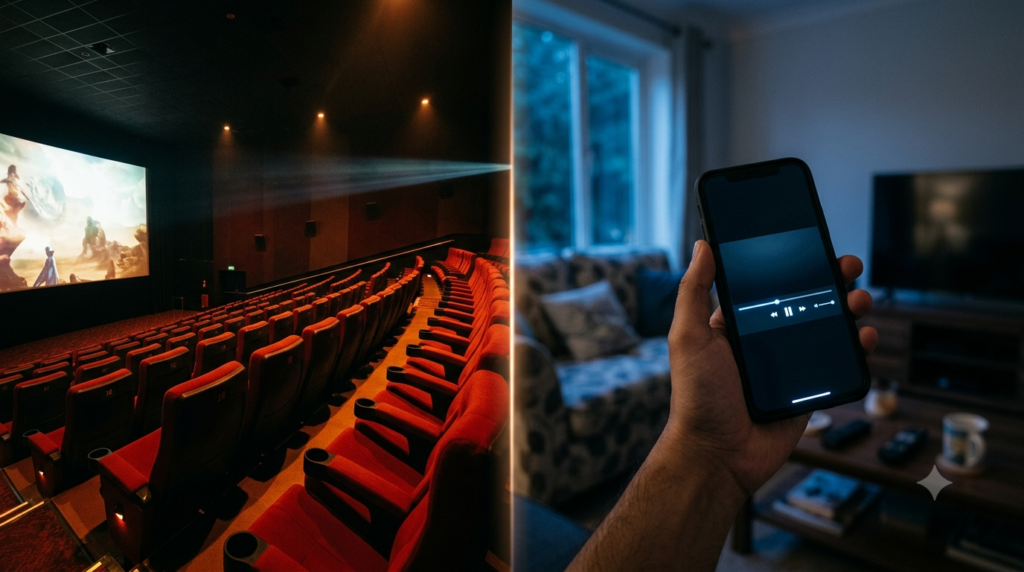
The OTT impact on Indian cinema is the single biggest shift the film business has seen since sound arrived on screen. Streaming did not just add a new place to watch movies. Instead, it rewired how films get made, sold, priced, and judged.

Here is a surprising twist most people miss: cinemas did not die. Theatrical revenue actually rose 16% in 2025, even as streaming exploded around it. So the real story is not death but reinvention, and this guide walks through exactly what changed and why it matters.
The OTT Impact on Indian Cinema at a Glance
- Direct-to-OTT was born in lockdown. When theatres shut in 2020, films like Angrezi Medium and Gulabo Sitabo skipped cinemas entirely.
- The release window collapsed, then rebuilt. The old 8-week cinema-only gap shrank to 4 weeks, and it later returned as an enforced rule.
- Regional cinema went pan-India. Telugu, Tamil, Malayalam, Marathi, and Bengali films found nationwide audiences through subtitles and dubbing.
- Money moved online. Digital rights jumped from roughly 30-40% of a film’s revenue to 50-60% at the peak.
- Paid video subscriptions reached 216 million across 143 million Indian households in 2025, according to the FICCI-EY report.
What Exactly Is the OTT Impact on Indian Cinema?
 Photo by cottonbro studio on Pexels
The OTT impact on Indian cinema describes how over-the-top streaming platforms reshaped every stage of the film journey. This covers production choices, release strategy, revenue splits, and even what kind of stories get greenlit. Because streaming removed the need for a theatrical slot, filmmakers gained a second, sometimes primary, route to their audience.
Over-the-top (OTT) simply means content delivered over the internet, bypassing cable and satellite TV. Netflix, Amazon Prime Video, JioHotstar, ZEE5, SonyLIV, and aha are the major players. Since each one commissions its own films and series, they now behave like studios, not just shop windows.
How the Pandemic Triggered the OTT Impact on Indian Cinema
The turning point came in March 2020. Cinemas closed nationwide, and producers were stuck with finished films and no screens. So several of them took a route that once felt unthinkable. They sold their movies straight to streaming platforms.
Angrezi Medium moved to Disney+ Hotstar within days of its aborted theatrical run. Amitabh Bachchan and Ayushmann Khurrana’s Gulabo Sitabo premiered on Amazon Prime Video. Meanwhile, in the South, Tamil and Telugu films such as Dharala Prabhu and Madha followed the same path. This was survival at first, yet it quickly became strategy.
Audiences, stuck at home, subscribed in huge numbers. As a result, platforms with deep pockets started paying producers handsomely for digital rights. The habit stuck even after theatres reopened, because viewers had discovered how convenient home viewing could be.
The Shrinking Theatrical Window
Before streaming, a movie ran in cinemas for eight weeks or more before reaching any home format. That gap is called the theatrical window. When OTT money poured in, the window shrank fast.
Streamers offered producers more cash to cut the wait from eight weeks to four. Since digital revenue had become so large, many producers agreed. Some struggling films even landed online within three weeks of release. This shift is central to the OTT impact on Indian cinema, and the table below shows how the window moved over time.
| Period | Hindi films | South Indian films |
|---|---|---|
| Before 2020 | ~8 weeks in cinemas | ~8 weeks in cinemas |
| 2020-2021 (pandemic) | Direct-to-OTT or ~4 weeks | Direct-to-OTT or ~4 weeks |
| 2022 onwards | 8-week rule restored | ~4 weeks common |
| 2026 | 8 weeks (MAI-enforced) | 8-week window proposed |
Why the 8-Week Window Came Back
Short windows hurt the box office. When viewers know a film hits OTT in three weeks, many simply wait. So from August 2022, Bollywood producers restored the 8-week gap. Today the Multiplex Association of India enforces it, and national chains refuse to screen films that do not agree to the minimum gap.
The South is now following. In early 2026, South exhibitors and the Telugu Film Chamber moved to mandate an 8-week OTT window, because the earlier 4-week norm was thinning out theatre footfalls. Actor Aamir Khan even turned down a streaming deal reportedly worth around ₹125 crore, since he wanted a longer cinema-only run for his film. Our deeper look at OTT versus theatrical strategy shows how producers now weigh each route film by film.
The OTT Impact on Indian Cinema’s Regional Boom
 Photo by Ron Lach on Pexels
Perhaps no change runs deeper than this one. Before streaming, a Malayalam or Marathi film rarely travelled beyond its home state. OTT platforms broke those walls overnight.
Subtitles and dubbing let a Telugu thriller reach a Hindi-speaking viewer in Delhi and a Tamil drama reach someone in Kolkata. Because platforms wanted content in every language, they invested heavily in regional originals. South Indian cinema, in particular, built a genuine pan-India following through this route.
The recognition followed the reach. Allu Arjun became the first Telugu actor to win the National Award for Best Actor for Pushpa: The Rise, a film now streaming widely. Homegrown platforms like aha, meanwhile, proved that a Telugu-only service could thrive by backing local storytelling, and its rise gave mid-budget Telugu films a reliable digital home.
How the OTT Impact on Indian Cinema Went Global
OTT did not stop at India’s borders. Streaming carried Indian films to viewers across the world, often on the same day as their home release. This global shelf simply did not exist before.
The clearest proof came with RRR. The film found a huge international audience through streaming, and its song “Naatu Naatu” won the Academy Award for Best Original Song in 2023. Suddenly, a Telugu action epic was a global talking point.
Because platforms now market Indian titles worldwide, filmmakers write with a wider audience in mind. This global reach is one of the most lasting parts of the OTT impact on Indian cinema.
A Creative Renaissance: New Stories, New Voices
Streaming did more than shift logistics. It changed what stories were possible. Cinema halls demand a big opening weekend, so studios often played safe with star-driven formulas.
OTT loosened that pressure. Niche, bold, and character-driven films found a home online, because a platform judges success by long-term viewership, not a single Friday.
New writers and directors got their break through web films and series. Women directors especially gained ground, since OTT projects value concept over star power. Experimental Telugu films that theatres would never risk now reach audiences through streaming instead.
The OTT Impact on Indian Cinema: Following the Money
 Photo by Louis on Pexels
Follow the money, and the OTT impact on Indian cinema becomes crystal clear. Digital rights once made up 30-40% of a film’s income. During the streaming surge, that share climbed to 50-60% for many titles.
This new revenue reshaped budgets and risk. A mid-budget film could recover costs through an OTT sale even before release. So producers greenlit projects that theatres alone could never justify.
Numbers from the FICCI-EY report show the scale plainly. Paid video subscriptions reached 216 million in 2025, while digital subscription revenue jumped 60% to ₹16,300 crore. India’s streaming audience touched 601.2 million people, roughly 41% of the population.
The JioHotstar Merger and Consolidation
The market is also consolidating fast. On 14 February 2025, JioCinema and Disney+ Hotstar merged into a single platform called JioHotstar. This flowed from the $8.5 billion joint venture between Reliance and Disney.
The combined service launched with close to 300,000 hours of content and more than 500 million users. Because scale now matters so much, smaller and regional platforms are expected to merge or partner too. So the fragmented field of 50-plus services will likely tighten over the coming years.
Did OTT Kill the Theatre? The Myth vs the Data
Here is where competing articles get it wrong. Many claim streaming is killing cinemas, yet the data tells a different story. The film segment hit a record ₹20,500 crore in 2025, and over 1,900 films released that year. Theatrical revenue actually grew 16%.
What really happened is a split, not a collapse. Big spectacle films, mass entertainers, and star vehicles still pull crowds to theatres, because the large-screen experience cannot be copied at home. Smaller, dialogue-driven, and niche films increasingly find their real audience on OTT. Industry watchers call this the “AND” model, since audiences now embrace cinema and streaming together rather than choosing one.
What Guides Get Wrong About the OTT Impact on Indian Cinema
Most explainers repeat three myths. Correcting them is where the honest information sits.
- “Every film reaches OTT in four weeks.” False for Hindi cinema. The Multiplex Association of India enforces an 8-week window, so major Hindi films stay cinema-only for two months.
- “JioCinema and Disney+ Hotstar are still separate.” They merged into JioHotstar in February 2025, so the two old apps now feed one platform.
- “Streaming means smaller budgets.” Not quite. OTT platforms are trimming volume, not ambition. Content quantity dipped around 7% recently as platforms chose quality tentpoles over sheer output.
One more practical insight rarely gets stated. Genre now decides the route. Thrillers, crime dramas, and urban stories often go digital-first, as our roundup of direct-to-streaming films shows.
Grand mythologicals and hero-driven spectacles, meanwhile, still stay theatrical. A big-canvas film needs the box office to justify its budget, so it earns the eight-week window. So the route a film takes is strategic, not accidental, and reading it correctly tells you a lot about how a producer rates their own project.
The Bottom Line
The OTT impact on Indian cinema is best understood as a rebuild, not a takedown. Streaming widened who gets to tell stories, which languages travel, and how films earn money. At the same time, theatres adapted and held their ground for the films that truly demand a big screen.
For a viewer, this means more choice than ever before. For a filmmaker, it means two doors instead of one. The smart move now is to watch both windows, since the healthiest films in 2026 use cinema and streaming as partners.
Frequently Asked Questions
What is the OTT impact on Indian cinema in simple terms?
It means streaming platforms changed how films are made, released, priced, and watched. Movies now reach viewers online, often within weeks of a cinema run or straight to OTT. This gave filmmakers a second route to their audience and pushed regional films nationwide.
Did OTT platforms hurt the box office?
Not overall. Theatrical revenue rose 16% in 2025, and the film segment hit a record ₹20,500 crore. Big-screen spectacles still draw crowds, while smaller films lean on streaming. The two now work together rather than against each other.
How long before a movie comes on OTT now?
For Hindi films, the standard gap is 8 weeks, enforced by the Multiplex Association of India. Many South Indian films arrived within 4 weeks, though exhibitors proposed an 8-week rule in 2026. Some films still go direct-to-OTT with no theatrical release at all.
Which OTT platforms are biggest in India?
JioHotstar, Netflix, and Amazon Prime Video lead the pack, alongside ZEE5, SonyLIV, and regional players like aha. JioHotstar formed in February 2025 when JioCinema and Disney+ Hotstar merged. India now has more than 50 active streaming services.
How did OTT help regional Indian cinema?
Streaming gave regional films a national and global stage through subtitles and dubbing. A Telugu or Malayalam film could suddenly reach viewers across India. Platforms also funded regional originals, so local storytelling found bigger budgets and wider reach.
What is direct-to-OTT release?
A direct-to-OTT release is a film that premieres on streaming without a cinema run. This began during the 2020 lockdown out of necessity. Today it is a deliberate strategy for certain genres, especially thrillers, dramas, and content-driven stories.
Is theatrical cinema still relevant in the OTT era?
Yes, very much. Large-scale and star-driven films still earn most of their money in cinemas, because the big-screen experience cannot be matched at home. Record theatrical numbers in 2025 confirm that audiences still value the theatre for the right films.
Will the OTT and theatre balance change further?
Likely yes. Expect longer release windows, more platform mergers, and smarter content spending. Connected TVs are also shifting viewing to the living room. The core trend is partnership between cinema and streaming, not a winner-takes-all fight.