Screenplay Beat Sheet: Plot Points and Scene Planning
A screenplay beat sheet turns a film idea into a sequence of meaningful changes before you write full scenes. It shows what the protagonist wants, what blocks that goal, and what each decision causes next. A useful sheet can fit on a page or grow into a working scene plan.
The real test is not whether your story follows a famous template. It is whether one beat makes the next beat necessary. Below, an original short-film example moves from a logline to eleven story turns, then into a playable scene.
Screenplay Beat Sheet at a Glance
- Purpose: Track major events, decisions, reversals and consequences before drafting screenplay pages.
- Typical entry: One or two sentences that describe what changes, not just what happens.
- Scope: A beat may occur within one scene or unfold across several scenes.
- Flexible structure: Use the number and labels that serve your story, not a fixed quota.
- Next step: Expand a crucial beat into a scene with a goal, obstacle, turn and new outcome.
What Is a Screenplay Beat Sheet?
A screenplay beat sheet is a planning document that lists a story’s important dramatic turns in sequence. Each entry identifies a change in action, knowledge, power or emotion. Writers use it to test the plot’s cause and effect before committing to detailed dialogue and screenplay formatting.
Think of it as a map of decisions rather than a diary of every movement. “Zoya checks the projector” reports activity. “When the sound fails, Zoya must risk an improvised screening or cancel the event” creates a dramatic turn. The second version points toward a scene.
The Final Draft explanation of story beats makes a useful distinction: a beat changes the narrative, while a scene can contain several smaller beats. That scale matters because a beat sheet does not need a separate entry for every camera setup or line.
Which Plot Points Belong on the Sheet?
Keep the events that alter the direction of the story. An opening choice may establish a character’s flaw. An unexpected setback may force a new plan. Later, a reversal can make the old plan impossible, while a final action reveals whether the character has changed.
Labels such as inciting incident, midpoint and climax can help a writer diagnose movement. They are not compulsory boxes. A quiet character drama may turn on a withheld invitation, while a thriller may turn on a discovered key. Both stories still need clear consequences.
- Starting condition: What does the lead believe or control?
- Disruption: What happens that the lead cannot ignore?
- Escalation: Which attempt fails, and what does that failure cost?
- Choice: What decision reveals the lead’s priorities?
- Result: What changes in the world or relationship afterward?
Original Screenplay Beat Sheet Example: One Last Screening
This original example imagines a compact drama set inside a community cinema. Its eleven entries are a teaching choice, not a rule, because short films take many shapes. Each entry states an action and the new problem or opportunity it creates.
Logline: When the sound fails before a community cinema’s final screening, a meticulous volunteer must choose between cancelling the event and allowing the audience to perform the film live.
Protagonist: Zoya, a volunteer organiser who believes a good farewell must run perfectly. Opposition: Failed equipment, a closing deadline and her own fear of losing control. Emotional question: Can a flawed event still honour a place that brought people together?
Setup, disruption and apparent defeat
- Order before people. Zoya aligns the seats and straightens handmade programmes. She moves a crooked chair rather than greeting the arriving guests.
- A hard deadline. The hall caretaker, Rafi, reminds her that they must clear the venue after the screening. Zoya has no time for a second attempt.
- The personal stake. Teen filmmaker Manu arrives with friends and his grandmother. Their short film recalls stories she told the neighbourhood children.
- The disruption. Minutes before the doors open, the projector plays pictures without sound. Zoya’s carefully planned evening suddenly has no central event.
- The failed fix. Rafi tests the connection and Zoya tries the backup file. Neither restores sound, so the original screening plan collapses.
- The apparent defeat. Zoya writes a cancellation notice. Manu sees it and admits his grandmother came to hear the children’s version of her story.
The choice, public test and payoff
- An unwanted alternative. Rafi brings a separate portable speaker and Manu produces the dialogue pages. They could speak the lines live, but Zoya calls the idea embarrassing.
- The choice. Manu quietly rehearses the opening line. Zoya hears the effort, folds the cancellation notice and opens the doors.
- A rough beginning. The audience laughs when the speaker squeals and the performers lose their place. Zoya nearly stops the screening again.
- The shared climax. Manu forgets the final line. His grandmother supplies it, and the audience joins the last exchange.
- A changed ending. During the final cleanup, Zoya leaves one crooked chair untouched. She no longer mistakes control for care.
Notice the chain: equipment failure causes cancellation, which reveals the event’s emotional stakes. That disclosure makes a risky alternative worth considering. The final public mistake then becomes the very thing that allows the room to participate.
How the Screenplay Beat Sheet Builds Cause and Effect
A screenplay beat sheet becomes stronger when its middle events do more than fill time. The example would weaken if its middle beats were unrelated errands.
The backup file fails, so cancellation becomes plausible. Manu explains why the evening matters, so Zoya has a reason to reconsider. Rafi’s portable speaker offers a practical option, but Zoya still must choose it.
Here is a useful editing exercise: place the word “therefore” between consecutive beats. If that sounds false, try “but” to reveal opposition. A list that reads only “and then” may contain activity without enough dramatic pressure.
The portable speaker appears before the climax for that reason. It establishes the means of the improvised performance. The grandmother’s earlier presence establishes why her final intervention matters. Both payoffs earn their place through setup.
From One Beat to a Scene: The Decision in the Booth
Beat seven introduces a possible solution, but the more useful scene joins it to beat eight. The dramatic question becomes simple: will Zoya cancel or let Manu try? Its answer must emerge through visible behaviour, not a speech explaining the theme.
Scene objective: Zoya wants to end the evening without public embarrassment. Obstacle: Manu and Rafi show her a workable, uncertain alternative. Turning point: She hears Manu deliver the first line and recognises what cancellation would erase.
The scene in screenplay form
INT. COMMUNITY CINEMA – PROJECTION BOOTH – NIGHT
The film runs silently on a small monitor. ZOYA holds a handwritten notice: SCREENING CANCELLED.
RAFI enters with a portable speaker and a microphone. MANU follows, clutching pages covered in pencil marks.
ZOYA
The sound is gone. We can’t show half a film.
RAFI
This speaker works on its own. We use it for announcements.
He switches it on. A sharp squeal fills the booth. Zoya reaches for the power button.
ZOYA
That’s your solution?
MANU
We know the words. We wrote them.
He unfolds a page. His hands shake, but he raises the microphone.
MANU
“Every street has a story. Some are waiting for us to listen.”
Beyond the glass, his grandmother takes her seat. She smooths a programme across her lap.
Zoya looks at the notice. She folds it once, then again.
ZOYA
Tell everyone it won’t sound like the film.
MANU
They’ll know.
Zoya drops the folded notice into the bin and unlocks the booth door.
ZOYA
Then open the house.
The scene moves from refusal to permission without a long argument. The broken sound remains a real problem, while the working speaker makes a different solution possible. Zoya’s folded notice shows the decision before her final line confirms it.
What Changed Between the Beat and the Scene?
The beat-sheet entry said that Zoya considers an improvised screening. The scene turns that summary into action a viewer can watch. It gives each character a specific tactic: Rafi supplies equipment, Manu demonstrates courage, and Zoya tests the cost of saying no.
Small details now carry weight because viewers can notice them. The speaker’s squeal previews the later embarrassment. Manu’s marked pages make live dialogue possible. His grandmother’s quiet movement supplies the emotional pressure without telling Zoya what to feel.
The moment also has an internal sequence of tiny turns. Zoya rejects the plan; Rafi proves it could work; Manu makes it personal; Zoya changes her mind. These are scene-level beats, but the larger screenplay beat sheet can compress them into one decisive entry.
For the placement of INT., location and time cues, see Movieshala’s screenplay scene headings guide. The Academy Nicholl screenwriting resources also show conventional script presentation while acknowledging that professional formatting can vary.
Screenplay Beat Sheet vs Outline vs Treatment
These terms overlap in real writing rooms, so clarify the expected document before delivering one. A screenplay beat sheet normally highlights dramatic turns. A detailed outline often follows the action scene by scene. A treatment tells the story in flowing prose, including its tone and character journey.
| Document | Main purpose | Level of detail |
|---|---|---|
| Beat sheet | Test turning points and change | Short entries for crucial moments |
| Scene outline | Plan order and scene function | Each scene’s goal, action and outcome |
| Treatment | Convey the full story as prose | Connected narrative, tone and character choices |
| Screenplay | Present the film as playable scenes | Scene headings, action and dialogue |
The Writers’ Guild of Great Britain’s film-writing guide even uses “step outline” and “beat sheet” together for a scene-by-scene breakdown. This illustrates why labels cannot replace a shared brief.
Movieshala’s film treatment writing guide follows the same development path from premise to prose. Use that guide when you need to communicate the complete narrative, rather than inspect the location of each turn.
Story Beats Are Not Dialogue Pauses
The word “beat” causes confusion because screenwriters use it at different scales. On a planning sheet, it describes a shift in the story. Within dialogue, “(beat)” generally asks for a brief pause before the next line or reaction.
Those are not interchangeable instructions. If Zoya hesitates before saying “open the house,” that silence may shape the performance. However, the plot beat is her decision to open the doors. One changes the story’s direction; the other controls how a moment unfolds.
Often, a visible action communicates more than a written pause. Zoya folding the cancellation notice tells us she has reconsidered. Adding “(beat)” to every exchange would slow the read without increasing the dramatic stakes.
Movieshala’s guide to screenplay parentheticals and dialogue pauses explains when such cues help and when action lines work better. Reserve performance cues for moments where the intended meaning might otherwise remain unclear.
How to Write a Screenplay Beat Sheet Step by Step
Start with the conflict, not a list of scenes you hope to include. Then record only the changes that steer the story toward a meaningful choice. You can add scene detail after the structure feels clear.
- Write a logline. Name the lead, an active goal and the pressure opposing it. If the goal is vague, the beats will also drift.
- Define the ending change. Decide what the protagonist does differently at the end. You may discover a better ending later.
- List the unavoidable turns. Write the disruption, major setbacks, critical decision and result in everyday language.
- Add cause and effect. For each entry, ask what newly becomes possible or impossible. Replace repeated information with a choice.
- Mark scene candidates. Note where each turn might happen, who wants what, and what the audience can see or hear.
- Draft one hard scene. Choose a beat where two goals clash. Test whether the conflict creates a playable action.
- Revise the map. If the scene reveals a stronger turn, update the sheet instead of protecting the first outline.
For a simpler start, Movieshala’s screenplay logline guide helps establish the protagonist, goal and conflict. Once those are clear, the plot points become easier to select.
How to Turn Beats Into a Scene Plan
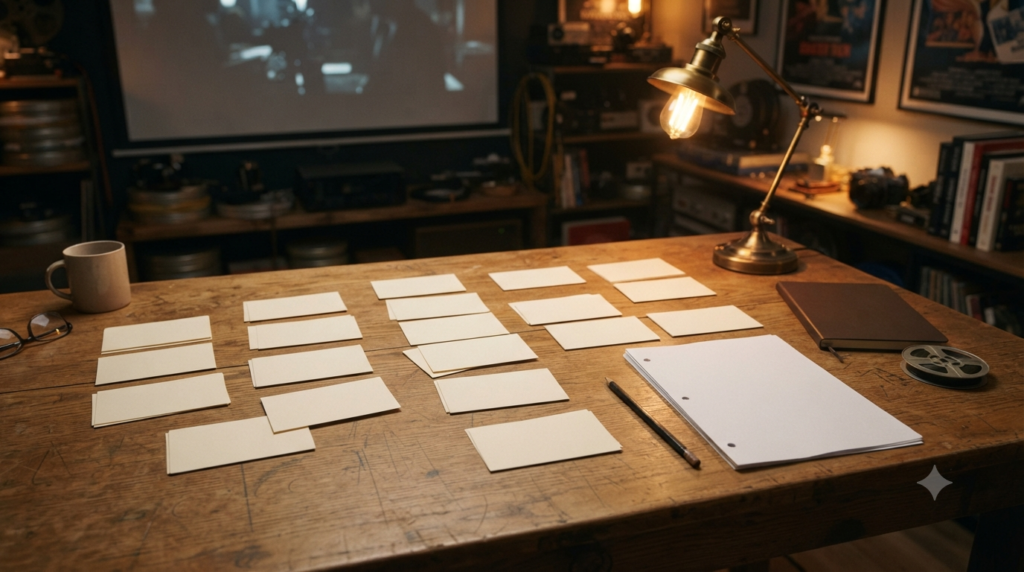
A screenplay beat sheet does not assign every turn its own scene. Not every scene needs a separate major beat. Use scene cards when you must choose the order of locations, character encounters and visible actions. A small scene can prepare a later turn without changing the plot by itself.
For each proposed scene, record five brief answers: where it occurs, who wants something, what resists them, what changes, and why the next scene follows. This makes a scene plan more useful than a list of locations.
In the cinema story, the failed equipment test and cancellation decision could occupy separate scenes or one continuous sequence. The choice depends on pacing. Keep them apart if each introduces new pressure; combine them if the second simply repeats the first.
Final Draft’s outline-to-script guidance describes how writers can move from story planning into scene action and dialogue. Paper cards, a document and dedicated software can all support the same thinking process, so use whatever helps you revise.
Mistakes That Make a Screenplay Beat Sheet Less Useful
A beat sheet loses value when it describes everything except the decisions that matter. The following problems tend to appear before a first draft, which makes them cheaper to fix early.
- Activity without change: “She goes to the booth” states a move. “She finds the backup has failed” changes the available options.
- Reversals without preparation: A solution introduced at the climax feels convenient. Seed its possibility earlier.
- Every beat carries equal weight: Distinguish a small reveal from the choice that defines the ending.
- Page targets become rules: A timing guide can expose a slow middle, but it should not force an artificial twist.
- Explanation replaces action: If a beat depends on what a character privately feels, find a visible decision that reveals it.
- The sheet becomes untouchable: If a drafted scene discovers a better conflict, revisit the plan rather than forcing the old version.
The Final Draft Beat Board discussion treats beats as a way to spot narrative problems and connect scenes. That is more useful than treating one diagram as proof that a script will work.
What If the Beat Sheet Stops Working?
A stuck beat sheet is not proof that the premise has failed. It often means the protagonist has too few meaningful options, or the consequence of a choice remains weak. Diagnose the first broken link instead of adding another surprise near the end.
When the middle repeats the same obstacle, raise the cost of the next attempt. If a twist comes from nowhere, plant information or a relationship earlier. When the ending requires a sudden change of heart, create a prior choice that makes that change believable.
For example, Zoya’s final decision would feel thin if the audience had never met Manu’s grandmother. The solution is not more speeches at the climax. It is an earlier scene showing why the screening matters to them both.
If a key beat will not expand into an active scene, try changing who makes the decision. You may discover that the wrong character owns the story’s central choice.
Before You Start the First Draft
Use your screenplay beat sheet as a working argument about the story, not a contract with yourself. Check that each major turn changes a goal, a relationship, the available information or the cost of action. Then write the scene where the protagonist faces the hardest real choice.
Keep the map nearby as you draft, but allow discoveries on the page to improve it. A strong plan creates room for invention because the writer knows what each moment must accomplish. That is a better test than hitting any prescribed number of beats.
Frequently Asked Questions
How many beats should a screenplay beat sheet have?
There is no universal required count. Some writers use a short list of major turns, while others plan almost every scene. Choose the level of detail that reveals missing causes, weak choices and pacing problems without turning the sheet into a full draft.
Is a beat sheet the same as a screenplay outline?
They can overlap, especially when someone uses “beat sheet” to mean a step outline. Usually, a beat sheet highlights key changes, while a scene outline describes what each scene does. Confirm the expected detail when working with an editor or producer.
What is the difference between a beat sheet and a treatment?
A beat sheet arranges dramatic turns as short entries. A treatment retells the story in connected prose so the reader can sense its characters, movement and tone. It often communicates the complete experience rather than simply testing plot order.
Does every beat need a separate scene?
No. A major turn can take several scenes to build, while one scene can include several smaller shifts. Group or separate scenes according to how conflict and information unfold on screen, not an assumed one-to-one rule.
Should I use a three-act or fifteen-beat structure?
Use either as an optional diagnostic tool if it helps your story. You do not have to force each moment onto a preset page. A contained short film, an ensemble drama and a nonlinear feature may need different planning shapes.
Can I change the beat sheet after drafting scenes?
Yes. A draft often exposes stronger character motives or a more natural order of events. Update the sheet when those discoveries improve cause and effect, then check what earlier setup or later payoff also needs revision.
Does “(beat)” in dialogue mean a plot beat?
No. In dialogue, “(beat)” usually signals a short pause. A plot beat marks a change in narrative direction. Use action instead of an added pause when a gesture, discovery or choice already makes the silence clear.
Can a screenplay beat sheet work for a short film?
Yes. Short films benefit from knowing what changes and why, even if they contain only a handful of major turns. The example above uses eleven entries for teaching, not because a short film must have that many.