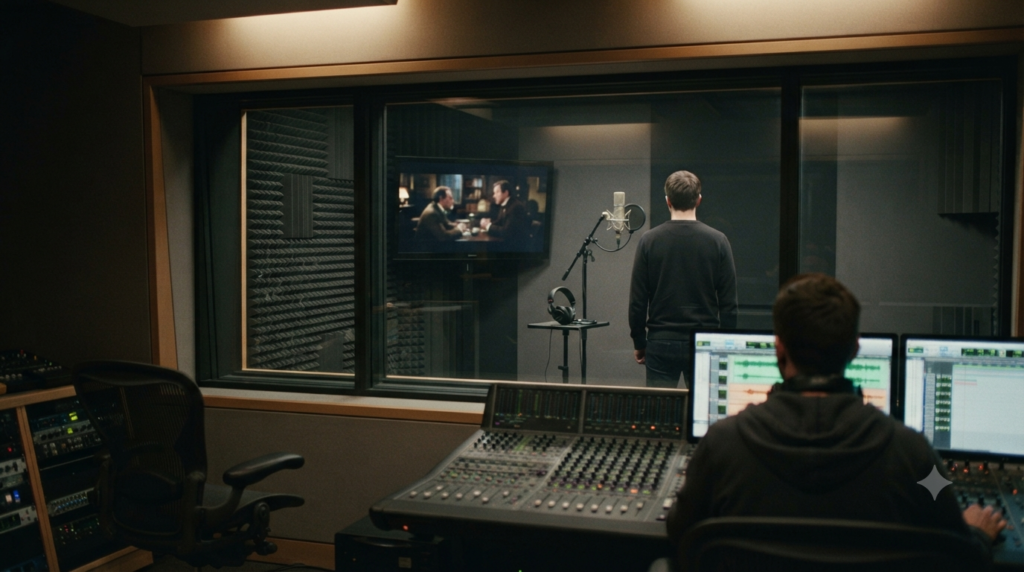
Automated Dialogue Replacement (ADR): Why Films Re-Record Dialogue
Automated dialogue replacement (ADR) is why a film character can sound clear even when the original recording was ruined by noise. After filming, a performer records the line again while watching the edited scene. The challenge is not just clean speech: the new voice must belong to the face, mood and place on screen.
Film fans often call this process dubbing, especially in Indian cinema. The terms overlap, but they do not always describe the same job. Here is how ADR works, why filmmakers use it and what makes a replacement line believable.
Automated Dialogue Replacement at a Glance
- Meaning: Re-recording dialogue after filming and syncing it to the on-screen performance.
- Common reasons: Traffic, wind, poor microphone coverage, unclear words or a planned line change.
- Core challenge: Matching timing, mouth movements, emotion and the room’s sound.
- People involved: Performers, dialogue editors, ADR recordists and directors or dialogue supervisors.
- Not the same as: Foley footsteps, general sound effects or narration that does not replace visible speech.
What Is Automated Dialogue Replacement in Film?
Automated dialogue replacement is a sound post-production process in which a performer records spoken lines again to fit an existing picture. The new recording replaces or supplements dialogue from the shoot. Editors match the voice to the actor’s visible speech and blend it with the scene’s remaining sound.
The word automated can mislead beginners. The actor still delivers each line, and sound professionals still judge the result. Technology helps cue, record and align performances; it does not simply generate a convincing replacement by itself.
ADR is also called looping or post-sync in some workplaces. ScreenSkills, the UK screen-industry skills body, describes the ADR editor’s job as recording additional lines after filming. It also explains why repeating a short scene helps performers match the picture. See its ADR editor career guide.
Why Do Filmmakers Use Automated Dialogue Replacement?
Filmmakers use ADR when the original line cannot serve the finished scene or when the story needs different words. A strong acting take may contain a passing vehicle or a sudden gust. Repeating the whole visual performance would be costly or impossible, so replacing its sound can save the shot.
Noise and microphone problems
Wind, traffic, aircraft and nearby machinery can cover speech during filming. A microphone may also sit too far from an actor, especially in a wide shot. When careful sound editing cannot restore clarity, a fresh voice recording becomes a practical option.
Noise does not always mean ADR is necessary. The dialogue editor may find a clean line in another take or repair the existing recording. Replacement becomes more useful when those less intrusive options fail.
Story changes and performance choices
A director may need a clearer phrase after editing reveals that a scene lacks context. An actor may also need to correct a word, change emphasis or complete a missing off-screen line. Yet changing the words under a close-up creates a harder sync problem because viewers can see the mouth.
iZotope’s film ADR explainer discusses both technical repairs and creative line changes. The important distinction is that ADR solves a specific picture-and-sound problem, rather than serving as an automatic improvement to every performance.
How Does Automated Dialogue Replacement Match the Picture?
Automated dialogue replacement matches the picture through repeated viewing, performance cues and detailed sound editing. The performer studies the visible line, including where it starts and ends. After several takes, an editor selects and adjusts a recording so the speech feels connected to the on-screen action.
- Spot the problem. The dialogue team marks a line that needs replacement and notes its timecode, wording and performance details.
- Prepare a picture cue. A short clip shows the actor’s mouth and movement. The original location recording may play as a guide.
- Give the performer a start signal. A studio may use countdown beeps, visual streamers or another cue, depending on its setup.
- Record several versions. The actor watches the image, repeats the line and adjusts pauses, stress, breath and energy.
- Choose and edit the take. The editor can trim, position or subtly retime the voice while protecting its natural sound.
- Blend it into the scene. The sound team matches tone, distance and background ambience before the final mix.
Avid describes cue sheets and picture overlays in its ADR cueing workflow. That workflow explains the term cue: a marked moment when the performer should speak. A cue is not a promise that one take will fit without further editing.
What Makes Automated Dialogue Replacement Sound Natural?
Good ADR must solve two problems at once: visual timing and believable sound. A sentence may start on the correct frame yet still feel false if its emotion or room tone changes. The listener should hear one continuous character performance, not a switch between two recording spaces.
Lip-sync and speech rhythm
The editor watches clear mouth shapes, especially visible openings and closures, but matches the whole phrase rather than each sound mechanically. A convincing take keeps natural pauses and emphasis. Slight timing adjustments may help, although drastic stretching can make speech sound artificial.
Shots with the actor facing away can offer more freedom because the mouth remains hidden. Close-ups are less forgiving. Even when the spoken words stay identical, the performer must follow the speed and shape of the original delivery.
Emotion, breath and physical effort
A calm studio voice will not fit a character who is sprinting or crying on screen. Actors may need to reproduce breath, strain or a hurried interruption. The director and recordist listen for intent as well as pronunciation.
One useful way to judge a take is to stop looking at the waveform. Watch the scene and ask whether the voice sounds like the same person in the same moment. That question catches problems which precise timing alone can miss.
Why Does Studio Dialogue Sometimes Sound Fake?
Studio dialogue can sound fake because the booth is quieter and drier than the location in the picture. The words may be clear, yet they seem too close to the listener or detached from the room. Poor timing, changed acting energy and an abrupt noise floor make the mismatch easier to notice.
Sound editors often use equalisation, or EQ, to shape the voice’s tone. They may add a suitable room response, adjust levels and restore background sound. However, those tools cannot fully rescue a delivery that feels wrong for the image.
Consider an illustrative scene: two people speak in a large, empty hall. The new line should not sound like a whispered podcast recording beside the viewer’s ear. Its distance, echo and level must support what the camera shows. This is a general example, not a claim about any particular film.
Automated Dialogue Replacement vs Dubbing, Voiceover and Foley
ADR, dubbing, voiceover and Foley all belong to audio work, but their purposes differ. ADR normally replaces dialogue to match an existing on-screen performance. Dubbing can replace a voice or language track. Voiceover speaks over images without necessarily matching visible lips, while Foley recreates physical action sounds.
| Technique | Main job | Must match visible lips? |
|---|---|---|
| ADR | Replace or add dialogue after filming | Usually, when the face is visible |
| Dubbing | Replace voices; often another language | Often, for lip-synced versions |
| Voiceover | Narrate or speak over visuals | Not normally |
| Foley | Create footsteps, cloth and prop sounds | No; it matches physical action |
Is ADR the same as dubbing in Indian cinema?
Not exactly. In Telugu and other Indian film industries, people may use dubbing for recording dialogue after a shoot, including the actor’s own voice. In international distribution, dubbing often means creating a different-language dialogue version. Both may rely on lip-sync, but the production purpose can differ.
Calling every voice session ADR hides an important detail. A performer replacing their own unusable location line and a language artist translating an entire role face different acting and writing demands. The label depends partly on local industry usage, so context matters.
How is voiceover different from ADR?
A voiceover may explain a story, guide a documentary or express thoughts while other images play. It usually does not try to replace the sound of a clearly visible mouth. ADR, by contrast, must commonly preserve the illusion that the speech happened during the filmed action.
How is Foley different from ADR?
Foley artists perform non-verbal sounds, such as footsteps, clothing movement and object handling. ADR performers deliver spoken words. Both techniques can repair a scene after the original sound disappears, but they create different parts of the soundtrack.
For a closer look at performed sound, read Movieshala’s guide to Foley sound in movies. It explains why even a simple footstep needs careful timing.
Where Does Automated Dialogue Replacement Fit in Post-Production?
Automated dialogue replacement fits between dialogue assessment and the final sound mix, often alongside other sound-editing tasks. Picture editors first establish the scene’s structure. Dialogue editors then identify problem lines, while ADR teams plan and record replacements. The re-recording mixer later balances the voices with effects and music.
The process works best with a stable picture edit because a new cut can change a line’s timing. Still, films do not all follow one fixed calendar. A late edit may force the team to revisit completed cues.
The production sound mixer and boom operator capture the voices on set. Post-production specialists take over if a line needs repair or replacement. For the wider division of work, Movieshala’s film crew roles guide covers the sound department and other teams.
Common Mistakes About Automated Dialogue Replacement
- “Automated means an algorithm speaks for the actor.” No. The classic ADR workflow relies on human performance, with software helping sync and edit it.
- “A clean take is always better than production sound.” Not necessarily. Original dialogue often carries useful emotion, physical energy and natural room sound.
- “Lip-sync is only about matching the first word.” No. Pauses, mouth shapes, breath and phrase endings can all expose a mismatch.
- “Dubbing always means translation.” No. In many Indian film conversations, dubbing can also describe same-language dialogue recording.
- “Foley can fix missing spoken lines.” No. Foley rebuilds action noises, not dialogue.
A good sound team begins by asking whether a line truly needs replacement. Then it preserves whatever works in the production recording. That decision can save work and retain the original performance’s character.
Can You Try Automated Dialogue Replacement at Home?
You can try automated dialogue replacement with a short clip, a microphone, headphones and any editor that displays audio beside video. Use footage you have permission to edit. The exercise will teach timing and performance, although a quiet bedroom will not match every film location.
- Choose a short spoken line from your own footage, then mute its dialogue track.
- Watch the actor’s mouth and note the line’s start, end and important pauses.
- Record several versions while watching the picture and listening to a guide track if useful.
- Align the best take, then compare its pace and expression with the original.
- Add suitable room tone and adjust its level so the new voice belongs in the scene.
If the result fails, test the performance before reaching for audio effects. A better re-take may solve a rhythm problem more cleanly than heavy time stretching. Avid’s audio-to-video sync overview shows why precise placement matters even in larger professional workflows.
What to Listen for in a Finished Film
Listen when a shot cuts from a close-up to a wider angle. Does the voice suddenly change tone or distance? Notice whether a rushed character sounds physically active, and whether an indoor line carries the space around it.
These clues do not prove a film used ADR. A change might come from microphone selection, mixing or another sound decision. The point is to hear how dialogue, picture and surrounding sound work together.
The Bottom Line
Automated dialogue replacement gives filmmakers a way to rescue or reshape spoken lines after the cameras stop. Its success depends on more than recording a clean voice. Timing, acting, space and the final mix must all support the same scene.
When you hear the word dubbing, check whether the speaker means same-language repair, another performer or language localisation. That small distinction makes film sound credits much easier to understand.
Frequently Asked Questions About Film ADR
What does ADR stand for in movies?
ADR commonly stands for automated dialogue replacement. The term describes recording dialogue after filming to match a completed or partly edited scene. Some professionals also use the names automatic dialogue replacement, additional dialogue recording or looping.
Why do actors re-record dialogue after shooting?
Actors may re-record lines because traffic, wind or poor microphone placement made the original hard to hear. A director might also change a line for story clarity. The new version must suit the original performance on screen.
Does automated dialogue replacement use AI?
Not by definition. Traditional ADR uses a performer speaking into a microphone while watching the picture. Software can assist with cueing and alignment, but the word automated does not mean the voice comes from artificial intelligence.
Do actors always do their own ADR?
No. Actors often return to record their own lines, but another authorised performer may supply a replacement voice. Dubbing artists also record versions for other languages. The choice depends on the production and the intended performance.
What is an ADR cue?
An ADR cue is a marked passage of dialogue that needs recording or attention. It can include the line, timecode and performance notes. Visual prompts or audio beeps help a performer begin at the right moment.
Is all movie dialogue recorded again?
No. Productions can retain usable location dialogue and replace only selected lines. Some filmmaking workflows rely more heavily on post-recorded voices, but there is no universal rule that every scene needs ADR.
Can ADR change dialogue without reshooting?
Yes, within visual limits. Rewording a line works more easily when the speaker’s mouth is hidden or the new phrase matches the existing mouth movement. A visible close-up makes major changes harder to hide.
What is the difference between ADR and Foley?
ADR creates replacement spoken dialogue, while Foley creates movement and object sounds. A line of speech and the footsteps beneath it might both need fresh recordings. They still require different performers and editing choices.