Film Montage Meaning: Time Compression and Shot Juxtaposition
Film montage meaning becomes clear when a film skips weeks of work in a few striking shots. A runner ties worn shoes, trains in rain, fails a race and finally crosses a finish line. We understand the journey without watching every morning of practice. Yet montage can do more than shorten time: it can make two images change how we read each other.
Film Montage Meaning: A Clear Definition
Film montage is the arrangement of selected shots to compress events, build an idea or create an emotional effect through their relationship. Instead of showing every action continuously, an editor places images in a meaningful order. The audience then connects the gaps, contrasts and repeated details to understand a passage of time or a new point of view.
In everyday film talk, montage often means a brief sequence showing progress across days or years. In film theory, the term also refers to the meaning that arises when images meet. Both uses matter because shot selection and shot order shape the audience’s response.
The Academy of Motion Picture Arts and Sciences’ editing guide describes both traditions. It discusses montage as a way to combine images for an emotional or intellectual response and as a way to compress a series of events.
Film Montage Meaning at a Glance
- Time: A short passage on screen can stand for days, months or years.
- Juxtaposition: Images gain added meaning from the shots beside them.
- Rhythm: Shot length and repetition can make the sequence feel urgent, calm or reflective.
- Story: Viewers infer change from a carefully chosen set of visual clues.
- Sound: Music, dialogue or silence may help, but none defines montage on its own.
A montage need not use frantic cuts or loud music. A quiet series of long views can still create meaning through contrast. The defining choice is what the editor asks us to connect.
How Montage Compresses Story Time
Time compression means showing the important changes while leaving out the hours between them. A character might study, make mistakes, improve and receive a result. Each image supplies a milestone, so the audience understands a longer process without seeing its routine.
Film editors also use simple omissions in ordinary scenes. A person closes their front door; the next shot shows them at work. That is a time skip, but it does not automatically make a montage. Montage usually builds a sequence of selected moments that work together as a larger impression.
This distinction helps when identifying film montage meaning in an exam answer or scene analysis. Ask whether several images jointly present growth, decline, travel, memory or a theme. If the edit merely removes an uneventful bus ride, calling it elliptical editing may be more precise. That distinction is central to film montage meaning.
Film Montage Meaning in a Fictional Training Sequence
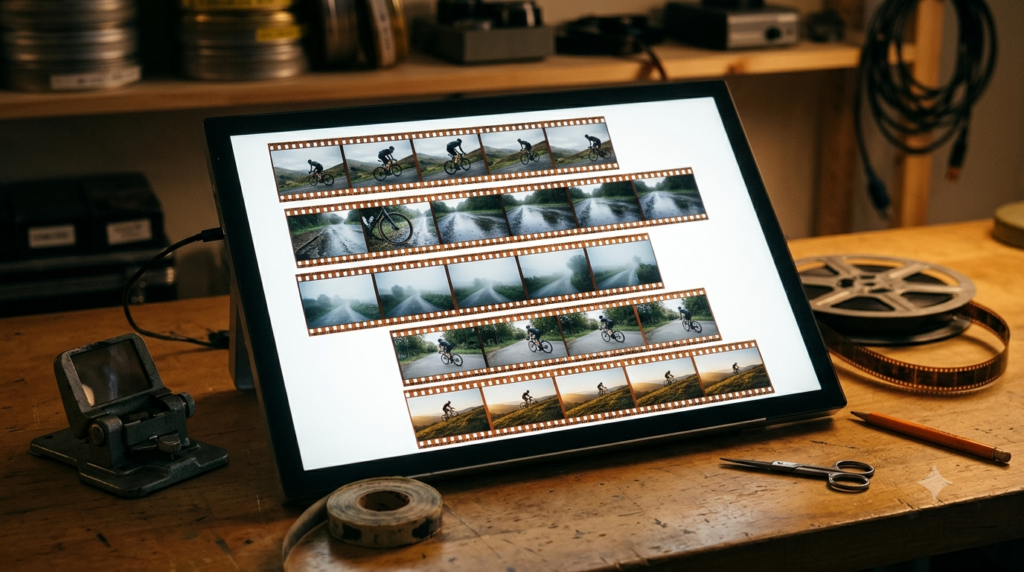
Imagine a short film about Meera, a cyclist preparing for a hill climb. The editor needs to show her progress without filming every practice ride. The following entirely fictional montage offers a clear example of time compression and visual storytelling.
| Shot | What appears | What viewers infer |
|---|---|---|
| 1 | Meera struggles up a steep lane. | The goal is difficult. |
| 2 | A tyre spins beside a rain-soaked curb. | Training continues in poor weather. |
| 3 | She marks another route on a worn map. | She keeps practising and planning. |
| 4 | The same lane appears in bright morning light. | Time has passed. |
| 5 | Meera rides the climb without stopping. | Her effort has produced progress. |
No shot states how many days passed, so the scene should not pretend to establish an exact duration. Instead, changes in weather, repetition and ability give the audience a sense of sustained work. The final shot matters because the earlier struggle gives it context.
Now remove the first shot. The final ride might look ordinary rather than hard-won. Film montage meaning depends on those relationships, not simply on having several clips in a row.
Film Montage Meaning Through Shot Juxtaposition
Juxtaposition means placing images next to each other so viewers compare them. Two shots can suggest a judgement that neither makes alone. For example, an empty lunch tin followed by a lavish banquet may invite a contrast about unequal access to food.
Change the second shot to an overflowing rubbish bin, and the idea shifts toward waste. Nothing inside the first frame has changed. The new relationship changes its meaning, which is why editing is more than shortening footage.
The Adobe introduction to video editing discusses the Kuleshov effect, a classic demonstration associated with filmmaker Lev Kuleshov. In that account, viewers interpreted a repeated face differently when editors paired it with different images. The principle remains useful even though a modern montage need not copy that experiment.
A fictional juxtaposition test
Picture an invented drama in which a school caretaker shuts an empty classroom at dusk. Cut next to a freshly painted playground, and the pairing may suggest investment or hope. Cut instead to a locked gate and a broken swing, and the same first shot may now feel like abandonment.
Neither reading is guaranteed because context matters. Earlier dialogue, performance and sound may point viewers another way. The useful test is to change only one shot and notice how the implied idea changes. This is the interpretive side of film montage meaning.
Film Montage Meaning Versus Continuity Editing
Montage and continuity editing answer different storytelling needs. Continuity editing usually helps viewers track one action through changing camera views. Montage may skip the action between shots or invite viewers to compare images from different moments and places.
| Feature | Montage | Continuity editing |
|---|---|---|
| Main aim | Condense a process or create a relationship. | Keep action and space clear. |
| Time | Often leaps across gaps. | Usually feels like ongoing action. |
| Shot connection | Contrast, repetition or progress. | Matching movement, direction and eyelines. |
| Viewer’s task | Infer what images add together. | Follow who does what and where. |
Consider Meera again. A close-up of her hand gripping a brake, followed by another angle completing that movement, may use continuity editing. A cut from her first failed climb to many later training moments instead creates a montage.
These approaches are not enemies. A film can use a smooth action match inside a montage, then return to a normal conversation scene. For a deeper look at matching action and screen space, see Movieshala’s continuity editing guide.
Montage Is Not a Sound Bridge
A sound bridge connects images by allowing audio to carry across a cut. A J-cut brings in the next shot’s sound before its image arrives. An L-cut keeps the previous shot’s sound after the picture changes. These terms describe audio timing, while montage describes how a sequence of shots creates meaning.
Imagine the cyclist montage under one steady drum rhythm. The music links the images, but the montage exists because the shot sequence traces effort and progress. Remove the music, and the pictures can still tell that story.
Alternatively, hear a train whistle over a kitchen scene before the picture cuts to a station. That can be a J-cut without being a montage. Sound overlaps and montage structures can coexist, but neither requires the other.
Adobe’s guide to J-cuts and L-cuts explains how sound and picture can change at different moments. Movieshala also has a separate J-cut and L-cut explanation with fictional sound-bridge examples.
Film Montage Meaning: Modern and Soviet Uses
When viewers say ‘montage’, they often picture a character learning a skill, a couple growing close or a city changing over time. This modern shorthand tends to compress events into a clear arc. However, montage has a wider history as a way to provoke thought through the collision of images.
In the 1920s, Soviet filmmakers and theorists including Sergei Eisenstein and Lev Kuleshov explored how shot order affects interpretation. The Academy’s teaching guide distinguishes that approach from the later everyday use of montage for time compression. The British Film Institute’s account of silent cinema also places Soviet montage within a period of rapid experiments in film cutting.
Do not treat Soviet montage as another name for a sports training sequence. A training scene can rely on progress, while a collision of contrasting images may make a political, emotional or abstract point. Both rely on editing relationships, but their aims differ. Any account of film montage meaning should keep those two uses distinct.
Three More Fictional Film Montage Examples
A friendship that fades
Two friends share tea at the same bus stop. In later shots, one sits alone, a second cup remains untouched, and a wall poster peels away. The repeated location anchors the sequence while small changes imply growing distance.
This example does not need a calendar or spoken explanation. Yet a different ending could change the entire reading. If the absent friend arrives with a suitcase, the sequence might suggest separation caused by travel rather than a broken friendship.
A neighbourhood rebuilding after a storm
Rainwater covers a lane, a hand lifts a fallen sign, neighbours sweep mud and a shop opens its shutters. Each image jumps ahead in the work. Together, the shots turn many separate efforts into a sense of shared recovery.
Now place the open shop before the muddy lane. The altered order might suggest a flashback or a setback rather than steady progress. That is another way film montage meaning emerges from sequence design.
A student facing exam pressure
A pen scratches across notes, an alarm glows in the dark, an untouched meal grows cold and a student stares at a closed textbook. The cuts can show repeated late nights. They may also suggest exhaustion if the editor lingers on the final image.
Music is optional because the chosen details already create a mood. A gentle track might soften the scene, while silence could make the final pause feel harsher. The soundtrack changes emphasis, not the basic visual logic. That contrast makes film montage meaning easier to recognise.
How to Recognise Film Montage Meaning in Any Scene
Start by noting what changes across the images rather than naming every camera angle. Does the sequence move through different days, repeat a location or compare unlike subjects? Then ask what would disappear if the editor removed one key shot.
- Identify the span. Decide whether the images suggest one continuous event or several separated moments.
- Track repeated details. Look for a place, object, gesture or frame that returns in changed form.
- Describe the contrast. State what the viewer compares: success and failure, wealth and need, hope and loss.
- Listen separately. Check whether music or a sound bridge shapes the mood without confusing it with the montage itself.
- Name the result. Explain the change or idea the full sequence communicates.
A useful analysis sentence names the evidence before the interpretation. For example: ‘Repeated shots of the same hill, paired with easier climbs, suggest weeks of practice.’ That is stronger than simply writing, ‘The director uses montage to show time.’
How to Build a Montage from Your Own Footage
Begin with a single purpose, such as showing a character’s improvement or contrasting two settings. A montage with no clear change can feel like unrelated highlights. Work backwards from the final idea so each shot earns its place.
- Write the change in one sentence. For instance: ‘A hesitant cyclist becomes confident on a hard route.’
- Pick the beginning and end. Choose two images that make the transformation easy to see.
- Gather middle evidence. Film attempts, obstacles, repeated actions and visible changes instead of filler angles.
- Arrange a silent version. Test whether viewers understand the progression before adding music.
- Adjust rhythm. Hold an image when it needs thought; shorten a shot when its idea is clear.
- Check the transitions. Keep accidental jumps from causing confusion unless a disorienting effect serves the story.
- Test another order. Swap two shots and see whether the meaning improves or becomes unclear.
The Australian Centre for the Moving Image’s editing resource stresses that shot length and sound choices change a finished film’s feel. Use those controls deliberately, rather than placing every clip on the same beat.
If you are planning a shoot, prepare a short shot list before recording. Movieshala’s storyboard and shot-planning guide helps turn the intended sequence into specific camera views.
Film Montage Meaning: Common Mistakes
Fast cutting is not the definition. A rapid action scene can maintain a continuous fight or chase, while a slow montage can move across years. The purpose and relationship of the images matter more than their speed.
Music does not create the montage by itself. A song over random images may make a pleasing reel, but it does not necessarily express a story idea. If the sequence becomes meaningless when muted, revisit the visual choices.
Every time skip is not a montage. One cut from a bedroom to an office may simply omit travel. Several linked moments showing a career develop are a clearer montage example.
Shot order is not neutral. Putting the apparent success before the struggle could suggest memory, defeat or irony. An editor should test these possibilities because viewers interpret the whole sequence, not isolated images.
The Bottom Line
Film montage meaning rests on a simple idea: chosen images create more together than they show apart. Some montages compress time, while others invite emotional or intellectual comparisons. To recognise one, describe the shots, identify their gaps or contrasts and explain the effect of their order.
For a practical test, storyboard five fictional images and try two different arrangements. If the audience reads a different story, you have seen the power of montage in action.
Frequently Asked Questions About Film Montage Meaning
What is montage in film in simple words?
Montage is a sequence of shots arranged to show change or create an idea. Often, it compresses a long process into a short scene. The meaning comes from how those shots relate to each other.
What is a simple example of film montage?
A fictional student studies, struggles with practice tests, revises their notes and finally finishes an exam. Those short images suggest a longer period of work. The audience fills in the routine between the selected moments.
Why do filmmakers use montage?
Filmmakers use montage to save screen time, suggest development or link ideas. It can also create rhythm and strong emotional contrasts. The right choice depends on what viewers should learn or feel from the sequence.
Is montage the same as continuity editing?
No. Continuity editing usually preserves understandable movement and screen space across related views. Montage often connects separated events or contrasting images. A film can use both techniques, even within the same broad sequence.
Does a montage always need music?
No. Music can establish rhythm or mood, but visuals alone can create a montage. Ambient sound, dialogue or silence may work better when the images need room to breathe.
Is a J-cut or L-cut a montage technique?
A J-cut or L-cut controls when audio changes relative to a picture cut. Editors may use either one inside a montage. However, a split edit is not automatically a montage because it describes a different aspect of editing.
What is the difference between a montage and a time lapse?
A time lapse usually records change through images captured at intervals and played as accelerated motion. A montage arranges separate selected shots, often from different camera views or moments. Both can suggest passing time, but they achieve that effect differently.
What does juxtaposition mean in film editing?
Juxtaposition places shots near each other so viewers notice a link or contrast. For instance, an empty table beside a lavish meal may suggest inequality. The interpretation also depends on the surrounding story.
Does montage have to show events in chronological order?
No. A montage may jump between memories, parallel ideas or imagined outcomes. Chronological progress is common in training montages, but thematic or emotional connections can be more important than sequence order.