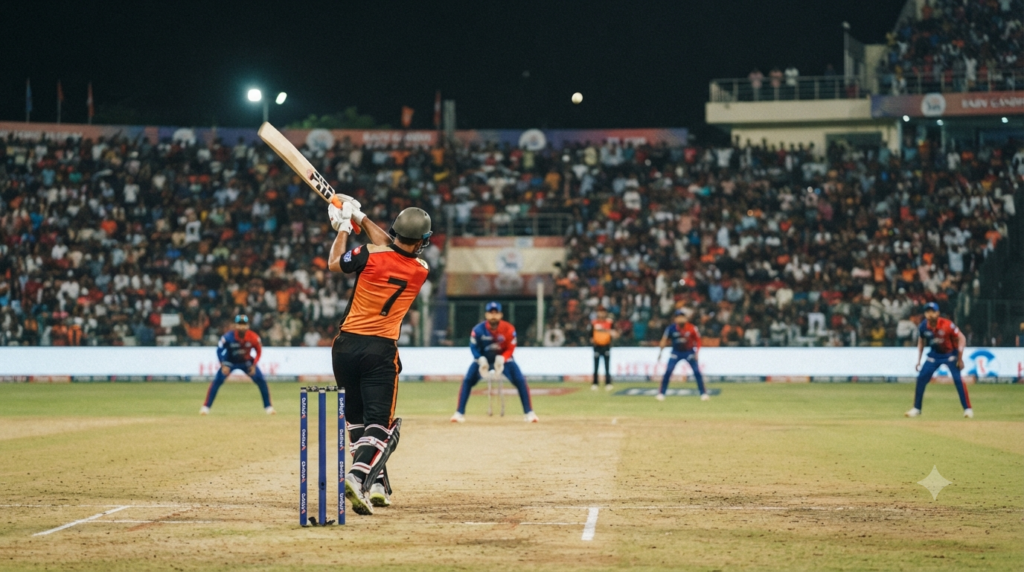
Abhishek Sharma 135*: Why DC Captaincy Was Questioned
Abhishek Sharma produced one of the defining innings of IPL 2026 when his unbeaten 135 powered Sunrisers Hyderabad to a 47-run win over Delhi Capitals on 21 April in Hyderabad. The score was spectacular, but the match became just as notable for Delhi captain Axar Patel’s bowling choices and the way a sensible match-up idea turned into a tactical problem.
The refreshed account matters because the original report mixed the confirmed scorecard with speculation that did not hold up. SRH were actually completing a third straight win, Abhishek was already the stand-in vice-captain before this game, and later claims that he became the ICC Men’s Player of the Month for April were incorrect. The official IPL record, post-match reaction and subsequent season results now give a much clearer picture.
Abhishek Sharma 135*: Match at a Glance
Abhishek Sharma scored 135 not out from 68 balls as SRH reached 242 for 2 in 20 overs. Delhi Capitals replied with 195 for 9, so SRH won by 47 runs. Abhishek struck 10 fours and 10 sixes, while the official IPL match report named him Player of the Match.
- Match: Sunrisers Hyderabad vs Delhi Capitals, IPL 2026 Match 31
- Date: 21 April 2026
- Venue: Rajiv Gandhi International Cricket Stadium, Hyderabad
- SRH: 242/2 in 20 overs
- DC: 195/9 in 20 overs
- Result: SRH won by 47 runs
- Player of the Match: Abhishek Sharma, 135* from 68 balls
| Key number | What happened | Why it mattered |
|---|---|---|
| 135* | Abhishek Sharma’s score | He batted through the innings |
| 10 fours, 10 sixes | 20 boundaries | DC never found a sustained control phase |
| 242/2 | SRH total | Delhi needed 243 to win |
| 0/55 | Nitish Rana in four overs | The part-time spin plan backfired |
| 2 overs each | Axar Patel and Kuldeep Yadav | Delhi’s frontline spinners were underused |
The official IPL match report confirms the result, the major batting scores and the 47-run margin. It also records that Delhi captain Axar Patel won the toss and chose to bowl first.
What Abhishek Sharma Changed in His Innings
Abhishek Sharma did not abandon the aggressive style that made him dangerous. Instead, he stretched it across a full innings. That distinction matters because his 135* was not a brief powerplay burst; he stayed unbeaten while SRH built three different partnerships around him.
Travis Head made 37 from 26 balls, and the opening pair added 97 before Head fell. Ishan Kishan then made 25 from 13, while Heinrich Klaasen finished with 37 not out from 13. Because Abhishek remained at the crease, SRH could keep attacking without needing a late rebuild.
The innings also showed control beyond the headline sixes. He reached his hundred in 47 balls, yet still had enough time to push SRH beyond 240. His final strike rate was 198.53, which meant he nearly doubled the run rate of a run-a-ball innings while batting through all 20 overs.
Why DC Captaincy Came Under Fire
Axar Patel’s captaincy drew criticism mainly because Delhi gave part-time off-spinner Nitish Rana a full four-over spell while Axar and Kuldeep Yadav bowled only two overs each. Rana conceded 55 runs without a wicket. Critics therefore questioned whether Delhi stayed with the match-up plan for too long after it stopped working.
The Nitish Rana gamble made sense on paper
The idea was not random. SRH’s top order had several left-handed batters, including Abhishek Sharma, Travis Head and Ishan Kishan. Off-spin turning away from a left-hander can be a useful match-up, so using Rana early had a clear tactical basis.
The problem came after SRH showed they were comfortable against him. Rana completed all four overs for 55 runs, while Axar finished with 1 for 23 from two overs. Kuldeep Yadav bowled two overs for 30. Once the part-time option became expensive, continuing with it invited scrutiny because Delhi still had specialist overs available.
Why Axar Patel and Kuldeep Yadav became the bigger question
Former players focused less on the first Rana over and more on the distribution of the remaining overs. Axar and Kuldeep are frontline international spinners, yet they combined for only four overs. Meanwhile, Abhishek Sharma was already set and controlling the pace of the innings.
That is why the captaincy debate was more specific than a generic complaint about “bad leadership”. The core issue was resource use. Delhi had specialist spin available, but the captain persisted with a part-time option even after the match-up stopped producing control.
Abhishek Sharma and the Chances Delhi Missed
Abhishek Sharma also benefited from chances that Delhi failed to convert. After the match, Axar Patel pointed to a missed run-out opportunity and a dropped catch as moments that could have changed the innings. His defence was straightforward: when a batter is striking cleanly, fielding chances become even more important.
That context matters because captaincy is only one layer of the result. A different bowling rotation does not guarantee a wicket, while a completed run-out or catch ends the innings immediately. Delhi’s fielding therefore weakened the margin for tactical error.
Abhishek still had to punish those mistakes, and he did. He hit pace and spin, kept the strike moving, and then accelerated with Klaasen at the end. The innings was strong enough that Delhi’s tactical errors and Abhishek Sharma’s batting excellence can both be true at the same time.
Was the Loss Really Only About Captaincy?
No. The bowling plan deserved examination, but Delhi also missed chances and then faced a target of 243. In the chase, several batters started well, yet SRH kept taking wickets when the asking rate rose.
Nitish Rana responded with 57 from 30 balls, KL Rahul scored 37 from 23, Sameer Rizvi made 41 from 28, and Tristan Stubbs added 27 from 16. Those contributions gave Delhi periods of momentum, but the chase never became stable enough to threaten the target late.
Eshan Malinga took 4 for 32, while Harsh Dubey added three wickets. As a result, Delhi finished at 195 for 9. The captaincy debate should therefore stay tied to the bowling allocation rather than become a claim that one decision alone caused a 47-run defeat.
What the Original Report Got Wrong
The old version contained several lines that looked current in April but were either inaccurate or unsupported. A refresh should remove those claims instead of preserving them for freshness.
- SRH were not bouncing back from recent defeats. The official IPL report says this was their third consecutive victory.
- Abhishek Sharma had already been made vice-captain. SRH announced on 18 March that Ishan Kishan would lead while Pat Cummins recovered, with Abhishek as deputy.
- The April ICC Player of the Month claim was wrong. Bangladesh fast bowler Nahid Rana won the ICC Men’s award for April 2026.
- No verified leadership overhaul followed at Delhi. Axar Patel was still captaining DC in their final league match on 24 May.
- Claims that several DC players had complained about the captain were unsupported. They should not be presented as fact without named, reliable sourcing.
The ICC’s April award announcement confirms Nahid Rana as the men’s winner. That correction is especially important because the old “Latest Update” section gave Abhishek Sharma an honour he did not receive.
What Happened After the Abhishek Sharma Century?
The rest of the season gives the match a clearer place in the IPL 2026 story. Delhi Capitals recovered enough to win their final three games, but they finished sixth with 14 points and missed the playoffs. Axar Patel remained captain for their last league match, a 40-run win over Kolkata Knight Riders.
Sunrisers Hyderabad went further. They reached the Eliminator, where Rajasthan Royals beat them by 47 runs. In that knockout, Abhishek Sharma was dismissed for a duck, while Pat Cummins had returned to captain SRH.
Those later results also show why the April speculation about immediate captaincy changes was overdone. Delhi did not replace Axar during the season, and SRH’s temporary leadership structure changed when Cummins returned. The match was significant, but it did not trigger the dramatic leadership reshuffle the original report predicted.
For more cricket-related coverage on Movieshala, read the site’s report on the Virat Kohli and Anushka Sharma airport story, which also separates verified reporting from social-media speculation.
For season context, the official DC season-ending match report records Delhi’s sixth-place finish. The official IPL Eliminator report confirms SRH’s exit against Rajasthan.
Why Abhishek Sharma 135* Still Stands Out
Abhishek Sharma’s 135* was the fifth-highest individual score in IPL history at the time of the match. It was also his second entry in the league’s top five, after the 141 he made against Punjab Kings in 2025. That combination underlined how quickly he had become one of the competition’s most destructive openers.
More importantly, this innings added a different dimension to his reputation. He did not merely win the powerplay and disappear. He managed tempo, stayed through the innings, and then allowed Klaasen to attack freely at the other end.
That is the strongest cricketing takeaway from the game. The DC tactical debate was real, but Abhishek Sharma created the conditions that made every bowling choice look worse. When a batter is already dominating both pace and spin, even a reasonable match-up can become a liability within a few overs.
Key Takeaways
- Abhishek Sharma made 135* from 68 balls with 10 fours and 10 sixes.
- SRH scored 242/2 and beat Delhi Capitals by 47 runs.
- DC captain Axar Patel and Kuldeep Yadav bowled only two overs each.
- Nitish Rana bowled four overs for 55 runs without taking a wicket.
- The Rana plan had match-up logic, but Delhi stayed with it after it became expensive.
- Delhi also missed fielding chances, so the defeat cannot fairly be reduced to captaincy alone.
- The old claim that Abhishek Sharma won the ICC Men’s Player of the Month award for April 2026 was false.
- DC later finished sixth, while SRH reached the Eliminator.
Frequently Asked Questions
How many runs did Abhishek Sharma score against Delhi Capitals?
Abhishek Sharma scored 135 not out from 68 balls. He hit 10 fours and 10 sixes, while SRH finished on 242 for 2. The innings earned him the Player of the Match award.
Who was Delhi Capitals captain in the SRH match?
Axar Patel captained Delhi Capitals in the 21 April 2026 match. He won the toss and chose to bowl first, but SRH reached 242 for 2 before Delhi fell 47 runs short.
Why was Axar Patel’s captaincy questioned?
The main criticism concerned bowling allocation. Axar and Kuldeep Yadav bowled only two overs each, while part-time off-spinner Nitish Rana completed four overs and conceded 55 runs without a wicket.
Why did Nitish Rana bowl four overs?
Delhi used Rana’s off-spin as a match-up against SRH’s left-handed top order. The theory was understandable, but Abhishek Sharma and the other batters handled the plan well, so persisting with Rana became the key tactical criticism.
Did Delhi Capitals have chances to dismiss Abhishek Sharma?
Yes. Axar Patel said after the match that Delhi missed a run-out opportunity and a catch. Those errors mattered because Abhishek Sharma stayed unbeaten and carried the innings through to 20 overs.
Did Abhishek Sharma win the ICC Player of the Month award for April 2026?
No. The ICC named Bangladesh fast bowler Nahid Rana as the Men’s Player of the Month for April 2026. The earlier Movieshala claim that Abhishek Sharma won that award was incorrect and has been removed in this refresh.
Was Abhishek Sharma SRH vice-captain in IPL 2026?
Yes. SRH named Abhishek Sharma vice-captain when Ishan Kishan became stand-in captain during Pat Cummins’ injury absence. That announcement came on 18 March 2026, before the Delhi Capitals match.
What happened to Delhi Capitals after this loss?
Delhi recovered late in the season and won their final three matches. However, they finished sixth with 14 points and missed the IPL 2026 playoffs, with Axar Patel still serving as captain in their final league game.
How far did Sunrisers Hyderabad go in IPL 2026?
SRH reached the Eliminator. Rajasthan Royals then beat them by 47 runs, ending their season before Qualifier 2. Pat Cummins had returned to lead SRH by that knockout match.