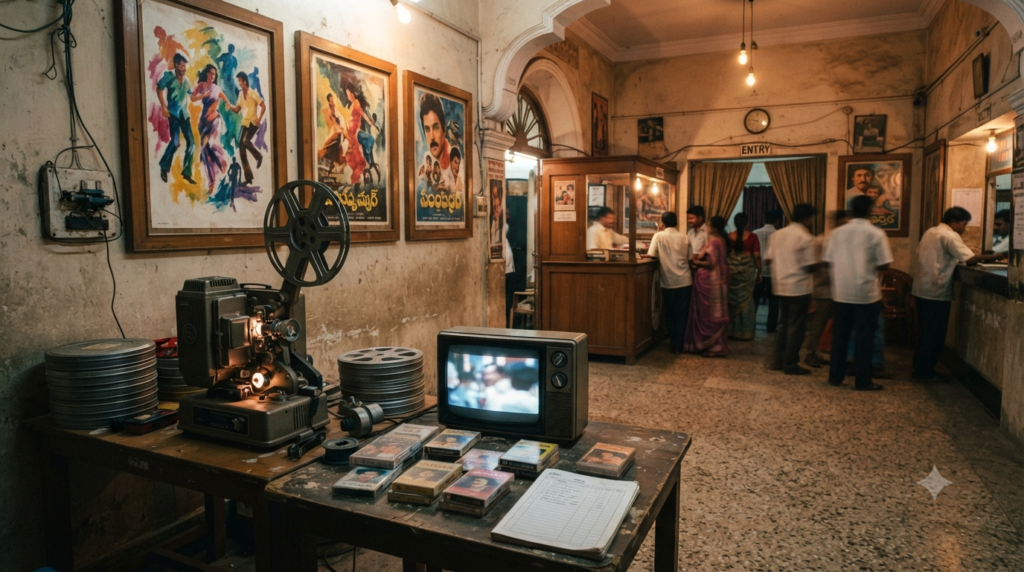
90s Telugu Movies: 10 Classics That Defined a Generation
90s Telugu movies did more than entertain a generation; they widened what mainstream Telugu cinema could look and feel like. The decade moved easily between fantasy, science fiction, road thrillers, family romance, devotional drama and large-scale mass action. That range is why the 1990s still feel unusually rich when Telugu film fans look back.

This is not a box-office ranking, and it is not a claim that only ten films mattered. Instead, the list picks ten titles that represent major shifts in genre, stardom, storytelling, music, visual ambition or audience taste. Official film-award archives, government film records and production-house material were used to verify the historical details where available.
90s Telugu movies at a glance
The strongest way to understand the decade is to see how many different kinds of films could become cultural touchstones. Some pushed technology, while others changed the grammar of romance or mass cinema. Together, these 90s Telugu movies show how the decade bridged the star-driven 1980s and the more polished 2000s.
| Film | Year | Director | Why it matters |
|---|---|---|---|
| Jagadeka Veerudu Athiloka Sundari | 1990 | K. Raghavendra Rao | Fantasy spectacle with enduring family appeal |
| Aditya 369 | 1991 | Singeetam Srinivasa Rao | Mainstream science-fiction and time travel |
| Kshana Kshanam | 1991 | Ram Gopal Varma | Road-thriller energy and grounded crime storytelling |
| Gang Leader | 1991 | Vijaya Bapineedu | Urban mass-star image and working-class anger |
| Gharana Mogudu | 1992 | K. Raghavendra Rao | Industrial setting, class conflict and star vehicle scale |
| Ammoru | 1995 | Kodi Ramakrishna | Devotional horror and effects-led spectacle |
| Ninne Pelladatha | 1996 | Krishna Vamsi | Modern romance inside a family-drama framework |
| Annamayya | 1997 | K. Raghavendra Rao | Devotional musical storytelling for a mass audience |
| Tholi Prema | 1998 | A. Karunakaran | Youth romance built on friendship and restraint |
| Samarasimha Reddy | 1999 | B. Gopal | Faction-drama template that shaped the next decade |
How we chose these 90s Telugu movies
A film made the list when it represented more than one successful Friday. The key test was influence. Did the film open a genre, sharpen a star image or change mainstream storytelling?
Did later films keep referring back to it? Awards were useful evidence, but they were not the only measure because cultural impact is wider than trophies.
That approach also avoids a common nostalgia trap. Commercial hits and award winners often belong to different conversations, yet both can define a generation. That is why 90s Telugu movies could place fantasy, devotion, romance and mass action inside the same mainstream space.
90s Telugu movies that expanded genre boundaries
The early 1990s were especially adventurous, and 90s Telugu movies often used stars to sell unusual ideas. Filmmakers did not abandon star cinema, but they stretched its limits. Fantasy, science fiction and road-thriller storytelling all found mainstream form before digital filmmaking made such experiments easier.
1. Jagadeka Veerudu Athiloka Sundari (1990)
Vyjayanthi Movies produced Jagadeka Veerudu Athiloka Sundari, while K. Raghavendra Rao directed it. Chiranjeevi and Sridevi lead a fantasy romance about a celestial visitor entering an ordinary human world. The film mixed comedy, songs, adventure and mythology without treating any one element as a side dish.
Its real importance is tonal. Telugu fantasy had long roots, yet this film made the form feel glossy, contemporary and star-driven for a new audience. Vyjayanthi Movies later restored and re-released the film. That revival shows why it still works as a shared nostalgia object, not a forgotten period hit.
2. Aditya 369 (1991)
Aditya 369 remains one of the decade’s clearest examples of mainstream Telugu cinema taking science fiction seriously. Singeetam Srinivasa Rao built the story around a time machine. He then moved the characters between the present, the Vijayanagara period and a future world. That structure was ambitious even before visual effects became routine.
Sridevi Movies’ official 2025 re-release campaign again credited Nandamuri Balakrishna, Mohini, director Singeetam Srinivasa Rao and composer Ilaiyaraaja. The renewed theatrical push matters because it confirms the film’s continuing life across generations. For many viewers, it is still the first Telugu title that comes to mind when the subject is science fiction.
3. Kshana Kshanam (1991)
Ram Gopal Varma followed the raw force of Siva with something more playful and mobile. Kshana Kshanam sends Venkatesh and Sridevi through a crime chase that keeps changing location, tone and pace. It feels part road movie, part caper and part romance, yet the characters stay grounded.
The film mattered because it reduced the distance between “commercial” cinema and genre filmmaking. Songs and humour remained, but they grew out of movement and character rather than stopping the story. Ramanaidu Film School’s profile of Venkatesh includes Kshana Kshanam among the significant films that followed his rise. That fits its long-term place in his 1990s screen identity.
How 90s Telugu movies reshaped mass stardom
Not every defining film needed a new genre. Some 90s Telugu movies changed the size, rhythm or social texture of the star vehicle itself. This is where 90s Telugu movies began laying down the commercial grammar that the 2000s would later amplify.
4. Gang Leader (1991)
Gang Leader sharpened Chiranjeevi’s image as an urban mass hero. He could carry anger, dance, comedy and action in the same performance. Vijaya Bapineedu’s film places family loss and working-class frustration inside a broad entertainer. So its emotional engine stays simple even when the staging turns loud.
What lasted was the combination of attitude and accessibility. The hero could be larger than life without being distant from ordinary viewers. That balance became central to Telugu star cinema. Later mass films kept returning to it because the hero felt aspirational while his grievance stayed recognisable.
5. Gharana Mogudu (1992)
K. Raghavendra Rao’s Gharana Mogudu pushed the star vehicle into an industrial workplace and turned class conflict into commercial entertainment. Chiranjeevi’s character stands opposite a wealthy factory owner. That setup lets the film combine labour identity, romance, comedy and confrontation inside a familiar masala frame.
The interesting part is not simply that the film was popular. It showed how a mainstream hero could embody economic resentment without becoming a political essay. The songs, fights and comedy kept the film broad, while the workplace gave that entertainment a specific social texture. That mixture would recur across later Telugu commercial cinema.
6. Samarasimha Reddy (1999)
By the end of the decade, the mass film moved from the city and factory toward Rayalaseema faction country. B. Gopal’s Samarasimha Reddy, starring Nandamuri Balakrishna, turned revenge, family honour and regional conflict into a large-scale star drama. Its imagery and confrontations were built for collective theatre response.
The film’s larger legacy is the template it helped consolidate. Early-2000s Telugu cinema would repeatedly use faction backdrops, powerful family histories and hero-elevation scenes. Movieshala’s own history of Telugu mass cinema traces how that grammar became a major commercial force after the decade ended.
How 90s Telugu movies changed romance and devotion
It would be a mistake to remember 90s Telugu movies only through male-star action films. The same decade produced devotional spectacles, family romances and youth love stories with very different emotional rhythms. That breadth is a major reason the era still feels alive in reruns, re-releases and family conversations.
7. Ammoru (1995)
Kodi Ramakrishna’s Ammoru brought devotional belief, horror and visual-effects spectacle into one intense mainstream package. Soundarya anchors the human side of the story, while Ramya Krishna’s goddess figure gives the film its mythic scale. The result is neither a conventional devotional film nor a standard horror movie.
That hybrid form was influential because it proved effects-heavy supernatural storytelling could work with local religious imagery and melodrama. Later fantasy and devotional films pushed technology much further. Still, Ammoru made miraculous events feel natural inside mainstream cinematic spectacle.
8. Ninne Pelladatha (1996)
Krishna Vamsi’s Ninne Pelladatha modernised the family romance without rejecting the family. Nagarjuna and Tabu play lovers whose relationship grows inside a warm social world. So the conflict hurts more when older family divisions return. The film feels youthful, but it never treats elders as background furniture.
The Government of India’s National Film Awards archive named Ninne Pelladatha the Best Feature Film in Telugu for 1996. Its citation praised the innovative handling of a contemporary family drama. That description gets to the film’s lasting appeal. It made romance feel current while keeping the scale of a traditional Telugu family entertainer.
9. Annamayya (1997)
Annamayya demonstrated that devotional cinema could still become a major shared cultural event in the 1990s. K. Raghavendra Rao directed Nagarjuna as the poet-saint Annamacharya, while M.M. Keeravani’s music carried the devotional experience far beyond the theatre.
The National Film Awards catalogue records the film as a 1997 Telugu feature starring Nagarjuna, Ramya Krishna, Suman and Bhanupriya. More important than the credits is the film’s position in the decade. It brought classical devotional material into a polished mainstream form.
Many viewers knew Annamacharya mainly through songs and temple culture. So the movie turned that tradition into an accessible screen narrative.
10. Tholi Prema (1998)
A. Karunakaran’s Tholi Prema shifted romantic drama toward youth culture, friendship and emotional hesitation. Pawan Kalyan and Keerthi Reddy lead a story that does not need family conflict in every scene. Much of its charm comes from what the characters do not immediately say.
The official 46th National Film Awards catalogue named Tholi Prema the Best Feature Film in Telugu for 1998. Andhra Pradesh’s Nandi Awards record also lists it as the year’s first best feature film. Those honours matter because the film was not merely a fan favourite. Its quieter romantic grammar earned formal recognition at both national and state level.
What 90s Telugu movies changed for the 2000s
The decade did not hand the next generation one formula. It handed them several. Science fiction could be sold through a star, while romance could feel modern without abandoning family. Devotional cinema used spectacle, and mass action built stories around regional identity.
That variety helps explain the 2000s. Films such as Okkadu, Pokiri and Magadheera did not appear in a vacuum. They inherited the 1990s habit of combining star power with a sharper genre hook.
Movieshala’s Telugu storytelling evolution begins in 2000. Yet many later shifts make more sense because 90s Telugu movies served as the testing ground.
There was also an industrial change happening underneath the films. Hyderabad had become the centre of Telugu production by the early 1990s. Our history of Telugu cinema covers that transition in detail. The new production base gave the industry room to grow in scale while its stars, directors and technicians built a more recognisable Telugu screen identity.
90s Telugu movies that narrowly missed this list
Any ten-film list will create arguments, and that is part of the fun. Bobbili Raja, Chanti, Hello Brother, Pelli Sandadi, Preminchukundam Raa, Raja and several Rajendra Prasad comedies could all support their own case. So could more serious films that won state or national recognition.
The goal here is representation rather than total coverage. These ten films map the decade’s range: fantasy, science fiction, crime, mass action, devotional storytelling, family romance and youth romance. If the list makes you argue for an eleventh title, it has probably done its job.
Before you revisit these classics
Availability changes across streaming platforms, television channels and official YouTube libraries, so this article does not freeze any “where to watch” claim that may become stale. Check the current rights-holder or platform listing before subscribing or paying. For historical credits and award records, the Directorate of Film Festivals’ National Film Awards archive and the Andhra Pradesh State Film, Television and Theatre Development Corporation are useful primary references.
The bigger point is simple: 90s Telugu movies were never one style of Telugu cinema. They were a decade of competing styles that all found audiences. That is why revisiting these films feels less like opening a nostalgia box and more like watching the foundations of modern Tollywood being laid in real time.
Frequently Asked Questions
Which 90s Telugu movies are essential for a first-time viewer?
Start with Jagadeka Veerudu Athiloka Sundari, Aditya 369, Kshana Kshanam, Ninne Pelladatha and Tholi Prema. Together they cover fantasy, science fiction, thriller, family romance and youth romance, so they show the decade’s range quickly.
Why is Aditya 369 still discussed so often?
Aditya 369 remains notable because it treated time travel as a mainstream Telugu-film idea in 1991. It also combined science fiction with historical fantasy and commercial entertainment, which made the concept easy for a broad audience to enter.
Did 90s Telugu movies focus only on mass heroes?
No. Mass-star cinema was powerful, but the decade also produced major romances, devotional films, comedies, thrillers and experimental genre hybrids. Ammoru, Ninne Pelladatha, Annamayya and Tholi Prema show how wide the mainstream really was.
Which 1990s Telugu film won a National Film Award for Best Feature Film in Telugu?
Several films from the decade received that honour. In this list, Ninne Pelladatha won for 1996 and Tholi Prema won for 1998, according to the Government of India’s National Film Awards catalogues.
Which film best represents 1990s Telugu science fiction?
Aditya 369 is the clearest starting point. Its time-machine plot moves across different eras while keeping songs, humour and star appeal, so it shows how Telugu cinema made a specialised genre feel mainstream.
Why is Samarasimha Reddy important to Telugu mass cinema?
Samarasimha Reddy helped consolidate the faction-drama style that became highly visible in the early 2000s. Its regional setting, family honour, revenge structure and hero-elevation scenes became familiar ingredients in later commercial action films.
Are these the ten best Telugu films of the 1990s?
No. This is a curated list of films that represent major shifts in popular Telugu cinema, not a definitive quality ranking. A different list could reasonably include more comedies, art films, women-led dramas or additional commercial blockbusters from the same decade.