Foley Sound in Movies: Footsteps, Clothing and Prop Sounds Explained
Foley sound in movies is the art of performing everyday noises again after filming, in time with the action on screen. A character walks across a room, pulls on a jacket or puts down a cup. Those small sounds may come from a performer in a recording studio, not the location where the camera rolled.
The distinction matters because Foley is neither dialogue dubbing nor a catch-all name for movie sound effects. It gives a scene physical detail, while other sound teams handle voices, background environments and larger designed effects.
Foley Sound at a Glance
- What it is: Custom, performed sound recorded in sync with the picture during post-production.
- Three core areas: Footsteps, clothing movement and handled objects or props.
- Who makes it: A Foley artist performs the noises while a recordist or Foley mixer captures them.
- What it is not: Actors re-recording dialogue, background music or every effect in the soundtrack.
- Why it helps: Foley restores lost detail and lets filmmakers adjust the weight, pace and texture of movement.
What Is Foley Sound in Movies?
Foley sound in movies means recording everyday physical actions to match an edited film scene. Foley artists perform footsteps, fabric movement and prop handling while watching the picture. Editors then place those recordings beside dialogue, other effects and music. The goal is not to draw attention to the trick but to make the scene feel complete.
The craft takes its name from Jack Foley, an early sound-film practitioner. The Australian Centre for the Moving Image (ACMI) explains how the practice grew from live sound-effects work into film post-production.
Importantly, Foley does not always replace a bad recording. Sometimes the original step or clink sounds fine, but a new performance makes it clearer or more consistent between cuts. In other cases, the editing team has removed noisy location audio, so the small actions need fresh sound.
The Three Everyday Sounds Foley Artists Recreate
Most Foley work falls into three practical groups: feet, cloth and props. That breakdown makes recording and mixing easier because each kind of motion needs different timing and texture.
Footsteps: Shoes, Surfaces and Character
Footsteps must follow the character’s gait, not merely arrive at regular intervals. A hesitant walk has a different rhythm from a hurried exit, even when both take place on the same floor.
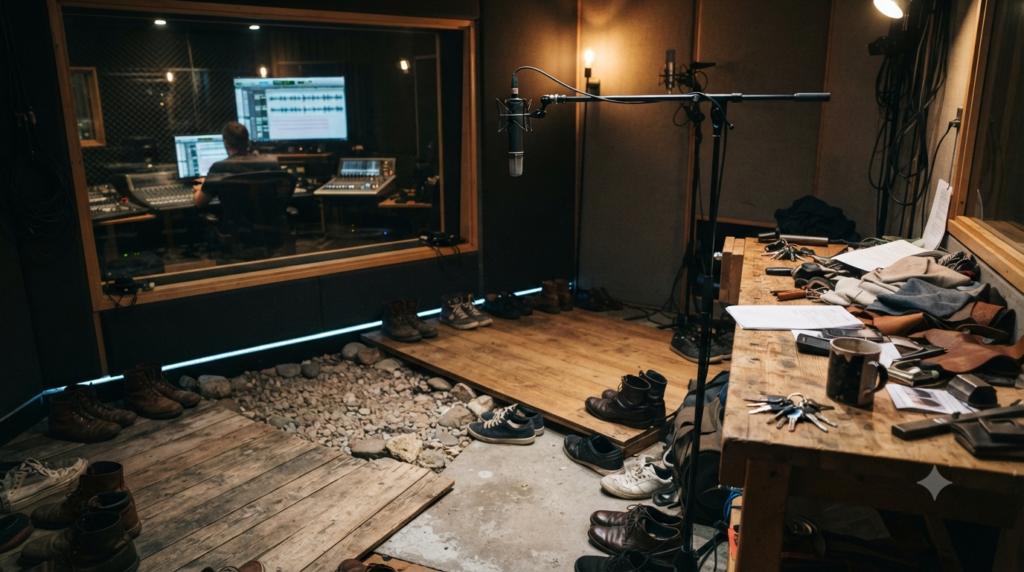
Artists choose shoes and walking surfaces to match the scene. For example, they may use wood, loose gravel or tile-like materials on a Foley stage. They also change pressure and pace because a heavy heel strike sounds different from a careful shuffle.
Good footsteps carry story information without dialogue. A character stopping outside a door can feel tense if the final step is sharp and the following silence remains intact. That is why Foley sound in movies can reveal character without another line of dialogue.
Clothing: The Rustle We Barely Notice
Clothing Foley covers sleeves brushing, a coat folding and fabric shifting as someone sits or turns. These noises are often quiet, yet their absence can make a close scene feel strangely empty.
A performer works with suitable fabric while watching the actor’s movement. The aim is not continuous loud rustling. Instead, cloth should respond to each action and sit gently under the spoken words.
Cloth tracks can also help restore texture when editors replace dialogue or remove noise. However, too much fabric movement can distract from a soft performance.
Props: Objects That Actors Touch
Prop Foley includes a key turning, paper sliding, a glass touching a table or a bag opening. Each sound should reflect how the object moves, not simply what the object is.
A lightly placed cup needs a small contact sound, while an angry drop calls for a harder impact. The Foley artist may test several materials because a real item does not always record with the clearest screen-ready sound. Foley sound in movies is about the result, not the prop inventory.
These are illustrative actions, not claims about how a particular released film created its soundtrack. The useful principle is simple: match the audible gesture to the visible one.
How Is Foley Sound in Movies Recorded?
Foley sound in movies usually starts after editors have a stable picture sequence. The team identifies movements that need sound, prepares footwear and objects, then performs each action while watching the scene. A recordist captures the takes, and an editor checks their timing. Finally, the re-recording mixer balances Foley with the full soundtrack.
- Spot the scene. Watch for visible steps, clothes and objects. Note which actions already sound convincing and which feel missing.
- Choose materials. Gather shoes, floor surfaces, fabrics and props that give the right sound rather than only the right appearance.
- Perform to picture. Watch the character and copy the rhythm. Several attempts may be needed when the movement changes speed.
- Record clean layers. Capture feet, cloth and key props separately when useful. That gives the sound team control over their levels.
- Edit and mix. Align impacts, remove unwanted noise and blend the recordings with dialogue, ambience, effects and score.
The University of Southern California’s Foley guide describes the stage, viewing screen, props and separate control room used for this process. A home setup can be smaller, but the basic idea stays the same.
Picture changes create extra work because footsteps must still land against the right action. Therefore, sound teams benefit from a stable edit and a clear list of changes. In practice, Foley sound in movies follows the cut, rather than driving the edit.
Foley vs ADR, Sound Effects and Production Sound
These terms overlap in a finished scene, but they describe different jobs. Foley is a performed branch of sound effects, whereas ADR concerns spoken lines. Production sound comes from the shoot, and ambience gives the location its wider acoustic setting.
| Sound element | What it covers | Typical method |
|---|---|---|
| Foley | Steps, fabric and physical prop actions | Performed to picture after filming |
| ADR | Replacement spoken dialogue | Voice recorded to match a scene |
| Hard or designed effects | Vehicles, impacts, machines or stylised sounds | Field recordings, libraries, synthesis or layering |
| Ambience | Room tone, street beds, wind or distant activity | Location recordings or sound libraries |
| Production sound | Audio captured during the shoot | On-set microphones and recorders |
This is a workflow guide, not an unbreakable rule about who records a noise. A door slam might come from Foley, a sound library or the original set recording. The deciding factor is how the team makes and uses it. Foley sound in movies is a method of performance, not a list of objects.
Foley Is Not ADR or Dialogue Dubbing
ADR stands for automated dialogue replacement, a common term for recording replacement lines after the shoot. An actor or voice performer matches the speech to the on-screen performance. Foley, by contrast, rebuilds non-verbal physical sounds around that speech.
In Telugu cinema, people also use the word dubbing for voice recording. However, dubbing can mean replacing a performer’s voice or producing another language version. Neither process turns speech into Foley.
When editors replace a noisy dialogue take, they may also lose footsteps or clothing sounds recorded underneath it. Foley restores those details without forcing the original noise back into the scene.
Foley Is Not Every Sound Effect
A passing aircraft, a distant storm and a long industrial rumble usually belong to wider effects or ambience work. Sound designers may combine recordings, processing and created elements for those sounds.
Foley focuses on particular actions that someone performs in time with the image. However, boundaries can overlap, especially with body impacts, doors and unusual props. Judge the technique, not just the object making the noise.
Curtin University’s film-school Foley explainer makes a similar distinction between performed actions and broader effects. It also explains how Foley can smooth gaps after dialogue replacement.
Why Foley Sound in Movies Makes Scenes Feel Real
Foley sound in movies creates a close link between what the viewer sees and what the viewer hears. A hand can seem weightless when it picks up a metal object without a sound. A measured click, however, gives that movement contact, material and intention. Small details help the audience believe in the space.
Sound also shapes attention. A key turning in an otherwise quiet room can direct the viewer toward a threat, while loud footsteps can make an ordinary entrance feel urgent.
Yet realism does not mean adding a noise to every visible action. A film may deliberately suppress footsteps to draw attention to dialogue or music. Effective Foley respects that choice instead of filling every silence.
Where Foley Fits in the Movie Crew
Foley artists usually work during sound post-production, not as the crew recording dialogue on set. A Foley mixer or recordist captures their performances, and a Foley editor may refine the tracks. The supervising sound editor and re-recording mixer help shape how everything fits together.
Film credits differ by production, so one person can handle several tasks on a smaller project. Meanwhile, large productions may separate these jobs across specialist teams. That is why Foley artist, sound designer and sound mixer should not be treated as identical titles.
For the broader team structure, read Movieshala’s guide to film crew roles. The site’s Telugu film production workflow also shows where editing, dubbing and sound finishing fit.
Another useful perspective appears in Movieshala’s coverage of women technicians in South Indian cinema, including editing and sound careers. These connected roles help explain why a polished soundtrack reflects more than one sound credit.
Can Foley Sound in Movies Replace Original Audio?
Yes. Foley sound in movies can replace an unusable footstep, cloth movement or prop sound from a production take. It can also reinforce an existing sound when the original lacks detail. However, Foley does not automatically replace the entire on-set recording, and it cannot substitute for a spoken performance.
A sound editor may keep the original glass clink but add a gentle close-recorded contact beneath it. Elsewhere, the team may remove the on-set footsteps entirely because traffic noise masks them.
The choice depends on the cut, the desired sound and how much clean production audio survives. There is no rule that every film scene needs a complete fresh Foley track.
Try a Simple Foley Exercise at Home
You do not need a professional stage to understand the craft. Make a short silent clip of someone walking to a table, unfolding paper and placing a cup down. Then recreate the sounds separately with a phone or basic recorder.
- Record the image first. Keep the camera steady and capture the actions clearly. Avoid identifiable music playing in the room.
- Play it without audio. Mark the shoe contacts, paper movement and cup landing. Note the speed of each action.
- Record three passes. Walk on a suitable surface, handle a sheet of paper, then place a similar cup on a table.
- Sync the tracks. Match each noise to the visible action, then trim late or early sounds. Listen through headphones at a comfortable volume.
- Compare versions. Watch the clip with no Foley, excessive Foley and carefully balanced Foley. Notice which version feels most natural.
This exercise shows why timing matters more than collecting impressive noises. If a cup sound arrives before the cup lands, the action feels wrong even when the recording itself sounds excellent.
What If the Foley Track Sounds Fake?
First, check timing, then check the sound’s weight and surface. A hard heel on a soft carpet will sound mismatched, while an over-loud sleeve can resemble a plastic bag. The recording may also contain room echo that does not fit the visual space.
Try a different material or microphone distance before adding complex effects. If the sound still draws unwanted attention, lower its level or omit it. A restrained track often works better than an elaborate one.
Common Foley Myths That Confuse Movie Fans
- “Every sound is Foley.” No. Music, ADR, ambience and designed sound effects have distinct jobs, even when they overlap in a mix.
- “Foley is recorded on the film set.” The usual Foley workflow happens in post-production while watching picture.
- “The artist must use the actual object.” Not necessarily. Sound matters more than a prop’s appearance, so substitutes may work better.
- “Louder footsteps mean better Foley.” Not always. Sound should fit the scene, character and distance from the camera.
- “Dubbing replaces all movie sound.” Dialogue replacement and foreign-language versions still need music and effects around the new voices.
The last myth matters for international releases. A separate music-and-effects track can preserve actions and environments when a different-language dialogue track takes the original voice’s place.
What to Listen for on Your Next Movie Night
Pay attention to a character entering a room, sitting down or searching through a bag. Notice whether the footsteps change across surfaces and whether the props react to the actor’s movements.
Then listen to a quiet conversation. Clothing and hand movements may sit under the dialogue so gently that you register them only when they disappear. This is the real strength of Foley: it supports the scene without competing for attention.
The Bottom Line
Foley sound in movies adds the physical detail that cameras cannot supply on their own. Footsteps, clothing and prop handling come from performances matched to the action, while ADR handles voices and other effects build the wider world. Once you hear the distinction, you can appreciate the care hidden inside an apparently simple movie scene.
For a first experiment, record three everyday actions and match them to a silent clip. Keep the best sounds, not the loudest ones.
Frequently Asked Questions
What does Foley mean in film sound?
Foley means performing and recording action-based noises to match a film’s picture. Footsteps, clothing rustles and prop handling are common examples. The name comes from sound-film pioneer Jack Foley.
What are the three main types of Foley?
The three main groups are footsteps, cloth and props. Footsteps follow shoes and surfaces, cloth tracks body movement, and props supply object-handling noises. Sound teams may organise their sessions differently.
Is Foley the same as sound design?
No. Foley is one part of a film’s sound work, while sound design covers a much wider range of created and shaped audio. A sound designer may use Foley alongside library recordings and synthetic effects.
What is the difference between Foley and ADR?
Foley records non-verbal movement sounds, while ADR records replacement dialogue. Both often happen after filming and must match the picture. An ADR session uses a voice performance rather than a performed footstep or prop action.
Do Foley artists record real footsteps?
Yes, Foley artists physically perform footsteps using shoes and surfaces chosen for the scene. They may adjust pressure and rhythm to match the character. The sound may come from a substitute floor material rather than the actual location.
Do all movies use Foley sound?
No single amount of Foley suits every film. Some scenes rely on good production sound, while others need many replacement details. The choice depends on the soundtrack’s condition and the creative goal.
Is Telugu film dubbing considered Foley?
No. Telugu dubbing and ADR deal with spoken voices, including replacement performances and language versions. Foley adds movement and object sounds around those voices, so the crafts remain separate.
Can I make Foley sounds with a phone?
Yes. A phone recorder can capture simple footsteps, paper and cup sounds in a quiet room. However, you still need to match their timing and adjust their levels while editing the video.