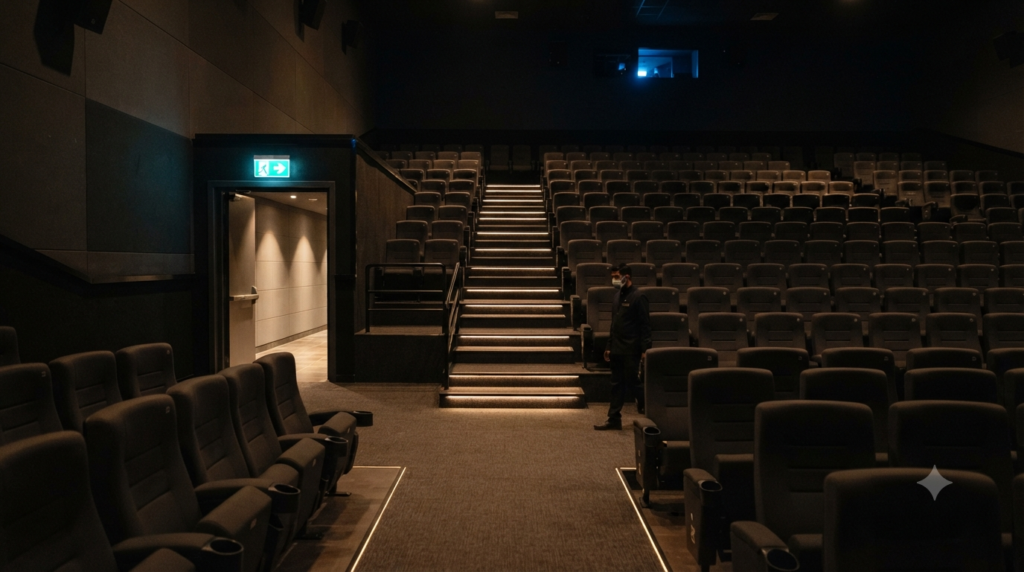
Cinema Emergency Evacuation: Exits, Staff and Safe Steps
Cinema emergency evacuation is easier to handle when you know where to look before the lights go down. A film may stop without warning, an alarm may sound, or staff may ask the audience to leave. Your safest next step depends on the situation and the cinema’s own instructions, not on a route you remember from another theatre.
Moviegoers can prepare without treating every screening as a risk. Notice the marked exits, keep aisles clear, and ask about assistance if you may need help. If an evacuation begins, act promptly and follow the route that staff or emergency personnel identify as safe.
Cinema emergency evacuation at a glance
- Before the film: Find the exit signs and note another marked exit if you can see one.
- When an alarm or instruction comes: Stop watching, listen, and prepare to leave without delay.
- While moving: Walk steadily, avoid pushing, and keep passageways open for others.
- If your route is unsafe: Do not move into smoke, fire, or a blocked passage; seek another safe exit and alert staff.
- If you need help: Tell staff about mobility, sight, hearing, or other assistance needs.
- Once outside: Move clear of the building and emergency access routes; do not re-enter without clearance.
These are general precautions. Cinema layouts, alarms, assembly areas, and assisted-escape arrangements differ, so no single route works everywhere. Good cinema emergency evacuation habits help you notice your options before anyone has to use them.
Why cinema exits deserve a quick look before the show
A dark auditorium makes it easy to focus on the screen and forget the room around you. That is exactly why a short check on arrival helps. Locate the illuminated or marked exit signs from your seat, and see whether the aisle beside you leads directly to one.
The way you entered may not be the best way out during an emergency. A side door may lead to an escape corridor or protected stairway rather than the foyer. Yet another exit might be unusable because of the incident, so follow current directions instead of assuming a familiar door is safest.
Public-assembly fire guidance from the UK Home Office explains why clear signs and alternative routes matter when visitors do not know a building well. It is helpful context, not a promise that every Indian cinema follows an identical floor plan. In cinema emergency evacuation, an unfamiliar side exit may prove safer than the busy foyer.
Before the film: a cinema emergency evacuation checklist
You do not need a building survey. Instead, spend a few moments checking what you can actually see and whom you can ask. This simple habit is especially useful in multiplexes, where several screens may connect to different corridors.
- Find the signs. Notice marked exits and any safety message shown before the feature.
- Check your aisle. Keep bags, food trays, and loose items out of the walkway.
- Identify staff. Notice an usher or the nearest staffed point in case you need directions.
- Ask about assistance. If steps, darkness, noise, or crowds could create a problem, ask staff about the venue’s own escape arrangements.
- Agree on a family plan. Tell children to stay close to their accompanying adult and to listen to cinema staff.
Do not open alarm doors merely to test them or enter staff-only passages for a look. Ask an employee if the marked route, seating arrangement, or access to an exit seems unclear. Movieshala’s cinema seat selection guide helps explain aisle symbols on booking maps, although a seat map is not an evacuation plan. A cinema emergency evacuation checklist should make the venue easier to understand, not encourage visitors to test safety doors.
Cinema emergency evacuation when the alarm sounds
When a cinema alarm sounds or staff announce an evacuation, pay attention immediately. Stop the film, your phone call, or any other distraction. Follow clear instructions from cinema personnel and emergency responders, using marked exits that remain safe. If you see fire or heavy smoke, do not wait for a routine announcement before moving away from danger.
A screen going dark does not by itself prove there is a fire. It could reflect a technical interruption. However, a visible hazard, evacuation alarm, or direct instruction to leave calls for a safety response, not a debate about whether the show will resume. Cinema emergency evacuation takes priority over the film, even if the announcement interrupts a key scene.
- Stand carefully. Check the step and the people beside you before entering the aisle.
- Leave belongings that slow you down. Do not return to your seat for snacks, shopping, or a misplaced item.
- Keep the flow moving. Walk, do not push, and do not stop in a doorway to record video.
- Use the directed route. Follow exit signs and staff guidance unless the path presents an immediate danger.
- Continue to a safer location. Move away from exits and building approaches once you are out.
Cinema emergency evacuation: which exit should you use?
The safest route is not always the door through which you entered. A cinema may have separate exits from the auditorium, connecting passages, protected stairs, or exits shared with a shopping centre. Staff may direct audiences along different paths when one area has become unsafe.
Use a marked route that is open and safe, while following the venue’s emergency directions. If the foyer contains smoke or a hazard, do not head there simply because it feels familiar. The same applies to an unmarked service doorway that you have never used.
| Situation | Safer response | Avoid |
|---|---|---|
| Staff directs you to a marked exit | Follow that route if it remains safe | Returning to your usual entrance |
| Exit route has smoke or fire | Move away, seek another safe route, alert staff | Entering the hazardous passage |
| Corridor is crowded | Keep moving calmly with the guided flow | Pushing or reversing into the crowd |
| Someone cannot use the stairs | Request the venue’s assisted-escape procedure | Improvised lifting or ordinary lift use |
There is no universal cinema evacuation map. The correct route can change even within the same building, depending on where the incident occurs. For cinema emergency evacuation, a safe direction matters more than a familiar destination.
Why staff instructions matter in a multiplex
A large multiplex is not always evacuated as one single group. One auditorium might receive a direct order to leave, while staff manage another area differently. Alarm systems, fire separation, and the location of the hazard can affect the response.
That does not mean moviegoers should independently decide to remain inside. Follow the instructions for your location. If you see immediate danger, move away and seek a safe exit. Where guidance conflicts or is unclear, tell staff what you can see and ask for a safe direction.
The key distinction is between following an organised response and assuming a response. Do not copy another audience’s movement without knowing whether their corridor serves your screen. Equally, do not stay just because viewers nearby remain seated. Cinema emergency evacuation instructions can differ between screens without giving patrons permission to ignore immediate danger.
What if you encounter smoke, a blocked door or poor lighting?
Smoke and blocked passages can make an otherwise familiar route unsafe. Turn away from visible fire or heavy smoke and seek another safe marked route. If smoke affects your area, keep low where possible as you move toward safety. Do not enter an unknown smoke-filled corridor to find out what is beyond it.
If a door will not open, do not spend valuable time forcing it while a safer alternative exists. Tell staff or emergency responders about the blocked exit. If you cannot escape, move away from danger, seek a safer place, call for help, and give responders your exact location.
A power cut can also make steps difficult to see. Use available emergency lighting and handrails, keep your footing, and follow trained staff. Avoid ordinary lifts during a fire unless emergency personnel direct you to a designated evacuation system.
The Latvian State Fire and Rescue Service’s public-place advice reinforces calm movement, staff directions, stairs, and low movement beneath smoke. Actual conditions should always guide your choice of a safe route. During cinema emergency evacuation, a slower safe exit beats a shortcut into smoke or fire.
Cinema emergency evacuation assistance before your screening
If you or someone in your group may need help escaping, speak to the cinema before the film starts. Ask about the procedure for your screen and seat rather than assuming a ramp, lift, evacuation chair, or staff escort will be available on every route. Discussing cinema emergency evacuation assistance in advance gives staff time to explain the available options.
Give staff the information needed to plan practical help. For instance, explain if you cannot manage stairs, need spoken directions, have difficulty hearing alarms, or may become disoriented in a dark crowd. You can also ask which staff member to alert if an emergency happens.
The UK government’s guidance on assisted escape discusses planned options for visitors, including people who need personal assistance. It is a useful model for the questions to ask, although the exact equipment and procedure depend on the venue.
Support for wheelchair users and people with limited mobility
Ask whether your seating area has an accessible exit route and what staff will do if stairs become the available route. Do not assume an ordinary passenger lift is suitable in a fire. Some buildings have special evacuation equipment or arrangements, but their availability and use require venue-specific advice.
If your planned route becomes unavailable, alert staff immediately. Do not attempt an unsafe transfer or let an untrained stranger carry you down stairs without considering the risk. Request trained assistance and follow the agreed emergency plan where possible.
Support for children, older viewers and sensory needs
Children may follow the crowd instead of the person looking after them. Before the screening, explain that they should stay close and listen for instructions. If someone becomes separated, tell staff or emergency responders where you last saw them rather than re-entering an unsafe building.
Older viewers and people with sight, hearing, or sensory needs may benefit from clear directions. Ask about audible announcements, visual alerts, suitable routes, and staff help. A small conversation in advance can prevent confusion when the auditorium becomes noisy.
Cinema emergency evacuation in shopping-mall multiplexes
Shopping-mall cinemas add another layer: the auditorium may have exits into shared spaces. The mall and cinema might use different announcements, staff teams, or assembly arrangements. Consequently, a route that leads to a familiar food court may not be appropriate during every incident.
Follow the instructions that apply to your location and do not assume all shops or screens need the same action. Once you leave, move away from doors, fire lanes, and incoming rescue vehicles. If a staff member identifies an assembly point, follow that direction when safe. Cinema emergency evacuation inside a mall may involve cinema staff and the wider building team.
Ask for guidance if you cannot tell whether an announcement concerns your screen. Where smoke, fire, or other immediate danger is evident, prioritise moving away from the hazard rather than waiting for more information.
After a cinema emergency evacuation: what to do next
Getting through the exit is not the end of the process. Move to the safe area identified by staff and leave access clear for firefighters, ambulances, and other responders. Check whether the people travelling with you reached safety, but do not go back into the cinema to search.
If somebody is missing, injured, or trapped, tell a staff member or emergency responder as soon as you can. Give the screen number, approximate seat location, and last known position when you know them. Clear, specific information helps more than returning to the hazard yourself.
For belongings left behind, Movieshala’s cinema lost-property guide explains how to contact the venue after it is safe. The final part of cinema emergency evacuation is keeping people and rescue access clear.
In India, the official Emergency Response Support System uses 112 for urgent police, fire, and medical assistance. Call when emergency help is needed and it is safe to do so. In other countries, use the local emergency number.
Wait for the cinema or responding authority to say when re-entry is safe. Even if the film restarts, do not assume an earlier evacuation has automatically ended.
Cinema emergency evacuation: common mistakes to avoid
The most avoidable problems often start with ordinary cinema habits. People turn toward the entrance they remember, pause to collect items, or stop in the doorway to check messages. Each choice can obstruct a moving crowd when a different route is safer.
- Following everyone blindly: Watch the signs and heed staff rather than assuming the largest group knows the route.
- Blocking an aisle: Keep personal items out of walkways before the show, not just when an alarm starts.
- Trying to record the incident: A phone can distract you and slow people behind you.
- Returning for property: Leave lost items until venue personnel confirm that retrieval is safe.
- Assuming every door is usable: A marked exit may be unavailable during a particular incident; seek the alternative staff identify.
- Assuming assistance is automatic: Ask about your needs early and alert staff promptly if your route changes.
One practical test is simple: can you point out an exit sign from your seat? If not, ask an usher before the film begins.
Does an evacuation mean a ticket refund or another show?
An evacuation does not, by itself, establish a universal right to a refund or replacement ticket. A cinema emergency evacuation can interrupt the show without settling how the ticket provider will respond. The outcome may depend on the operator’s booking terms, the ticket platform, the incident, and rules that apply locally. Safety comes first, so settle the ticket question only after leaving the affected area.
Keep your ticket or digital booking record. Later, contact the cinema operator or the official platform through which you bought it. Explain the screen, showtime, and interruption, then ask what remedy that provider offers.
Movieshala’s cinema ticket cancellation guide explains why remedies differ between sellers and venues. Do not return to an unsafe venue merely to request compensation.
Before the next screening
The best preparation is brief and specific: notice the marked exits, keep the aisle clear, and learn how to identify an usher. Ask about assisted evacuation if your group needs it, because arrangements vary by cinema. If an emergency occurs, follow current safety instructions instead of a familiar route or another patron’s guess.
For broader background on keeping escape routes clear, see the Government of Goa’s fire and life-safety guidance. This article offers general information, not a substitute for the venue’s emergency plan or directions from responders.
Frequently asked questions
Should I leave if the film suddenly stops?
Not every stopped film means an emergency. Look for an alarm, visible danger, or a staff announcement. If evacuation instructions come, follow them promptly. If you see fire or heavy smoke, move toward safety without waiting for the screening to restart.
Can I use the same cinema entrance to leave?
Only if it is a safe exit for the situation. A marked alternative may lead away from the hazard more directly. Follow staff and emergency signs rather than assuming the way in is always the way out.
What if a marked cinema exit is blocked?
Do not continue into a dangerous passage. Seek another safe marked route, tell staff about the obstruction, and ask for help if you cannot get out. If trapped, share your location with emergency responders when possible.
Should I use a lift during a cinema fire evacuation?
Avoid an ordinary passenger lift during a fire. Use stairs or the planned assisted-escape route as directed. Special evacuation lifts may exist, but only trained personnel or emergency responders should direct their use under the venue’s procedure.
What if I need wheelchair or mobility assistance?
Ask the cinema about its assisted-escape arrangements before the screening. During an incident, alert staff immediately and explain what help you need. The safest method depends on the building, your location, and the nature of the emergency.
Should I wait for staff if I can see smoke or fire?
Do not remain in immediate danger while waiting for routine instructions. Move away from the hazard using a safe exit, and warn staff or responders. Do not enter smoke-filled corridors or assume a particular door is usable.
Can I go back inside to find my child or belongings?
Do not re-enter an unsafe cinema. Tell staff or emergency responders if someone is missing and share their last known location. Recover bags or other belongings only after the relevant authority confirms that re-entry is safe.
Will I automatically get a refund after an evacuation?
No single refund outcome applies to every cinema. Once safe, check the operator’s current terms and contact the official booking channel. Keep your ticket record and ask how the disrupted show will be handled.
Which emergency number should I call in India?
Dial 112 when urgent police, fire, or medical assistance is needed. Tell the operator the cinema name, location, and nature of the emergency. When you are outside India, use the emergency number for that country.