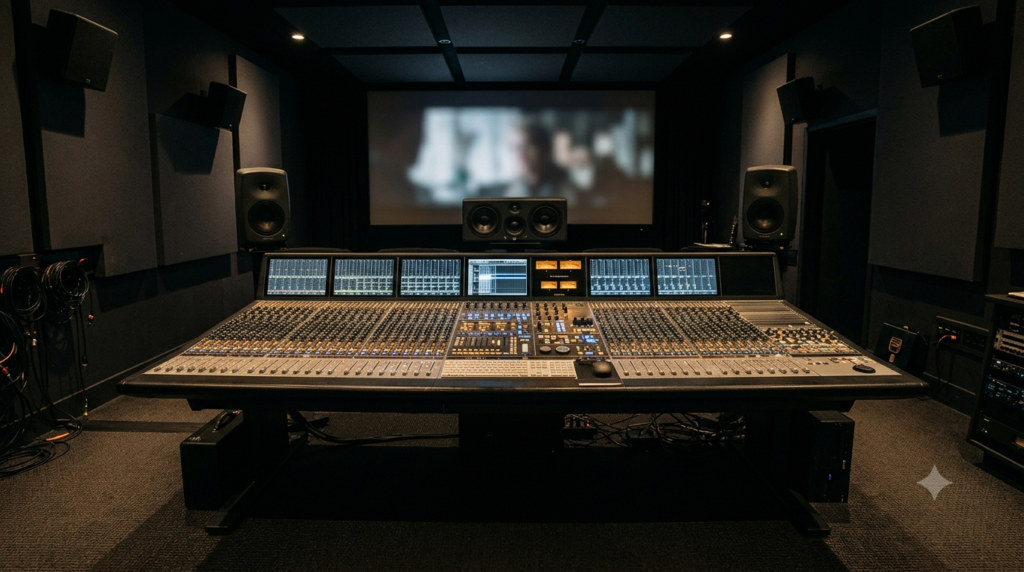
Movie Sound Mixing: Dialogue, Music, Effects and the Final Soundtrack
Movie sound mixing decides what you hear, what you almost miss and what a scene feels like. A clear line can sit above a busy street without making the traffic disappear. Minutes later, that same street might overwhelm the character on purpose. The difference comes from choices about balance, space and attention, not simply turning every track up.
Movie sound mixing joins dialogue, music, effects and ambience into one experience. Yet each layer begins with a different job. Understanding those jobs makes it easier to hear what the mixer actually contributes.
Movie Sound Mixing at a Glance
- Meaning: Balancing and shaping prepared audio so it works with the edited picture.
- Main layers: Dialogue, music, sound effects, Foley and background ambience.
- Key decisions: Which sound leads, how close it seems and when it changes.
- Main specialist: The re-recording mixer, also called a dubbing mixer in some workflows.
- Final result: A soundtrack and any separate versions or stems the production needs.
What Is Movie Sound Mixing?
Movie sound mixing is the post-production process of combining edited dialogue, music, sound effects and ambience into a coherent final soundtrack. A re-recording mixer shapes volume, tone, dynamics and spatial placement so viewers follow the story. The aim is not to make every sound equally prominent; it is to make the right sound matter at the right moment.
The Academy of Motion Picture Arts and Sciences explains this as the final re-recording mix. Its sound and music teaching guide describes how mixers bring separate tracks together and direct attention. That is why a whisper can carry more meaning than a nearby engine.
One scene might need natural location sound. Another may demand a dreamlike shift in perspective. The tools can stay the same while the dramatic goal changes. Good movie sound mixing serves what the audience should understand, feel or question.
The Five Layers That Reach the Final Mix
Sound teams organise recordings by purpose so they can change one element without damaging another. The exact track layout varies between productions. Still, these familiar layers explain most of what reaches the mixing stage.
| Layer | What it contributes | Typical mixing choice |
|---|---|---|
| Dialogue | Speech, breaths and spoken performance | Protect clarity and believable distance |
| Music | Score, songs and musical transitions | Support emotion without masking key words |
| Effects | Impacts, vehicles, machines and designed sounds | Give important actions their proper weight |
| Foley | Performed footsteps, cloth and object handling | Match movement while avoiding exaggerated detail |
| Ambience | Room tone, wind, crowds and distant activity | Keep locations continuous and convincing |
These are useful creative groups, not five required output files. For delivery, teams often combine material into dialogue, music and effects groups. Foley and ambience may sit within the effects side while remaining separate during the working mix.
How Movie Sound Mixing Keeps Dialogue Clear
Dialogue often carries the information viewers need most, so a mixer usually gives it a stable place. That does not mean every line must sound close or louder than its surroundings. A character across a crowded room should still sound distant when the story calls for distance.
The mixer first listens for uneven words, harsh tone and abrupt changes between shots. Level moves can keep a quiet phrase intelligible without making every breath identical. Equalisation, or EQ, can reduce frequencies that make voices muddy. Compression can control large level swings, although too much processing flattens expression.
When the music and dialogue compete, lowering music briefly may help more than boosting speech. The mixer might also clear space in the music’s tone. These choices depend on the voices, instruments and scene. There is no fixed setting that rescues every conversation.
When dialogue should not dominate
Some films deliberately let a crowd, storm or machine overpower a voice. That can convey panic or place the audience inside a character’s confusion. The choice works when it supports the story, rather than exposing an accidental problem with the mix.
Think of someone trying to speak beside a departing train. The audience may need the effort and frustration more than every word. By contrast, a key revelation in a quiet kitchen usually needs enough space to land clearly.
Mixing Background Score and Songs Around Speech
Music can create momentum, sadness or anticipation before a character says anything. Yet a powerful score can also cover the line it should support. Film mixers therefore adjust music across individual moments, not merely set one level for the entire scene.
A score may swell after a sentence ends and retreat before the next reply. This movement often feels more natural than keeping music low throughout. Songs with lyrics need special care because sung words can compete with spoken ones. Sometimes the best decision is to delay a vocal phrase or use a different musical passage.
In movie sound mixing, the music’s role changes as the film moves between conversation, montage and action. A song heard from a car radio may also need to sound small and enclosed. Later, that same music could expand into a full score. Our diegetic sound guide explains this story-world distinction.
Making Sound Effects Powerful Without Making Everything Loud
A glass breaking, a door closing and a passing motorbike do not deserve equal emphasis in every scene. The mix gives each sound a weight based on story, framing and distance. An off-screen impact can interrupt a conversation, while a visible background vehicle may barely register.
Layers often make a designed effect convincing. For example, a fictional machine could combine a low hum, a metallic click and a short burst of air. The mixer then decides whether those parts read as one event. If every layer stays prominent, the sound can become busy rather than large.
Movie sound mixing also uses contrast. A sudden impact feels stronger after a restrained passage. Raising the entire soundtrack throughout an action scene removes that contrast and can exhaust the listener. Silence, or an almost silent room tone, can therefore do more dramatic work than another heavy effect.
Where Foley fits into that balance
Foley artists perform movements such as footsteps, fabric rustles and handled props. These sounds may need careful timing and light emphasis. They should not turn a normal walk into a parade of conspicuous noises.
Our Foley sound in movies guide explains how the performances happen. The editor aligns them with picture, and the re-recording mixer judges their place alongside voices and other effects. Recording a sound is not the same as deciding how loudly the audience should hear it.
Why Ambience Matters Even When You Hardly Notice It
Ambience tells the ear where a scene lives. A room has its own soft background sound, while a street can carry distant traffic and people. Removing all those layers may make an edited dialogue scene feel oddly empty.
Background sound also hides unwanted gaps between takes. Suppose two lines came from different camera positions, each with a different noise floor. Consistent room tone can help them belong to one continuous space. The mixer then shapes that background so it never draws attention away from a key phrase.
Sound perspective matters too. A voice in a tiled corridor should not resemble a close studio recording in a dry booth. Suitable reverberation can suggest reflections from the room.
Yet adding echo to everything will blur the scene. Movie sound mixing uses ambience and space together, with restraint.
Movie Sound Mixing vs Recording, ADR, Foley and Editing
The word mixer causes confusion because film crews use it for more than one job. A production sound mixer supervises audio capture during filming. A re-recording mixer works with prepared material during post-production to form the finished soundtrack.
ScreenSkills distinguishes the on-set sound mixer from the post-production dubbing mixer. The first aims to capture useful sound; the second decides how all the layers work together. Small productions may combine roles, but the tasks remain different.
| Task | Main question | Typical result |
|---|---|---|
| Production recording | Can we capture a clean performance on set? | Location dialogue and other original sound |
| ADR | Must a spoken line be recorded again? | Replacement or added dialogue |
| Foley | Which physical actions need new sound? | Performed movement and prop recordings |
| Sound editing | Which clips belong where, and when? | Clean, selected and aligned audio tracks |
| Final mixing | What should viewers hear most clearly? | Balanced soundtrack and required outputs |
MovieShala’s film crew roles guide covers location sound recording and post-production responsibilities. For dialogue replacement, see our ADR explainer. Mixing uses their results, but it does not turn those separate crafts into synonyms.
Why sound editing and mixing sometimes overlap
Sound editors choose takes, repair transitions, position effects and align events with the picture. Mixers shape their combined impact. In practice, a mixer may request a different effect or adjust its timing during a review. That collaboration does not erase the basic distinction.
Picture editing raises another related question. An editor may let a voice enter before the next image or continue after a cut. Our J-cut and L-cut guide covers those timing choices. Final mixing then helps the sound bridge feel steady in level, tone and space.
What Happens During a Final Film Sound Mix?
The final film sound mix starts with organised audio tracks and a version of the picture the team can work against. The mixer reviews problem spots, builds balances and checks the film with the creative team. Exact responsibilities and schedules differ, but the main sequence is easy to understand.
- Receive and check the tracks. Confirm dialogue, effects, Foley, ambience and music align with the current picture.
- Set a dialogue foundation. Establish useful speech levels and identify changes in tone, distance or noise.
- Bring in backgrounds and Foley. Give each scene a believable setting and physical detail without clutter.
- Build music and effects moments. Shape entrances, fades, impacts and quiet passages around the dramatic focus.
- Automate changes. Record level, panning and processing moves that shift through a scene.
- Review the whole film. Listen across scene boundaries and revise choices with the director or sound team.
- Prepare the required versions. Check the final mix and the separate elements requested for distribution.
Avid’s film sound workflow series demonstrates automation, panning, reverb, track groups and final delivery preparation. It shows why mixing remains a creative process even with powerful software. The machine recalls the settings; people decide what the scene needs.
One Scene, Four Different Listening Priorities
Imagine an invented scene in a roadside café. Two friends talk while scooters pass outside. A fan hums overhead, cups clink on the table and a gentle score begins. The recordings could stay identical while four different mixes tell different stories.
- Conversation first: Keep words clear, soften passing traffic and let the score rise between replies.
- Unease first: Let the fan’s uneven pulse draw attention, then introduce a distant mechanical rattle.
- Public chaos first: Push street sound forward until a character struggles to be heard.
- Private memory first: Pull away the café noise and bring the music closer as the character remembers something.
None is automatically the correct mix. The script, performance and director’s intention decide. That is the overlooked skill in movie sound mixing: it ranks competing sounds by dramatic importance, not just by their recorded volume.
Notice another consequence. Making one layer louder is not always the most effective adjustment. Reducing three rival layers can create the same focus while keeping the mix relaxed. This matters when voices, cymbals and sharp effects compete in a crowded scene.
Stems, Stereo, Surround and the Final Soundtrack
A mix may need more than one final version. A stereo release and a surround release use different playback layouts. Some productions also prepare immersive versions. The exact package depends on the distributor, venue and project’s agreed delivery specifications.
Separate groups called stems help teams manage versions. Dialogue, music and effects are common groups, often shortened to D, M and E. A music-and-effects version can support another language’s dialogue recording. However, the team must check for stray spoken words or other language-dependent sounds before calling that version suitable.
A final mix is not simply one universal volume number. Cinema playback conditions, broadcast rules and streaming requirements differ. Because of that, a team checks the actual destination’s specifications rather than copying a supposed film-wide loudness target from a tutorial.
Format names also do not guarantee a good experience. A carefully balanced stereo mix can tell the story more clearly than a crowded immersive mix. The measure is whether speech, action and atmosphere survive on the intended playback system.
Common Movie Sound Mixing Mistakes to Notice
Bad mixing often sounds like a problem of focus rather than a shortage of sounds. Beginners sometimes try to fix every issue with another volume boost. These checks reveal the deeper problem.
- Speech disappears under music: Check the music entrance and tone before raising every line.
- Every action feels oversized: Lower decorative effects so the important impacts retain contrast.
- Background noise jumps at cuts: Compare room tone and ambience across the joined shots.
- ADR sounds too close: Match distance, room character and performance, not only lip-sync.
- Quiet scenes feel empty: Restore suitable background texture without adding pointless noise.
- The mix works only on one speaker setup: Review it on the actual delivery layout and sensible alternate playback systems.
No mix can guarantee every word will remain clear on every device. A phone speaker, television and cinema may reveal different weaknesses. The practical response is to test, listen and revise. Automatic processing helps, but it does not replace judgment.
Try Hearing the Mix Instead of Just the Movie
Choose a short scene you can watch legally and play it twice. First, follow the story normally. Then listen for what moves forward or backward: dialogue, score, footsteps, atmosphere and silence. Do not assume an audible sound reveals how or where it was recorded.
- Identify the main information the scene must convey.
- Notice what becomes quieter when a character starts speaking.
- Listen for changes in the room’s background between camera angles.
- Ask whether footsteps or impacts sound close, distant, heavy or light.
- Notice when music rises after words end.
- Decide whether a moment of apparent silence changes your attention.
You can also test the idea with your own footage. Keep the dialogue fixed while adjusting a music bed and two effects. Compare the versions without watching the controls. If one version tells the story more clearly, you have already made a meaningful mixing decision.
The Final Take
Movie sound mixing is the art of deciding how all a film’s sounds coexist. Recording captures material, ADR and Foley add performances, and editing prepares the tracks. The final mix gives those pieces a clear dramatic order. Next time a scene pulls your attention from a whisper to a distant sound, listen for what changed around it.
Frequently Asked Questions
What is the difference between sound mixing and sound editing?
Sound editing selects, cleans, creates and places audio clips against a film’s picture. Sound mixing balances those prepared tracks into a finished listening experience. An editor may repair a dialogue cut, while the mixer chooses how that dialogue competes with music and effects. The roles sometimes overlap on smaller productions.
Is movie sound mixing the same as recording on set?
No. A production sound mixer records usable dialogue and location audio during filming. A re-recording mixer works later with dialogue, music, effects and backgrounds. The shared word mixer describes different stages of the same soundtrack workflow.
Both roles require listening and level control, but their goals are not identical.
Why does music sometimes make film dialogue hard to hear?
Music can mask speech when it competes in level or frequency, especially during busy passages. A mixer may lower the score, reshape its tone or change the timing of a musical rise. Raising dialogue alone is not always the cleanest solution. The intended dramatic effect also influences the choice.
What are dialogue, music and effects stems?
Stems are separate groups of audio prepared from the mixing session. Dialogue, music and effects are common categories. They help teams create alternate versions and check individual elements without rebuilding every track. A music-and-effects version may support language localisation, but it needs careful review for leftover speech.
Does every film need Foley and ADR before mixing?
No. A film uses Foley or automated dialogue replacement when the material and creative plan call for them. Some production recordings already contain useful dialogue and movement detail. Other scenes need replacement voices or newly performed sounds.
The mixer works with the elements available, rather than demanding every technique for every shot.
Is there one correct loudness level for all movie soundtracks?
No universal loudness figure suits every cinema, television, streaming and other delivery context. Productions follow the requirements for their actual release format and destination. A mixer also manages contrast within scenes, not just overall level. Copying one number from an unrelated workflow can lead to an unsuitable result.
Who decides what should be loudest in a movie scene?
The re-recording mixer makes detailed balancing choices in collaboration with the director and other sound specialists. The story usually supplies the priority. A key line may lead one scene, while an impact or atmosphere takes over another. There is no permanent rule that dialogue must beat every other sound.
Can a film sound good in stereo without Dolby Atmos?
Yes. A well-made stereo soundtrack can offer clear dialogue, strong effects and convincing ambience. Immersive formats provide other placement options, but the format does not replace good balances or storytelling. Quality depends on the mix, the release version and the system on which the audience hears it.