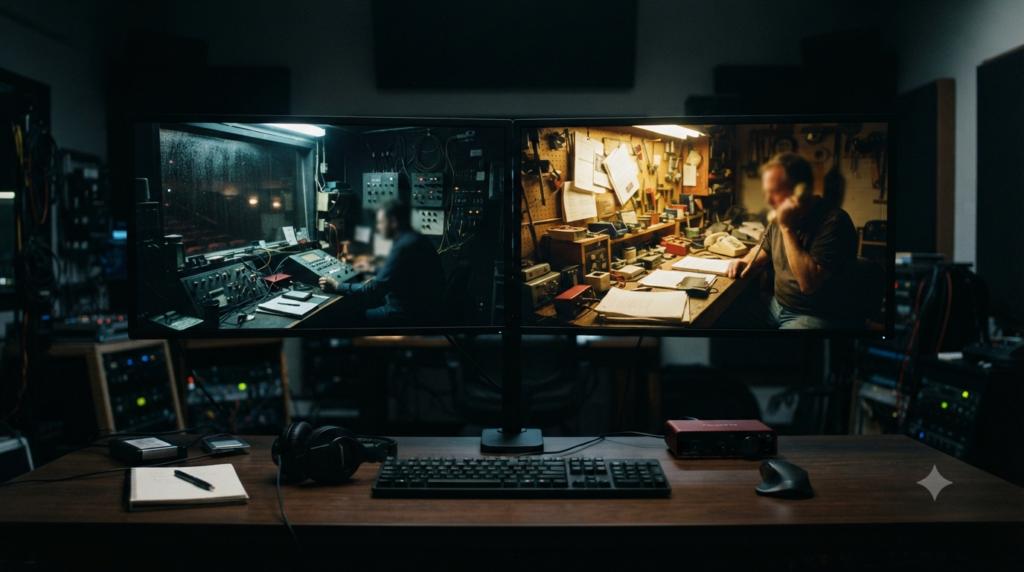
Screenplay Intercut: Telephone Scenes and Clear Location Changes
A screenplay intercut moves between two established locations without repeating a full scene heading after every line of dialogue. It works especially well for a phone call when viewers need to see both speakers. The trick is to make the geography clear before the conversation starts moving.

A bare INTERCUT label cannot rescue a confusing setup. Give each place its own scene heading, show who is there, and then let the exchange flow. Below is an original example with a deliberate exit, plus guidance on when a simpler phone scene works better.
Screenplay Intercut at a Glance
- Purpose: Move between two places without printing a new location heading at every switch.
- Best fit: A call or linked action where both locations matter to the story.
- Setup: Establish each place with its own full scene heading and a visual action beat.
- Cue: Use a clear line such as INTERCUT – PHONE CONVERSATION after the setup.
- Exit: Show the call ending, then stay in a clearly identified place or begin a new scene.
Screenwriter John August explains the INTERCUT shortcut for phone scenes. Final Draft’s screenplay guide also discusses its use after setting up locations. The BBC Writersroom screenplay format example shows both a combined heading and a two-location setup.
What Does a Screenplay Intercut Mean?
A screenplay intercut is a writing cue that tells the reader to move between two established settings as one connected passage. Instead of repeating the kitchen and office headings throughout a phone call, the writer establishes both places and uses INTERCUT to carry the exchange. The camera’s exact timing remains open.
That distinction matters because a script is not an edited film. The screenplay needs to tell a reader what happens and where it happens. An editor later chooses the precise shots, holds and cuts, often with the director.
Not every switch between locations needs this cue. A single move from one room to another is usually a new scene heading. Use a screenplay intercut when repeated alternation forms one continuous dramatic unit.
When to Use a Screenplay Intercut
Use a screenplay intercut when showing both locations adds information, tension or emotion. In a rescue call, the person giving instructions may notice a mistake on a diagram. Meanwhile, the person in danger can react before the other speaker understands the risk.
A romantic conversation can also gain meaning from contrasting surroundings. One person may be in a noisy celebration while the other sits alone. If that contrast does not matter, keeping the camera on one person may be stronger.
Ask whether the audience needs to see the second speaker. If the answer is no, you can keep one scene heading and use the remote caller’s voice. A screenplay intercut earns its space when the second location contributes something visual.
How to Format a Phone Call with INTERCUT
Begin with ordinary screenplay elements: scene heading, action, character cue and dialogue. Then establish the other end of the call before introducing the intercut cue. Movieshala’s guide to screenplay scene headings explains how INT., EXT., location and time keep scene geography readable.
- Establish location one. Write a full heading and show your first character answering or making the call.
- Establish location two. Give the second character a full heading and an action worth seeing.
- Introduce INTERCUT. Place INTERCUT – PHONE CONVERSATION on a clear standalone line before the sustained back-and-forth.
- Write the exchange. Use standard character cues, dialogue and brief action beats without repeating each location heading.
- Exit deliberately. Show the call ending and identify the location where the next action takes place.
This is a practical default, not the only accepted layout. Some writers use INTERCUT: or INTERCUT BETWEEN THE TWO LOCATIONS. Keep the cue brief and consistent with your script’s style.
Original Screenplay Intercut Example: A Call Under Pressure
Here is an original phone scene at a municipal theatre. Mira is in the lighting booth while Dev checks a wiring plan elsewhere. Both locations matter because the characters hold different pieces of the answer.
INT. MUNICIPAL THEATRE – LIGHTING BOOTH – NIGHT
Rain rattles the windows. MIRA watches the emergency-light indicator turn red. Her phone is pressed to her ear.
MIRA
The house is dark. People are still inside.
INT. DEV’S GARAGE – NIGHT
DEV balances his phone against his shoulder. He spreads a stained wiring plan across a workbench.
DEV
Find the panel beside the booth door.
INTERCUT – PHONE CONVERSATION
Mira pulls open the panel. Two switches carry faded blue tape.
MIRA
There are two. Which one?
Dev traces a line on the plan. He stops at a warning mark.
DEV
Not the upper one. That opens the smoke vent.
Mira pulls her hand away. Beyond the glass, the exit signs flicker.
MIRA
The lower switch has a broken handle.
Dev flips the plan over. A repair note is taped to the back.
DEV
There’s a manual latch beneath it. Pull that first.
Mira finds the latch and pulls. The emergency lights come on across the empty stage.
MIRA
I can see the stairs again.
DEV
Good. Now get everyone outside.
Mira ends the call.
END INTERCUT.
INT. MUNICIPAL THEATRE – STAIRWELL – CONTINUOUS
Mira pushes through the stairwell door. A line of people moves toward the lit exit.
Formatting note: This webpage uses simple HTML spacing for easy reading. A screenplay editor should apply the usual character and dialogue indents.
Why the phone scene is easy to follow
The first scene heading identifies Mira’s place. The second heading establishes Dev’s garage before the script asks readers to switch between them. Neither setting becomes a mystery midway through the call.
The screenplay intercut then carries dialogue and visual actions without a heading for every change of speaker. Dev discovers the repair note, while Mira sees the flickering signs. Those are separate visual discoveries, not dialogue that merely repeats a briefing.
The example ends with a hang-up and an explicit END INTERCUT. After that, a fresh stairwell heading makes the move into another room unmistakable. END INTERCUT is an optional clarity cue; it is not a universal rule.
Screenplay Intercut vs Cross-Cutting: The Real Difference
A screenplay intercut describes a way to organise alternating locations on the script page. Cross-cutting describes the movement between lines of action in the finished film. The ideas overlap, so many filmmakers also use the word intercutting for the editorial pattern.
However, the terms answer different working questions. The writer asks how to express two connected locations clearly. The editor asks when to leave one image and return to another to shape meaning, suspense or pace.
| Term | What it mainly describes | Typical example |
|---|---|---|
| INTERCUT cue | Screenplay page organisation | One phone exchange across two rooms |
| Cross-cutting | Editing between lines of action | Rescuers approach while a door starts to fail |
| Parallel editing | Alternation that links separate action | Two preparations shown as related events |
These are useful distinctions, not rigid borders. Some film teachers treat cross-cutting and parallel editing as close synonyms. For a fuller look at timing and suspense, read Movieshala’s cross-cutting and parallel editing guide.
When a One-Sided Phone Call Is Better
A screenplay intercut may be unnecessary when the story only needs one character’s reaction. Imagine Mira learning that the theatre’s power is failing. If the scene’s main point is her silence, stay on Mira and let Dev’s voice arrive through the phone.
That version needs only the theatre’s scene heading. The remote voice can use a V.O. extension, according to a common screenplay convention. Meanwhile, the action remains anchored to Mira’s face and surroundings.
Do not automatically tag both speakers V.O. during a two-location intercut. Once the screenplay establishes each person on screen, ordinary character cues are often clearer. Movieshala’s parentheticals and voice-extension guide explains how dialogue cues differ from action.
There is no winner in the abstract. A one-sided call keeps attention on a single reaction, while an intercut can make the audience compare two visual situations. Choose by what the viewer must know.
How to End a Screenplay Intercut Clearly
End a screenplay intercut by showing the call finish, then make the next location obvious. A hang-up followed by action on one established side may be enough. If the story moves somewhere new, use a fresh scene heading so the reader never has to guess.
In the original example, Mira ends the conversation, the cue says END INTERCUT, and a stairwell heading follows. That combination makes the handoff explicit. Yet professional examples may omit END INTERCUT when the hang-up and the next action already make the shift clear.
Do not confuse a formatting label with an edit command. END INTERCUT does not tell the editor which precise shot ends the sequence. It simply removes doubt about how to read the following lines.
Mistakes That Make an Intercut Hard to Read
Most screenplay intercut problems come from unclear geography, not from the choice of label. A reader should know both locations before encountering rapid alternation. The rest of the page should support that clarity.
- Skipping location two: A new voice appears, but nothing tells us where its owner stands.
- Repeating full headings: Printing the same two headings after each reply adds noise without improving orientation.
- Using INTERCUT for any cut: A one-time change of scene is not automatically a sustained intercut sequence.
- Hiding action inside dialogue: Put visible changes in action lines, not long parentheticals beneath names.
- Failing to exit: The call ends, yet the next action could belong to either location.
- Cutting by every speaker: An intercut permits visual alternation; it does not require a shot change on every line.
Read the scene without imagining a camera plan. If you cannot tell where a hand reaches or which character sees a clue, revise the action. Screenwriting format should make those questions easier, not harder.
A Quick Revision Test Before Sending the Script
Use this screenplay intercut checklist once the dialogue feels complete. It tests the reader’s view of the scene rather than adherence to one software template.
- Cover the dialogue. Can you still identify both locations from the headings and opening action?
- Mark each visual reveal. Does each location contribute information that the other cannot show?
- Find the INTERCUT cue. Does it appear after both sides have enough context?
- Read only the action. Can you tell which character performs each important movement?
- Locate the exit. Can a reader identify where the camera stays when the call ends?
- Try a one-sided version. Does showing both locations genuinely improve the story?
One useful test is to remove Dev’s garage from the theatre example. Without seeing the plan and repair note, Dev’s correct answers become convenient guesses. Keeping both places visible gives the audience evidence that his instructions have a source.
By contrast, a breakup call may gain more force from a single unmoving reaction. Format follows the dramatic choice, not the other way around.
Before You Move On
For most two-location calls, establish each place, introduce INTERCUT and write the conversation normally. Keep visible discoveries in action lines and let the reader understand the shifts without repeated headings. When the call ends, mark the handoff with clear action or a scene heading. A screenplay intercut should make the page lighter while keeping the story geography intact.
Frequently Asked Questions
What is an INTERCUT in a screenplay?
A screenplay intercut connects established locations so the script can alternate between them without repeating headings. It often helps with phone conversations because both people can appear during one exchange. The cue does not prescribe a precise cut after every line.
Do you need two scene headings before a screenplay intercut?
Two separate headings are a clear, reliable way to introduce both ends of a call. Some accepted examples use a combined INTERCUT heading instead. Choose one approach consistently, and ensure the reader understands both locations before the exchange accelerates.
Should I write INTERCUT or INTERCUT PHONE CONVERSATION?
Both can work when the surrounding scene makes the intention clear. INTERCUT – PHONE CONVERSATION removes ambiguity for a beginner reading the page. If several characters or settings appear, name the parties or locations rather than relying on an unexplained label.
Does a screenplay intercut need END INTERCUT?
No universal screenplay rule requires END INTERCUT. A visible hang-up and the following action may already show that the call has ended. Add an explicit end cue when it helps readers reorient, especially before a quick change of place.
Should phone dialogue use V.O. during an intercut?
Not automatically. When both callers appear in their own established locations, normal dialogue cues usually read cleanly. A voice-over extension can help when one caller remains unseen and only a voice comes through the phone. Follow the convention used by your production or submission format.
Is a screenplay intercut the same as cross-cutting?
They overlap, but their emphasis differs. Screenplay intercut usually refers to a writing cue for alternating locations. Cross-cutting usually describes the editing pattern that switches between actions. The same sequence may use both terms without contradiction.
Can an intercut include action instead of only dialogue?
Yes. Action often provides the strongest reason to show both locations. One person might find a clue while another faces the consequence. Keep each action beat tied to its character so the reader can follow the movement.
Can you intercut between three locations?
Yes, if the sequence stays clear. Establish all relevant places, then name the parties or locations in the cue when needed. Longer multi-location passages may work better with renewed headings whenever the geography becomes hard to track.