AI and VFX in South Cinema: How Technology Reshapes Films
AI and VFX in South Cinema have moved from the edit bay to the writers’ room, and the shift is faster than most fans realise. Films like Kalki 2898 AD, Devara, and Sita Ramam now lean on real-time rendering and machine learning at nearly every stage.
Yet the real story is not the spectacle on screen. It is why studios adopted these tools so quickly, what it costs, and who it affects. This guide separates the verified facts from the hype, corrects a few myths, and looks honestly at where the technology goes next.
AI and VFX in South Cinema at a Glance
- India’s animation and VFX segment grew just 1.6% in 2025 after a sharp decline the year before, according to the FICCI-EY 2026 report.
- Studios embedded AI across their pipelines mainly to offset lower pricing and shorter delivery timelines, not merely for visual flash.
- Project K and Kalki 2898 AD are the same film; “Project K” was only the working title.
- Hyderabad and Chennai remain the twin engines of South Indian visual effects, with Makuta VFX and the listed studio PhantomFX leading.
- The biggest open questions are jobs, deepfake consent, and whether AI actually lowers a film’s budget.
What Is Driving AI and VFX in South Cinema
The rise of AI and VFX in South Cinema is as much an economic story as a creative one. After the global production slowdown of 2024, Indian studios faced re-priced contracts and leaner budgets. So they turned to automation to protect their margins.
The FICCI-EY 2026 report is titled “Stories, scale and impact.” It found the animation and VFX segment grew only 1.6% in 2025, reaching about ₹105 billion. That points to early stabilisation, not a boom.
Because clients wanted faster turnarounds at lower cost, studios embedded AI tools directly into their workflows. This is the quiet engine behind the flashy results. When a producer asks for a stormy sea or a ruined city on a tighter timeline, machine-assisted rotoscoping and rendering close the gap. The visuals get the applause, yet the balance sheet is what pushed the technology into daily use.
South cinema had a head start here. The region’s appetite for large-scale spectacle, built over the Baahubali and RRR years, meant its studios already ran heavy pipelines. As a result, they adapted to AI faster than many peers.
How AI and VFX in South Cinema Actually Work on Set
Across a modern South Indian production, AI now touches almost every department. It rarely replaces a human decision. Instead, it removes the slow, repetitive work so artists can focus on craft. The table below shows the shift in broad terms; exact tools vary by studio and project.
| Stage | Traditional method | AI-assisted method today |
|---|---|---|
| Pre-visualisation | Hand-drawn storyboards | Rapid concept frames from tools like Midjourney and Runway |
| Rotoscoping | Frame-by-frame masking | Machine-assisted roto and cleanup |
| Environments | Manual matte painting | Real-time rendering in game engines |
| Editing | Manual assembly | AI sorting of takes and rough cuts |
| Dubbing | Separate voice sessions | AI-supported lip-sync across languages |
These uses are practical, not magical. A junior artist still checks every AI-generated mask. A supervisor still signs off each shot. The gain is speed, since the machine handles the grind while people handle judgement.
Virtual production and the LED wall
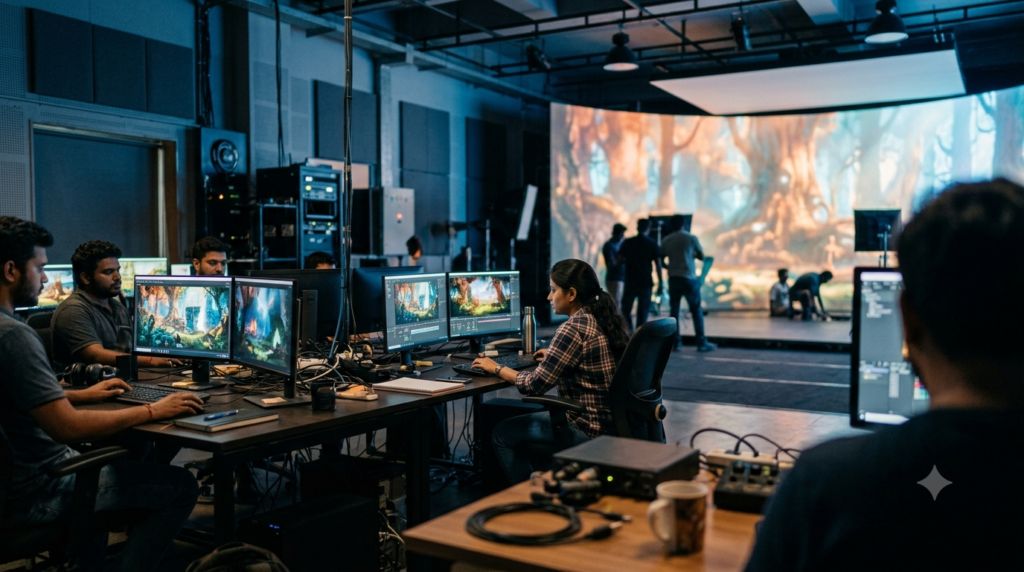
Virtual production is the technique that changed South cinema most visibly. Instead of a green screen, actors perform in front of a giant curved LED wall that displays a live, rendered world. Hyderabad’s Annapurna Studios built one of India’s largest LED volumes for exactly this work. Because the environment reacts in real time, directors can light a scene to match a digital sunset while the camera rolls.
Kalki 2898 AD, directed by Nag Ashwin for Vyjayanthi Movies, leaned heavily on this approach to build its dystopian world of Kasi. The film released on 27 June 2024 with a reported budget near ₹600 crore, and it went on to gross over ₹1,000 crore worldwide. Nag Ashwin has spoken about designing the story and the technology together rather than bolting effects on afterward.
Who Builds These Visuals: The Studios Behind South Cinema
The studios doing this work are concentrated in two cities. Hyderabad and Chennai supply most of the region’s high-end effects, and a handful of names appear again and again in the credits.
- Makuta VFX (Hyderabad): founded by VFX supervisor V. Srinivas Mohan, it delivered thousands of shots for Baahubali 2 and worked on 2.0. Creature and environment work at scale is its signature.
- PhantomFX (Chennai): led by founder Bejoy Arputharaj, it is one of the few listed VFX firms in India, trading on the NSE. It reported revenue of roughly ₹104 crore for the year ending March 2025 and has credits including Jailer and Indian 2.
- Prasad Corporation and other post houses: long-standing labs that now fold real-time tools into restoration and finishing.
Consolidation is reshaping this list. During 2025 PhantomFX acquired the UK’s Milk VFX and the post house Lola Post. That signals a change, since Indian studios now buy capability abroad rather than only selling labour. The old idea of India as merely the “back office of Hollywood” is fading, since local firms now take creative lead roles.
VFX as a Storytelling Tool, Not a Gimmick
Modern South Indian films increasingly use effects to serve emotion, not to show off. The best work disappears into the story. When you stop noticing the CGI, the artists have done their job well.
Consider a few examples. In Sita Ramam, subtle period detailing and gentle digital touches deepened a 1960s romance without ever pulling focus. In Pushpa 2: The Rule, colour grading and environment work kept the forest world consistent across scenes shot months apart. These are quiet uses, and they matter more to a viewer than any explosion.
This restraint marks a real change from the early 2010s. Back then, VFX often meant spectacle for its own sake. Now the tools support character and mood, which is exactly why audiences rarely credit them.
Does AI Actually Make South Indian Films Cheaper?
Not exactly, and the honest answer is more useful than the hype. AI can trim redundant labour on a given task, yet a big film’s total effects bill keeps rising because ambition rises with it. The savings show up as more shots per rupee, not a smaller cheque.
The budget split tells the story. According to the FICCI-EY 2026 report, tentpole films now allocate roughly 25% to 30% of their budgets to VFX and post-enhancement. Mid-budget films have pushed their share up to about 10% to 15%, because affordable tools finally put polished visuals within reach. So AI widens access more than it cuts costs.
For a small studio making an OTT feature, that access is the real prize. A modest team can now attempt a look that once needed a blockbuster budget. Whether the result feels earned still depends on taste and story, not the software.
The Jobs Question and Other Challenges Ahead
The hardest part of this shift is human, not technical. As studios lean on automation, the industry is shedding roles even while output grows. This tension sits at the centre of AI and VFX in South Cinema today.
The numbers are sobering. The FICCI-EY 2026 report noted that Technicolor’s 2025 shutdown displaced up to 2,000 VFX and animation professionals in Bengaluru. When Jellyfish Pictures halted operations, more than 100 artists in Mumbai lost work too.
Consolidation protects some studios, yet it thins the wider talent pool. New entrants must now learn AI tools on top of classical craft just to stay employable.
Consent is the other flashpoint. AI de-aging and digital doubles raise real questions about performer likeness rights. When a face can be recreated, an actor’s image becomes a negotiable asset.
The industry has no settled rulebook for this yet, so contracts and unions are scrambling to catch up. Data and storage costs for high-fidelity renders add a further, less glamorous strain on AI and VFX in South Cinema.
Common Myths About AI and VFX in South Cinema
Several claims about this topic circulate widely and are simply wrong. Correcting them matters, because the myths shape how fans judge the films.
- Myth: Project K and Kalki 2898 AD are two different movies. They are one film. “Project K” was the working title before the official name was revealed at San Diego Comic-Con in 2023.
- Myth: AI now writes and directs these films. It does not. AI assists with previews, roto, and dubbing, while writers, directors, and supervisors make every creative call.
- Myth: AI has made VFX a booming, high-growth business in India. The segment grew only 1.6% in 2025 and is still recovering from a steep 2024 decline. Adoption is about survival and efficiency as much as growth.
The Future of AI and VFX in South Cinema
Looking ahead, the momentum points toward mythology at scale and smarter, faster pipelines. The next few years will test how far the tools can go before audiences push back.
A wave of large mythological films is lined up for 2026 and 2027 across Indian cinema. These event movies will demand the heaviest effects work yet.
Meanwhile, festivals are already treating AI as a creative medium in its own right. The 2026 Mumbai International Film Festival featured a dedicated “AI Films” section, showcasing works that blended technology with storytelling. That signals a shift from AI as a hidden tool toward a visible authorial choice.
The FICCI-EY 2026 report expects the segment to grow around 10% a year. That would lift it from ₹105 billion in 2025 to roughly ₹138 billion by 2028. If it holds, South cinema’s studios are well placed to lead. Still, the winners will be those who pair the technology with genuine craft, because a tool alone has never moved an audience.
Final Thoughts
AI and VFX in South Cinema are neither a miracle nor a menace. They are a set of tools reshaping how films get made, driven as much by tight budgets as by big dreams. The verified picture is one of cautious recovery, real consolidation, and hard questions about jobs and consent.
For viewers, the payoff is bolder worlds told with more restraint than the early spectacle years. For the industry, the task is to keep human craft at the centre while the machines handle the grind. That balance, more than any blockbuster, will decide what the next decade looks like.
Frequently Asked Questions
What role does AI play in South Indian cinema?
AI assists across production, from concept art and rotoscoping to editing and multilingual dubbing. It speeds up repetitive tasks so artists can focus on creative work. It does not replace directors, writers, or supervisors, who still make every key decision.
Are Project K and Kalki 2898 AD the same film?
Yes. “Project K” was the working title of the Nag Ashwin film that was officially named Kalki 2898 AD at San Diego Comic-Con in 2023. Some articles wrongly list them as two separate movies, which is a common error.
Which studios lead AI and VFX in South Cinema?
Makuta VFX in Hyderabad and PhantomFX in Chennai are among the biggest names. Makuta built its reputation on Baahubali, while PhantomFX is a rare publicly listed VFX firm that has recently expanded by acquiring studios abroad.
Is the Indian VFX industry actually growing?
Growth is modest. The animation and VFX segment grew just 1.6% in 2025 after a sharp fall in 2024, according to the FICCI-EY 2026 report. The segment is expected to recover to about 10% annual growth through 2028, but it is not the runaway boom some claim.
Does AI make films cheaper to produce?
Not really. AI trims redundant labour, yet total effects budgets keep rising as ambition grows. The clearer effect is access, since mid-budget films can now afford polished visuals that once needed blockbuster money.
What are the biggest risks of AI in filmmaking?
Job losses and consent are the main concerns. Studio shutdowns displaced thousands of artists in 2025, and AI de-aging raises unresolved questions about performer likeness rights. Rising data and storage costs add further pressure.
What is the mythic-futuristic genre in South cinema?
It blends ancient mythology with futuristic settings, as seen in Kalki 2898 AD. The style uses heavy VFX and virtual production to place mythological ideas inside a science-fiction world, which resonates strongly with modern audiences.
Will AI-generated films become common in South cinema?
Fully AI-made features are still experimental, though festivals like the 2026 Mumbai International Film Festival now showcase AI films. For mainstream releases, AI will likely remain a support tool rather than the author for the foreseeable future.
For more on official industry data, see the FICCI-EY Media and Entertainment report and the IBEF media and entertainment overview. You may also enjoy our related guides on Telugu cinematography trends and how OTT changed Indian cinema.