Telugu Cinema Cinematography (2020–2025): The Visual Revolution
Telugu cinema cinematography went through its biggest visual leap in a decade between 2020 and 2025. Frames that once chased loud colour now chase feeling. Yet much of what fans read online about this shift is wrong, because popular posts keep mis-crediting who actually shot Pushpa, OG and Kalki 2898 AD. This guide corrects those errors film by film, and it shows how the craft really changed on the ground.
The short version: budgets grew, streaming raised the bar, and directors of photography moved from lighting a scene to authoring its emotion. Below you get verified credits, the tools behind the look, and where the visuals go next.
Quick Summary: What Changed in the Visuals
- Colour got quieter. Oversaturated mass palettes gave way to muted, story-led grading.
- Cameras started moving with emotion, so drones and gimbals track feeling, not just scale.
- Virtual production arrived, because Kalki 2898 AD and RRR leaned on LED walls and pre-viz.
- Foreign DoPs came in, since Polish, Spanish and Serbian cinematographers shot several tentpoles.
- The big correction: the cinematographers most fan pages name for these films are frequently the wrong people.
How Telugu Cinema Cinematography Trends Evolved After 2020
For years, Telugu films favoured high-contrast, oversaturated colour to please a mass crowd. The 2020s changed the default. Cinematographers moved toward naturalism, so muted tones, shadow play and balanced exposure became the new house style.
High-budget projects and OTT deals pushed this along. Streaming platforms wanted a global look, while pan-India releases needed frames that held up on a giant screen and a phone alike. As a result, Telugu cinema cinematography started borrowing freely from world cinema without losing its own texture.
You can see the range in a single year. Rooted village dramas like Balagam and Dasara sat next to sci-fi spectacle like Kalki 2898 AD. Both looked deliberate, and both used light to carry meaning rather than just fill the frame.
Color Grading Trends in Telugu Cinema Cinematography
Grading became the most visible change, because colour now sets mood before a word is spoken. Directors of photography started treating each film as its own palette rather than a generic “rich” look.
From Vibrant to Cinematic
Pushpa: The Rise leaned on earthy brown and red tones to sell the dusty forests of the Chittoor smuggling world. Dasara used warm sepia and coal-dust hues, so the frames felt gritty and tactile. Hi Nanna, by contrast, chose soft pastels to carry tenderness and nostalgia.
LUTs as Emotional Tools
Colour grading turned psychological across the board. Cool blue often signals melancholy, while golden warmth reads as pride or memory. Monotone with hard contrast, meanwhile, builds dread, which is why tense thrillers reach for it. Each film now ships with its own colour identity, and that identity often becomes part of the marketing.
Camera Movement: Drones, Gimbals and Handheld
Movement carried as much emotion as colour did. The “drone aesthetic” reshaped how Telugu films frame a landscape, since drones no longer sit still for a simple establishing shot.
Drone and Gimbal Work
Drones now chase characters, follow action and pull the audience inside a sequence. RRR‘s big rescue set-piece stacks multiple layers of aerial choreography. Pushpa‘s chase scenes use stabilised drone pans so the speed feels real rather than staged. In Dasara, overhead shots of the mines build atmosphere instead of just showing off scale.
Steadicam and Handheld Intimacy
Handheld work made rural stories feel close and lived-in, which suits films like Balagam and Middle Class Melodies. Stabilised gimbal rigs took over the action space, so slick thrillers like OG and Salaar keep their motion smooth even at full pace.
VFX and Virtual Production Took Over the Tentpoles
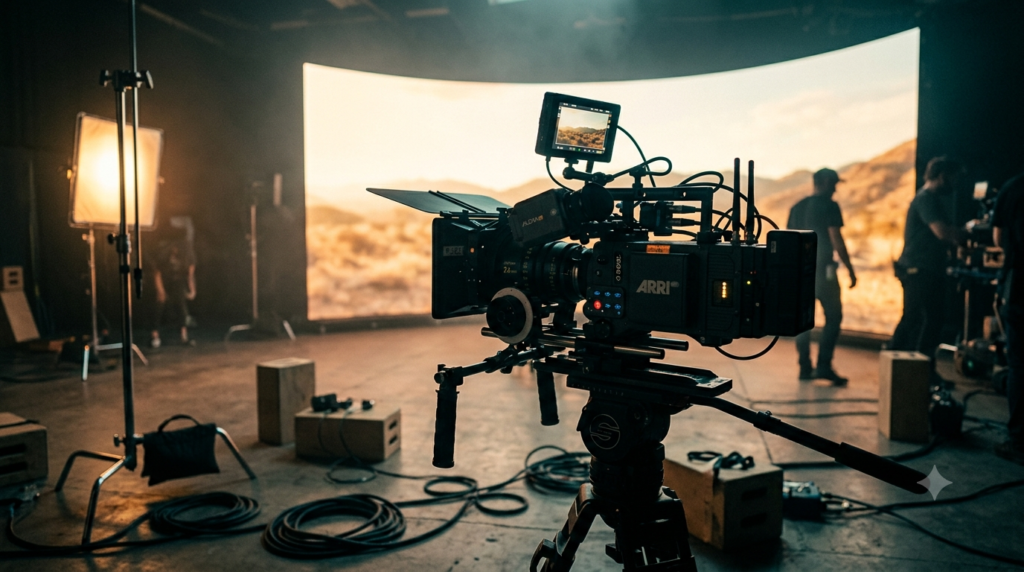
The biggest films embraced virtual production between 2020 and 2025. LED volume walls, digital set extensions and pre-visualisation moved from Hollywood into Hyderabad.
Kalki 2898 AD is the clearest example. Made on a reported ₹600 crore budget, it ranks among the most expensive Indian films, and it was shot largely at Ramoji Film City using heavy digital environments. Serbian cinematographer Djordje Stojiljkovic handled the final look, giving the sci-fi world a photoreal depth that Indian cinema rarely attempts.
RRR pushed the previsualised approach too, since its CG-heavy scenes needed lighting maps planned in advance to keep shadows consistent. Cinematographers now sit with the VFX team from pre-production, so the camera captures clean plates that composite cleanly later. High dynamic-range bodies like the ARRI Alexa LF and Sony Venice make that possible.
This matters for Telugu cinema cinematography as a whole. Once the biggest films proved that LED walls and pre-viz could work here, mid-budget projects started borrowing the same playbook. Virtual sets now show up in dream sequences and period scenes that would have demanded costly location shoots only a few years ago.
Who Actually Shot These Films?
Here is the section most fan pages get wrong. Many popular articles credit the wrong cinematographer for the era’s biggest films. The table below lists the verified directors of photography, checked against film credits and industry interviews.
| Film (Year) | Actual cinematographer | Common online error |
|---|---|---|
| Pushpa: The Rise (2021) & Pushpa 2 (2024) | Mirosław Kuba Brożek | Wrongly credited to Indian DoPs |
| They Call Him OG (2025) | Ravi K Chandran | Often mis-listed |
| Kalki 2898 AD (2024) | Djordje Stojiljkovic | Dani Sanchez-Lopez, who was replaced |
| Balagam (2023) | Acharya Venu | Frequently mis-credited |
| Rangasthalam (2018) | R Rathnavelu | — |
| Dasara (2023) | Sathyan Sooryan | — |
Two corrections matter most. Pushpa and its sequel were shot by Polish cinematographer Mirosław Kuba Brożek, who won a Filmfare South award for the first film. OG, meanwhile, was led by veteran Ravi K Chandran, not the names that circulate on aggregator sites.
The Kalki mix-up is the trickiest. Kalki 2898 AD was finished by Djordje Stojiljkovic after Dani Sanchez-Lopez left the project. Sanchez-Lopez had shot Nag Ashwin’s earlier film Mahanati, so fans reasonably assumed he stayed on, yet the credited DoP changed.
The DoPs Driving Telugu Cinema Cinematography Trends
A handful of directors of photography defined this stretch. Each brought a distinct visual grammar, and each proves that lensing is now a form of authorship.
- KK Senthil Kumar (RRR, Baahubali): grand-scale motion and epic staging.
- R Rathnavelu (Rangasthalam, Sarileru Neekevvaru): rustic texture and desaturated realism.
- Mirosław Kuba Brożek (Pushpa 1 & 2): dynamic movement and earthy, high-energy frames.
- Djordje Stojiljkovic (Kalki 2898 AD): photoreal sci-fi and virtual-production depth.
- Ravi K Chandran (OG, Bheemla Nayak): stylised, hard-light noir energy.
- Acharya Venu (Balagam): soft, minimal light and quiet village intimacy.
Brożek’s work on Pushpa 2 shows how technical the craft has become. He shot on Cooke anamorphic and spherical lenses, favouring 32mm and 50mm focal lengths, so the film gained depth and clean highlight roll-off.
Ravi K Chandran took a different route on OG. He told an interview that he wanted the film to look like a “Tarantino film”, so he used harder 1980s and 1990s-style lighting for its Mumbai underworld.
Cameras and Tools That Made It Possible
Better gear reached mid-budget films, and that democratised the high-end look. The ARRI Alexa LF, ARRI Mini LF, Sony Venice, Sony Venice 2 and Blackmagic 12K all appear across recent Telugu productions.
These bodies matter because their wide dynamic range protects detail in shadow and highlight alike. That gives colourists more room in the digital intermediate, and it gives VFX teams cleaner plates. OTT delivery pushes the same point, since Prime Video and Netflix titles increasingly need Dolby Vision mastering that must look right on a theatre screen and a phone.
Colour pipelines matured alongside the cameras. Telugu cinema cinematography now assumes a full digital-intermediate stage, so grading is planned from the first day of the shoot rather than patched together in post. That planning is a big reason the recent look feels so consistent within each film.
How Visuals Now Drive the Story
Cinematographers increasingly shape screenplay rhythm, not just image quality. In Dasara, mine dust, backlight flares and slow-motion silhouettes define class struggle visually, so the film argues its theme without spelling it out.
Pushpa shifts its tones from dusk to firelight to mirror the hero’s rise. Even smaller films like Hi Nanna and Balagam lean on lens choice to separate emotional beats, because a wide lens opens up a community while a longer lens isolates a private moment.
Telugu Cinema Cinematography Trends Go Global
The craft is now genuinely international. Telugu teams hire foreign directors of photography, and they bring in colourists and camera technicians from Los Angeles, Prague and Singapore for the digital intermediate stage.
That exchange runs both ways. Polish, Spanish and Serbian cinematographers learned to shoot Indian scale, while local crews absorbed global workflow habits. The result is a hybrid look that travels well, so Telugu cinema cinematography now sits comfortably beside other world cinema on a streaming home page.
The Future of Telugu Cinema Cinematography Trends
The next wave is already visible. Several trends point to where the visuals go after 2025.
- Virtual production hubs: Hyderabad studios are adding LED volume stages, so more films can shoot digital worlds in-house.
- AI-assisted grading: machine-learning tone matching speeds up the digital intermediate, though human colourists still make the calls.
- Greener shoots: virtual sets and drone scanning cut travel and location costs.
- Bigger swings: SS Rajamouli‘s next film, Varanasi, is set for a worldwide release on 7 April 2027, and it will test how far this scale can stretch.
None of this replaces judgement. The tools are getting cheaper and smarter, yet the films that stand out still win on choices, because a strong eye behind the camera matters more than the camera itself.
Final Frame
The 2020–2025 stretch turned Telugu cinema cinematography from a support craft into a storytelling force. Colour, movement and virtual production all matured at once, and foreign talent sped the change along.
If you take one thing away, make it accuracy, since the biggest films of the era are also the most mis-credited. Want the technology side in depth? Read our guide on AI and VFX in South cinema, then trace the roots in our history of Telugu cinema.
Frequently Asked Questions
What is the biggest change in Telugu cinema cinematography after 2020?
The shift from loud, oversaturated colour to muted, story-led grading is the clearest change. Cameras also became far more mobile, so drones and gimbals now track emotion. Virtual production and foreign directors of photography added a global polish on top.
Who shot Pushpa: The Rise and Pushpa 2?
Polish cinematographer Mirosław Kuba Brożek shot both Pushpa: The Rise (2021) and Pushpa 2: The Rule (2024). He won a Filmfare South award for the first film. Many online lists credit the wrong person, so this is a common error to avoid.
Who was the cinematographer of Kalki 2898 AD?
Serbian cinematographer Djordje Stojiljkovic is the credited director of photography on Kalki 2898 AD (2024). Dani Sanchez-Lopez was attached earlier but was replaced. Sanchez-Lopez had shot Nag Ashwin’s Mahanati in 2018.
Which Telugu film used virtual production most heavily?
Kalki 2898 AD made the largest use of LED-volume and digital set extensions. RRR also pushed previsualisation and lighting maps for its CG-heavy scenes. Both films moved Hyderabad closer to Hollywood-style pipelines.
Which cameras are common in modern Telugu films?
The ARRI Alexa LF, ARRI Mini LF, Sony Venice, Sony Venice 2 and Blackmagic 12K appear often. Filmmakers pick them for wide dynamic range, because that protects detail and helps both grading and VFX.
Are foreign cinematographers common in Telugu cinema now?
Yes, and increasingly so. Polish, Spanish and Serbian directors of photography have shot major recent titles. Telugu teams also hire overseas colourists and technicians for the digital intermediate stage.
Who shot RRR and Rangasthalam?
KK Senthil Kumar shot RRR and the Baahubali films, bringing large-scale visual grammar. R Rathnavelu shot Rangasthalam and Sarileru Neekevvaru, and he is known for rustic, desaturated realism.
Why did Telugu cinema cinematography change so quickly?
Three forces lined up at once. Bigger budgets funded better gear, OTT platforms demanded a global look, and foreign directors of photography brought fresh habits. Together they pushed Telugu cinema cinematography forward faster than any single decade before it.