South Indian Folk Tales Waiting to Become Great Films
South Indian folk tales are one of cinema’s biggest untapped reserves, yet most of them still live only in village courtyards and hilltop shrines. Tollywood, Kollywood and Mollywood keep mining the same epics, while a huge archive of regional legends waits offstage.
These stories carry ready-made worlds, strange gods and moral stakes that a screenwriter would kill for. So why do they stay unfilmed? This guide maps four folk-tale goldmines and shows why the timing has never been better. It also explains how to bring them to screen without flattening the cultures they come from.
South Indian Folk Tales at a Glance
- The gap: big-budget cinema favours pan-India epics, so hyper-local legends get sidelined despite strong screen potential.
- The proof: Karthikeya 2, Kantara and HanuMan showed that rooted, region-first stories can go national and earn hundreds of crores.
- Four sources: Telangana’s Oggu Katha ballads, Andhra’s Tholu Bommalata shadow theatre, the Renuka–Yellamma legend, and the spirit-lore of coastal Karnataka.
- The catch: each one needs genuine research and community involvement, because these are living traditions, not free set dressing.
Why So Many South Indian Folk Tales Stay Off the Screen
Despite the success of mythological and folklore-fantasy films across South India, a vast store of regional legend stays unexplored. The reasons are mostly practical, not creative. Folklore at scale demands big budgets, heavy VFX and long shoots, so producers hesitate before committing.
Many of these South Indian folk tales are also deeply local. They carry a specific language, community and geography, which can look “too regional” to a financier chasing a Hindi-belt release. Mainstream attention has shifted toward crime thrillers and OTT formats too, so older myths slip further down the slate.
Yet that caution hides the opportunity. Because these legends are unfamiliar, they offer fresh worlds and characters no other film has used. When the core theme is universal, a rooted story travels further than a generic one, since audiences can feel the authenticity underneath it.
Four South Indian Folk Tales Ready for the Big Screen
Below are four traditions with real cinematic muscle. Each entry lists the source, a story angle, its standout strength and the honest challenge that comes with it. The table sums them up before we dig in.
| Tradition | Region | Best-fit genre | Main challenge |
|---|---|---|---|
| Oggu Katha ballads | Telangana | Period fantasy-adventure | Portraying pastoral communities with respect |
| Tholu Bommalata | Andhra Pradesh | Meta fantasy-thriller | Translating puppet aesthetics to live action |
| Renuka–Yellamma | Karnataka, Telangana | Mythological drama | Handling real community traditions sensitively |
| Coastal Karnataka spirit-lore | Coastal, Malenadu Karnataka | Folk horror or fantasy | Avoiding lazy “spooky village” clichés |
Oggu Katha: Telangana’s Deity-Ballads of Mallanna and Beerappa
Oggu Katha is a Telangana ballad tradition where hereditary performers narrate the legends of deities like Mallanna, Beerappa and Yellamma. Singers from the Golla (Yadav) and Kuruma communities blend song, drumming and drama, using a small hand drum called the oggu that echoes Shiva’s damaru. At the Komuravelli Mallanna shrine, this oral ballad is still the only scripture the legend has.
Film potential: a period fantasy-adventure set across Telangana’s hills and hamlets, following a young balladeer who uncovers a lost deity’s secret. Why it stands out: the visual world is rich, since ritual drums, folk dance and dusty tribal terrain do half the world-building for you. Challenge: these are worshipped caste-gods and living communities, so authenticity and consultation matter more than spectacle.
Tholu Bommalata: Andhra’s Shadow-Puppet Epics
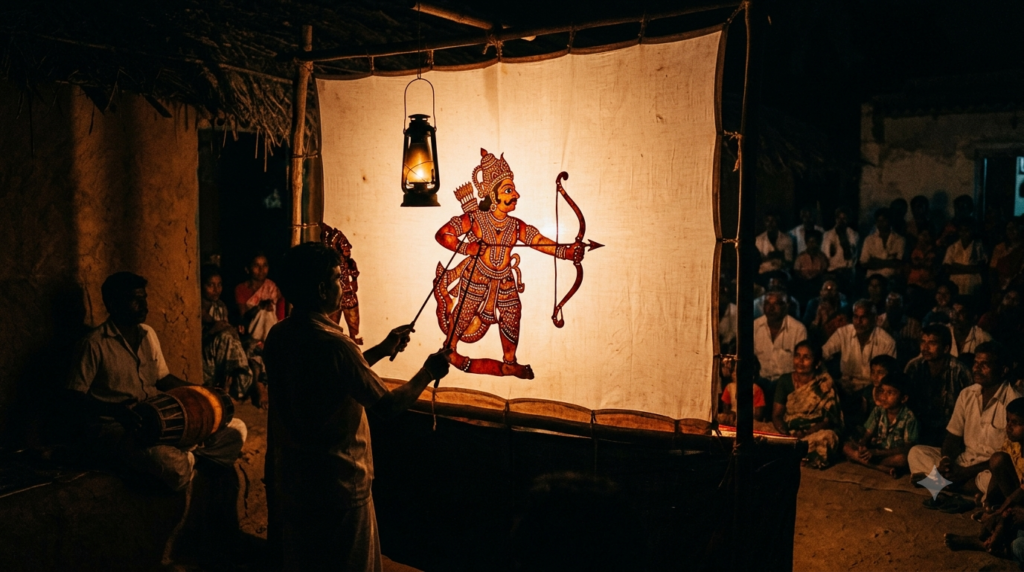
Tholu Bommalata is a centuries-old shadow-puppet theatre from Andhra Pradesh, once used to narrate the Ramayana and Mahabharata on backlit screens. The puppets are cut from translucent goatskin and stand unusually tall, often between 120 and 180 centimetres. This craft flourished under Vijayanagara patronage and earned a Geographical Indication (GI) tag in 2008, though only a handful of troupes still perform it today.
Film potential: a meta fantasy-thriller where modern filmmakers rediscover the art and accidentally release ancient mythic characters into the real world. Why it stands out: the visual novelty is instant, because leather figures, night-shows and lamp-lit screens give you a look nothing else has. Challenge: you must translate that puppet magic into live action while keeping its handmade soul intact.
Renuka–Yellamma: A Feminine Divine Story
Renuka, worshipped as Yellamma across Karnataka, Telangana and Maharashtra, anchors one of the most layered legends in the South. Her story moves through devotion, betrayal and transformation, and it sits at the centre of strong regional worship. It also connects to real communities, including the Jogappa tradition, which makes it powerful and delicate at once.
Film potential: a mythological feature about Renuka’s trials and her rise as Yellamma, told with a feminine divine centre. Why it stands out: few South Indian folk tales offer a goddess-led arc with this much social and emotional weight. Challenge: the surrounding traditions carry a difficult history, so the material needs careful research, community voices and zero exploitation of vulnerable groups.
Coastal Karnataka: Spirits, Nagas and Bhutas
Karnataka’s coastal and Malenadu belt hides a dense web of spirit-lore, from serpent guardians to forest and sea spirits. These beliefs are less documented online, yet they shape daily ritual life across the region. Anyone who saw Kantara already glimpsed how cinematic this world can be.
Film potential: a folk-horror anthology or single feature about local guardians, megalithic stones and supernatural protectors of forests and coasts. Why it stands out: the setting feels genuinely new, while the genre appeal of horror and dark fantasy sells easily in South markets. Challenge: the research load is heavy, and you must avoid reducing rural belief to a cheap scare.
The upside is that these spirit-worlds come with their own rules, aesthetics and moral order. A serpent guardian or a forest bhuta is not just a monster, since it enforces a code the community actually lives by. When a film respects that logic, the horror stops feeling generic and starts feeling earned.
Why South Indian Folk Tales Fit Cinema Right Now
This is no longer a theory, because the box office has already proved it. Over the last few years, rooted myth and folklore stories have become one of Indian cinema’s most reliable formulas. The numbers are simply hard to argue with.
Nikhil Siddhartha’s Karthikeya 2 (2022) turned a mythology-adventure into a pan-India hit. Rishab Shetty’s Kantara (2022) built its whole spine from coastal Karnataka’s Bhuta Kola ritual, then crossed every language barrier it met. Its 2025 prequel, Kantara: Chapter 1, became one of the year’s biggest Indian releases, reportedly grossing around ₹656 crore worldwide.
Prasanth Varma’s HanuMan (2024) fused a superhero arc with devotional aura and stunned the trade. Even Hombale’s animated Mahavatar Narasimha (2025) marched toward the ₹200 crore mark. Together these films show that region-first storytelling now travels, so a well-made folk adaptation carries real commercial logic, not just cultural pride. For more on this shift, see our look at Telugu mythology and superhero films in 2026.
The audience appetite behind these numbers is not an accident either. OTT platforms have trained viewers to explore regional content, while the diaspora hungers for stories that feel rooted in a real place. Niche myth-fantasy answers both cravings at once, because it offers spectacle and cultural depth in the same package. That combination is exactly why a fresh folk source can punch far above its budget.
How to Adapt South Indian Folk Tales Without Losing Their Soul
Getting the box office logic right is only half the job. The harder half is treating the source culture as a partner, not a prop. These tales belong to real people, so the adaptation has to earn its authenticity.
- Involve local stakeholders. Bring in folk artists, community custodians and elders early, whether that means Oggu performers or coastal ritual practitioners.
- Preserve cultural specificity. Use original dialects, authentic costumes and folk music instead of a generic “mythic” gloss.
- Balance fantasy and realism. Respect the spiritual core of the myth while still delivering cinematic drama and scale.
- Find a modern entry point. A young outsider discovering the legend can widen appeal without diluting the tradition.
- Avoid the exotic trap. Never treat tribal or folk communities as set-pieces, because agency and depth are what make the story land.
Sensitivity is not a limit on creativity here. It is the thing that separates a film people cherish from one a community feels robbed by. This matters even more when a tale touches faith, caste or vulnerable groups, so consultation should be built into the script stage.
What Producers Should Weigh Before Backing a Folk-Myth Film
For producers, these South Indian folk tales are a calculated bet rather than a gamble, provided the planning is honest. A few practical factors decide whether the project soars or sinks.
- Budget versus scale. A folk-myth film can stay mid-budget when the tone is restrained. Costs only balloon when VFX spectacle takes over, so match ambition to the story.
- Marketing hook. Lean on the “first time on screen” angle, since audiences are drawn to legends they have never seen filmed before.
- Regional first, pan-India later. Launch in the local language, prove the connection, then dub and stream outward, exactly the path Kantara followed.
- Streaming synergy. These myths work well as OTT films or series, which extends their life long after the theatrical run ends.
The lesson from recent hits is consistent. When the roots are real and the craft is strong, a regional legend can outperform a far costlier “safe” project.
Want to understand why local identity travels so well now? Read our piece on how regional identity shapes Telugu cinema. Our explainer on what “pan-India film” really means digs deeper too.
The Bottom Line
South India’s cultural landscape is rich not just in famous legends, but in untold ones living in tribes, villages, coastlines and hills. The commercial case is now proven, and the creative case was never in doubt.
For any filmmaker willing to do the research and share the credit, this is fertile ground. These South Indian folk tales are ready whenever the industry is brave enough to back them. The next unforgettable South Indian film may well begin where tradition meets the screen for the very first time.
FAQs About South Indian Folk Tales in Cinema
Why haven’t more South Indian folk tales been made into films?
Mostly it comes down to budget, scale risk and a fear of limited reach. Many folk tales survive only as oral traditions, so adapting them takes serious research before a script even exists. That extra effort has kept producers cautious.
Can a very local legend succeed at pan-India scale?
Yes, and recent films prove it. Kantara grew from a Karnataka coastal ritual into a national phenomenon, because its core themes of faith and identity were universal. Strong execution and rooted authenticity matter more than a “safe” generic setting.
Which genres suit South Indian folk-tale adaptations?
Fantasy, folk horror, period adventure and mythological drama all fit naturally. Some tales even work as modern thrillers with a mythic undercurrent. The genre matters less than pairing authenticity with real cinematic craft.
How can a film ensure cultural authenticity?
Engage cultural consultants, include folk artists and shoot on location where possible. Respecting community traditions during production, not just in the credits, is what keeps a folk adaptation honest and believable.
What are some real examples of this trend working?
Karthikeya 2, Kantara, Kantara: Chapter 1 and HanuMan all drew on Indian myth and folklore and became major hits. The animated Mahavatar Narasimha added to the wave in 2025. Together they show the formula is commercially durable.
Where should a storyteller start when exploring a folk tale?
Begin with lesser-known legends from your own region and document them through interviews and community sources. From there, map a clean cinematic structure of setup, conflict and resolution. Grounding the film in a real place gives it instant texture.
Is there a risk in adapting sensitive folk traditions?
There can be, especially when a tale touches faith, caste or vulnerable communities. The safeguard is early consultation, accurate research and genuine respect for the people involved. Handled well, sensitivity strengthens a film rather than limiting it.