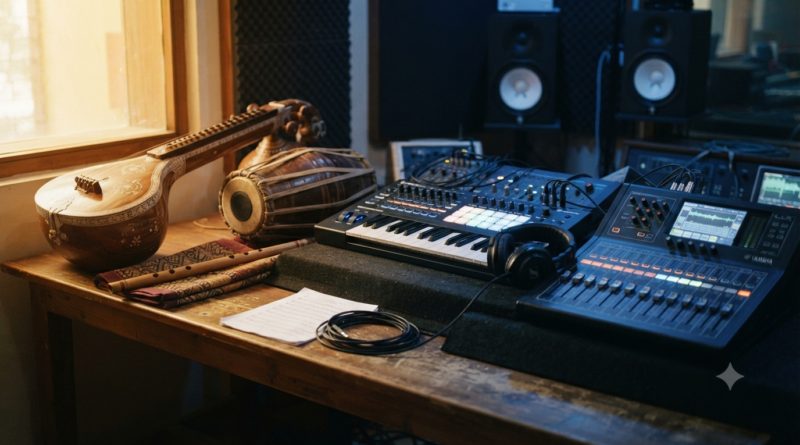
Telugu Film Music Evolution: From Ghantasala to Thaman
The story of Telugu film music begins with Ghantasala’s raga-rooted melodies in 1949 and runs all the way to Thaman’s chart-topping beats and the Oscar-winning “Naatu Naatu.” Across more than seven decades, the sound of Tollywood has shifted from voice-and-veena simplicity to layered, beat-driven, globally streamed anthems. This guide traces that journey composer by composer, so you can hear how each era set up the next. Along the way, it fills in the golden-age names most timelines skip, because the leap from Ghantasala to Ilaiyaraaja actually took thirty crowded years.
Telugu Film Music at a Glance
Here is the whole arc in one glance before we dig in. Each phase built on the last rather than replacing it.
- Golden Age (1949–1950s): Ghantasala and Saluri Rajeswara Rao anchor songs in Carnatic melody and light orchestration.
- Classic era (1960s–1980s): KV Mahadevan, K Chakravarthy and Raj–Koti rule the mass-and-classical divide.
- Fusion turn (1980s): Ilaiyaraaja folds Western harmony and folk rhythm into the palette.
- Keeravani epoch (1990s–2020s): cinematic scoring grows up and goes pan-Indian, ending in an Oscar.
- Modern surge (2015–now): Thaman and Devi Sri Prasad push pop, EDM and viral hooks to the front.
The Golden Age That Shaped Telugu Film Music
Early Telugu film music leaned on melody, Carnatic ragas and sparse instrumentation. The voice sat at the centre, while strings, flute and mridangam filled the frame around it. Because most playback singers carried real classical training, songs were rendered with a purity that still defines the “golden” label. This chapter sits inside the broader history of Telugu cinema, where sound and story grew up together.
Ghantasala and the Melodic Foundation
Ghantasala Venkateswara Rao (1922–1974) is remembered first as a legendary playback voice, yet he also composed. His debut as a music director came with Keelu Gurram (1949), a folklore hit that was also the first Telugu film later dubbed into Tamil. His style mirrored classical tradition: clean ragas, simple harmony, and arrangements that never buried the singer. That template shaped what audiences expected from a Telugu song for years.
Saluri Rajeswara Rao and Early Orchestration
Working alongside him, Saluri Rajeswara Rao (1922–1999) wove Indian classical music into cinema for five decades. His score for the comedy classic Missamma (1955) shows how melody and playful orchestration could coexist. His sons later carried the craft forward, so his influence outlived his own charts.
The Classic-Era Composers Most Timelines Skip
Here is where the usual “Ghantasala to Ilaiyaraaja” jump loses thirty years. Between the 1960s and the 1980s, a whole generation of composers defined the daily sound of Tollywood. Skipping them hides how the industry actually learned to score at scale.
KV Mahadevan: The Classical Peak
KV Mahadevan (1918–2001) earned the Telugu title “Swara Brahma,” meaning the creator of musical notes. His work with director K Viswanath produced Sankarabharanam (1980), a film built entirely around Carnatic music that became a cultural landmark. He later scored Sirivennela and Swathi Kiranam in the same tradition. When people say Telugu cinema once treated ragas as the hero, this is the body of work they mean.
K Chakravarthy: The Volume King
If Mahadevan was the classicist, K Chakravarthy (1936–2002) was the workhorse. He debuted in 1971 and went on to compose for more than a thousand films, most of them Telugu. His melodies drove the mass-hero films of the 1970s and 1980s, so an entire decade of hits carries his fingerprint. Keeravani, notably, began his own career as Chakravarthy’s assistant.
Raj–Koti and the Late-1980s Sound
The duo Raj–Koti bridged the classic and modern eras. Koti, a son of Saluri Rajeswara Rao, teamed with Raj in 1983 and scored roughly 180 films before they split in 1994. Their peppy, keyboard-forward arrangements pointed straight toward the synth-driven 1990s. After the split, Koti kept composing for hundreds more titles.
The Ilaiyaraaja Era: Fusion Enters Telugu Film Music
Ilaiyaraaja is celebrated most in Tamil cinema, yet his Telugu work reshaped the region’s sound. He brought Western harmony, folk percussion and adventurous orchestration, while keeping an Indian melodic core. Because he could write a full string arrangement and a village folk beat with equal ease, later composers inherited a much wider canvas.
The Films That Proved It
Two Telugu titles show his range clearly. Sagara Sangamam (1983) and Rudraveena (1988) both won him the National Film Award for Best Music Direction. The first is a dancer’s film soaked in classical melody, while the second wraps social drama in soaring, hummable songs. He also scored Swathi Muthyam and Geethanjali, so his Telugu catalogue is deep, not incidental.
Folk and Rhythmic Energy
One lasting shift was his bold use of folk and percussion-heavy rhythms. He treated village sounds as serious material rather than novelty. That instinct echoes today whenever a modern hit like “Naatu Naatu” leans into folk energy for global appeal.
The Keeravani Epoch and the Pan-Indian Breakthrough
MM Keeravani (born 1961) became the defining voice of modern Telugu film music. He blends strong melody, orchestral richness, Western classical texture and contemporary beats. Known as MM Kreem in Hindi cinema, he has scored for over two hundred films across languages. His enduring partnership with cousin and director SS Rajamouli shaped much of that run.
From Debut to National Award
Keeravani debuted with Manasu Mamata (1990), then broke through with Ram Gopal Varma’s Kshana Kshanam (1991). Every song in that film became a chartbuster. He won the National Film Award for Best Music Direction for the devotional epic Annamayya (1997), which proved he could carry tradition and mass appeal at once.
Background Score Becomes a Character
Under Keeravani, the background score stopped being filler. His work on Magadheera (2009), the Baahubali duology (2015–2017) and RRR (2022) used motifs, choirs and full orchestration to carry the story. Themes attached to characters, so the music told you who had entered a scene before the dialogue did. That cinematic scoring is now the Telugu standard.
The Oscar Moment
His song “Naatu Naatu,” written with lyricist Chandrabose, made history. It won the Golden Globe in January 2023 and then the Academy Award for Best Original Song in March 2023. That made RRR the first Indian film to win the Oscar for Best Original Song. A Telugu track had, quite literally, gone to the top of the world.
The Modern Surge in Telugu Film Music
Today’s Telugu film music is fast, loud and built for phones. Composers freely mix pop, EDM, hip-hop and folk, while still chasing a melody you can hum. Two names lead the mass-market charge, backed by a deep bench of younger talent.
Thaman and the Pop / EDM Infusion
Thaman fuses electronic drums, processed vocals and drop sections with catchy tunes. His breakout viral hit is “Butta Bomma” from Ala Vaikunthapurramuloo (2020), sung by Armaan Malik. The song crossed 400 million YouTube views and was named Viral Song of the Decade at the Mirchi Music Awards South. It became the ringtone-and-reel anthem of its year.
Devi Sri Prasad and the Pushpa Effect
Devi Sri Prasad, known simply as DSP, may be the most streamed of them all. His Pushpa: The Rise (2021) soundtrack delivered “Srivalli,” “Saami Saami” and the phenomenon “Oo Antava.” He returned for Pushpa 2: The Rule (2024) with “Pushpa Pushpa,” “Kissik” and “Peelings.” Each of those songs was engineered from the first beat to travel across Instagram and short video.
New Names and Fresh Voices
Around them, composers like Anirudh Ravichander, GV Prakash Kumar and Mickey J Meyer keep pushing the edges. They mix trap, rap, synthwave, cinematic soundscapes and regional folk to reach both mass crowds and niche listeners. Because streaming rewards variety, no single template dominates the way one composer once could.
How Style, Instrumentation and the Score Changed
The clearest way to see the shift is side by side. Each era added tools without fully discarding the old ones, so the modern soundstage still hides a veena under the synths.
| Era | Lead composers | Signature sound | Landmark work |
|---|---|---|---|
| Golden Age (1949–50s) | Ghantasala, Saluri Rajeswara Rao | Raga melody, light orchestra | Keelu Gurram (1949) |
| Classic (1960s–80s) | KV Mahadevan, K Chakravarthy | Classical peaks and mass hits | Sankarabharanam (1980) |
| Fusion (1980s) | Ilaiyaraaja | Western + folk fusion | Sagara Sangamam (1983) |
| Cinematic (1990s–2020s) | MM Keeravani | Orchestral, motif-driven score | RRR / Naatu Naatu (2022) |
| Modern (2015–now) | Thaman, DSP | Pop, EDM, viral hooks | Pushpa (2021–2024) |
Instrumentation Shifts
The staple kit was once strings, flute, veena, mridangam and tabla. Later composers added brass, choral voices and full orchestral winds. The modern desk now layers synthesizers, programmed drums, samples and digital effects on top of all of it.
The Score as a Silent Character
Early scores mostly supported the songs. Now they shape mood, foreshadow drama and stitch scenes together, much as global cinema uses a theme as a “silent character.” A single recurring motif can tell an audience how to feel before anyone speaks.
Music as Marketing: How Telugu Film Songs Go Viral
Songs are no longer only part of a film; they are its advertising. A strong single launched weeks ahead can build buzz before the first ticket sells. Many Telugu films now release two or three singles in sequence to keep interest hot.
Hooks Built for Short Video
Modern composers design short “hook lines” on purpose. These 15-to-30-second bursts are ideal for reels, and the beat drop is placed exactly where a creator will loop it. “Butta Bomma” spread this way, as its catchy portion was reused across millions of short clips.
Challenges and Cross-Platform Reach
Dance challenges then stretch a song’s life far past release week. “Naatu Naatu” travelled worldwide on the back of its step challenge, reaching viewers who had never watched a Telugu film. Because lyric videos, unplugged cuts and dance versions all feed the same track, one song can earn across YouTube, streaming and live shows for years.
What’s Next for Telugu Film Music
Predicting art is risky, yet a few directions already look likely rather than certain. Treat these as informed observations, not settled facts. The safe bet is that hybridisation keeps accelerating.
- More genre hybrids: expect lo-fi, trap and synthwave blended with Indian instruments and folk motifs.
- Global collaborations: pan-Indian budgets increasingly invite foreign producers and session players.
- Folk revival: after “Naatu Naatu,” composers are mining lesser-known regional traditions for fresh hooks.
- AI-assisted tooling: sample libraries and generative sketches may speed up drafting, a shift already visible in AI and VFX across South cinema, though the melody call stays human.
The Bottom Line
Telugu film music has grown from soulful, voice-first roots into grand, genre-blending, globally streamed ambition. Ghantasala laid the melodic foundation, the classic-era composers built the industry’s craft, and Ilaiyaraaja opened the doors to fusion. Keeravani then added cinematic depth and carried a Telugu song to the Oscars, while Thaman and DSP made the music travel on every phone. If you want to feel the whole arc in one sitting, start with Sankarabharanam, jump to Sagara Sangamam, then finish with “Naatu Naatu” and “Pushpa Pushpa.”
Frequently Asked Questions
How has Telugu film music changed over the decades?
Telugu film music moved from raga-based melody with light orchestration to fusion, then to full cinematic scoring, and finally to pop and EDM built for viral reach. Each era added tools without erasing the melodic core. The voice mattered most in 1949, while the beat and the hook lead today.
Who composed the first Telugu film song as a music director debut?
Ghantasala made his debut as a music director with Keelu Gurram (1949). He was already a celebrated playback singer, and this folklore film marked his first full composing credit. It was also the first Telugu film later dubbed into Tamil.
Which composer won the Oscar for a Telugu film song?
MM Keeravani won the Academy Award for Best Original Song in 2023 for “Naatu Naatu” from RRR, alongside lyricist Chandrabose. The song had already won the Golden Globe weeks earlier. It was the first Indian film song to win an Oscar.
Why do older Telugu songs sound more melody-focused?
Early composers prioritised voice and melody because they were rooted in Carnatic tradition. The instrument palette was also smaller, so arrangements stayed spare. Singers with classical training then rendered those tunes with careful purity.
Who are the biggest Telugu film music composers today?
Thaman and Devi Sri Prasad lead the current mass market, powered by hits like “Butta Bomma” and the Pushpa songs. Younger names such as Anirudh Ravichander and GV Prakash Kumar are rising fast. The field is more crowded and varied than in any earlier era.
Did Ilaiyaraaja really work in Telugu cinema?
Yes, and extensively. He won National Awards for the Telugu films Sagara Sangamam (1983) and Rudraveena (1988). His Telugu catalogue also includes Swathi Muthyam and Geethanjali.
Why do Telugu film songs go viral so easily now?
Composers design short, danceable hooks made for reels and shorts. A well-placed beat drop invites reuse, while dance challenges spread the song beyond its language. Cross-platform releases then keep a single track earning for years.
