Film Jump Cut: Time Skips, Examples and Editing Tips
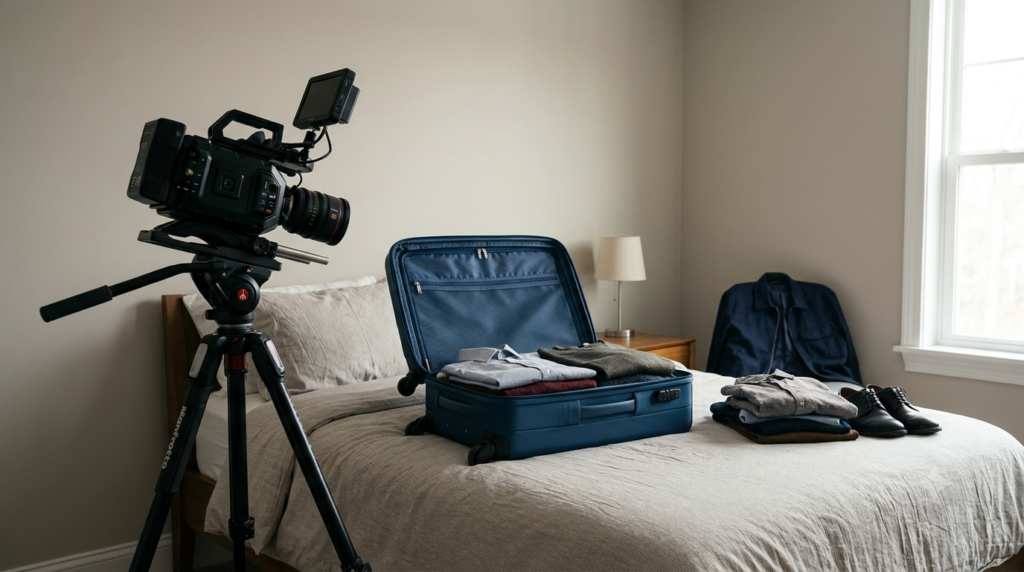
A film jump cut lets one action leap forward without pretending that nothing happened between the images. Picture a traveller packing a suitcase. One moment it lies empty; a beat later, clothes have appeared inside it, although the camera still faces the same bed. That visible break is the point.
Jump cuts often shorten screen time, but the skipped minutes are only part of their effect. The edit also draws attention to the missing action. Our entirely fictional packing scene makes that distinction easy to see.
What Is a Film Jump Cut?
A film jump cut is an abrupt edit between moments of apparently continuous action, often from the same or a very similar camera view. Part of the action goes missing, so a person or object appears to jump ahead. Rather than hide the gap, the cut makes viewers notice it.
Adobe describes the familiar form as removing a section from one continuous shot. The Adobe explanation of jump cuts also notes the sudden shift in a subject’s position. Meanwhile, the New York Film Academy’s editing glossary identifies missing action and disrupted continuity as defining traits.
The central clue is not speed. It is the contrast between an almost unchanged view and a changed moment within that view. A film jump cut may feel playful, impatient, tense or oddly mechanical, depending on the scene around it.
Film Jump Cut at a Glance
- Visual clue: the setting looks much the same, but the subject suddenly occupies a new position.
- Time: the edit leaves out part of an ongoing action instead of showing every beat.
- Purpose: it can compress routine, sharpen a rhythm or make a break feel deliberate.
- Key distinction: a simple move to a later scene is not automatically a jump cut.
One practical test helps. If the new image seems to continue the same view but an important piece of movement has vanished, you may be looking at a jump cut. The next sections test that idea with one invented scene.
A Film Jump Cut in a Fictional Packing Scene
Imagine Leena packing for a journey. The camera sits on a tripod across from her bed, with an open blue suitcase near the centre. A lamp and a folded jacket remain visible behind it. Nothing in this example comes from an existing film.
Leena puts one shirt into the case. We then cut forward, without moving the camera, to find several shirts inside and her hands holding a pair of shoes. The missing folds are obvious because the room and frame stay familiar.
| Moment | What the camera shows | What the viewer notices |
|---|---|---|
| Before the cut | Leena stands beside a nearly empty suitcase, holding one shirt. | The packing has just begun. |
| First jump | Same view; the case holds several shirts, and Leena now lifts shoes. | Some packing steps have disappeared. |
| Second jump | Same view; the lid is nearly shut, and Leena presses it down. | More effort has passed without a smooth bridge. |
| Final beat | Leena stops pressing, then looks at a passport left on the bed. | The rush has produced a small problem. |
The first two changes establish a brisk, broken rhythm. However, the last beat has room to breathe, so the forgotten passport can land as a joke or a moment of panic. The film jump cut shapes the feeling, not merely the running time.
Why keep the suitcase in the same part of the frame?
Keeping the suitcase in a fixed area makes the time gap easier to read. The bed, lamp and camera height become points of reference, while the contents shift abruptly between cuts. Viewers do not need an on-screen clock because the changing state of the case tells them what vanished.
This is a useful piece of visual logic. If every shot also changes angle, scale and background, the audience may read a normal sequence of coverage instead. Repeated framing makes the missing action stand out.
What Would Continuous Action Look Like Instead?
Continuous action would show Leena taking the shirt, folding it, placing it in the suitcase and reaching for the next item. An editor could change camera angles during those gestures, yet the movement would still feel unbroken. The viewer follows a complete action across the cuts.
A close-up might begin when Leena reaches into a drawer. The next view could show the same reach finishing, with her hand arriving at the right instant. That is an action match, not a film jump cut, because the edit helps preserve the gesture.
For a fuller look at screen direction and matching movement, see Movieshala’s continuity editing guide. Its purpose differs from this example: it explains how editors help viewers follow action smoothly through changes of camera view.
Film Jump Cut vs Montage vs Graphic Match
These terms describe different decisions. A film jump cut describes a conspicuous break between nearby moments. A montage describes how several selected shots work together to compress a process or create an idea. A graphic match describes a visible resemblance across an edit.
| Technique | Packing-scene version | What matters most |
|---|---|---|
| Jump cut | The same wide view jumps from one shirt to a half-full suitcase. | Missing action becomes visible. |
| Continuous action | Leena’s reach continues smoothly across two camera angles. | Movement feels unbroken. |
| Montage | Close-ups of clothes, a travel map, a ticket and a closing suitcase form a short sequence. | Selected images create a larger process or idea. |
| Graphic match | The round suitcase wheel cuts to a round station clock in similar framing. | Shape or composition links the images. |
The comparison is not a set of rigid boxes. A montage can contain several jump cuts, while a graphic match can connect two moments that are far apart. The labels describe different features of an edit, so more than one may apply.
Why a montage is not just many jump cuts
Suppose we cut from Leena folding a shirt to a train departure board and then to rain outside a station. Those images build the idea of a journey. They do not necessarily preserve the same camera view or expose missing movement within one action.
A montage might also show the suitcase filling through repeated fixed shots. In that case, the sequence uses jump cuts as part of a montage. Movieshala’s film montage explanation explores time compression and shot order in greater depth.
Why a graphic match can still feel abrupt
Imagine a close-up of the suitcase’s circular wheel followed by a station clock with the same shape and placement. The two objects link through composition, even though the location changes. That is a graphic match, regardless of whether the cut feels gentle or startling.
The film jump cut in our bed-side view works differently. It keeps nearly the same subject and setting but drops part of an action. For more on visual resemblance, read Movieshala’s graphic match cut guide.
What Makes Deliberate Discontinuity Work?
Deliberate discontinuity works when the audience can see a break and still follow the scene’s essential meaning. The editor may refuse a smooth bridge, but some clear reference remains. In the suitcase example, that reference is the fixed bed and the steadily filling case.
Contrast is doing most of the work. The camera says we are still in the same place; the clothes say time has moved. This conflict makes the missing action noticeable, while the scene’s larger goal remains simple.
Emotional context also changes the result. Three brisk skips can make Leena look efficient when upbeat sound accompanies them. The same pattern may feel anxious if she keeps checking the door and hearing a distant countdown.
A film jump cut is therefore not automatically comic or chaotic. It becomes meaningful through duration, performance, sound and what happens before and after the edit. The technique supplies a visible interruption; the story supplies its meaning.
How to Edit a Film Jump Cut Step by Step
You can build a film jump cut from one locked-off shot without buying a special transition effect. Record a longer packing action, choose moments with visibly different states, then remove the action between them. The cut itself should remain plain enough for the change to register.
- Fix the camera. Place it on a stable support so the suitcase stays in one familiar area of the image.
- Record the full task. Ask the performer to pack several items while the camera runs continuously.
- Choose meaningful moments. Keep an early shirt, a half-full case, a nearly shut lid and the final reaction.
- Remove the routine. Delete the folds, searches and pauses between your chosen moments.
- Join the clips directly. Use straight cuts instead of dissolves, then watch how the hands and objects seem to jump.
- Check comprehension. Make sure viewers still know who is packing, where the case sits and what the character wants.
Editors working with separate takes can create a similar effect when the framing stays close enough to invite comparison. Still, one continuous recording offers a simple starting point because camera distance and lighting usually stay consistent.
How much time should each cut remove?
There is no single required length for the missing action. Remove enough time to make a change visible, yet retain the moments that explain the task. A missing fold may barely register; a jump from empty suitcase to full suitcase makes the gap unmistakable.
For the fictional scene, choose cuts by action rather than by a preset number of seconds. Pause on the passport when its discovery matters, then shorten earlier folds to increase the contrast. The rhythm should serve the character’s problem.
The Most Common Film Jump Cut Mistakes
The first mistake is treating every sudden edit as a jump cut. A hard cut to the train platform could simply start a new scene. It may skip time, but it does not necessarily create the distinctive interruption of a near-continuous view.
Another mistake is hiding the leap accidentally. If the camera shifts too far or the suitcase moves out of frame, the audience loses its visual reference. A film jump cut becomes clearer when the composition changes less than the action does.
Excess also causes trouble. If every tiny movement jumps, the packing may become hard to read. Keep the beats that show progress, and let a few actions play normally so viewers can feel the difference.
Watch for distracting continuity slips too. A jacket that appears on the wrong side of the bed might read as a mistake rather than purposeful compression. Deliberate gaps and accidental errors are not the same storytelling choice.
Does the 30-degree rule define a jump cut?
No. Editors often use the 30-degree rule as a practical guide to making angle changes read clearly, not as an absolute definition. A very small angle change can call attention to a cut, but the film jump cut is best recognised through its noticeable discontinuity.
Adobe discusses this guideline in its overview of editing cuts. The better question for the packing scene is whether the action appears to leap forward while the view stays familiar.
Three Small Edits That Change the Same Scene
Keep the footage of Leena, the blue suitcase and the forgotten passport. Then change only the cut pattern. This small test shows why editing can alter our reading without changing the story’s basic events.
- The efficient version: use several evenly spaced jump cuts as the case fills, then hold on the closed lid. The rhythm suggests determination.
- The frantic version: shorten the intervals and let Leena return repeatedly to the same half-packed state. Her hurried movement may suggest stress.
- The comic version: skip from a near-empty case straight to Leena sitting on the bulging lid. Hold for a beat before revealing the passport.
All three versions omit work. Yet their patterns lead viewers toward different emotions because repetition and pauses steer attention. This is why a film jump cut is more than a way to trim unwanted footage.
When Should You Avoid a Jump Cut?
A jump cut may be the wrong choice when viewers must understand exactly how an object moves or how a task succeeds. If Leena discovers a fragile item inside the suitcase, its placement may matter. Skipping the crucial hand movement could make the next moment confusing.
Keep continuity when a gesture carries plot information, such as hiding a key beneath a shirt. Save the jump for repetitive packing that adds no new clue. The stronger edit is the one that preserves what the audience needs.
It also helps to watch the sequence without music. If the film jump cut only feels purposeful under a loud soundtrack, the image rhythm may need more work. Try restoring one ordinary action before removing more footage.
The Bottom Line
A film jump cut makes missing action visible, especially when two moments share nearly the same view. The suitcase exercise shows how that break can save time and shape emotion. Continuous action hides the seam, montage builds a sequence of selected images, and graphic matching links visual forms.
When editing, protect the viewer’s grasp of the scene before chasing speed. Keep a clear visual anchor, omit routine actions and preserve the beat that matters. The most useful film jump cut is not merely noticeable; it changes how the audience experiences the moment.
Frequently Asked Questions
What is a jump cut in film editing?
A film jump cut is an abrupt move between moments of the same action, often with similar framing. The omitted action makes the subject seem to change position suddenly. Viewers can notice that a stretch of time has disappeared.
Is a jump cut the same as a time skip?
No. A time skip can occur between separate scenes without looking like a jump cut. The film jump cut usually makes the missing time conspicuous within what looks like a continuing scene or shot.
Can jump cuts happen in one camera shot?
Yes. Record one long take and remove sections from its middle. When you join the remaining pieces, the subject may appear to leap from one stage of an action to another.
Why do filmmakers use jump cuts?
Filmmakers use them to compress action, increase pace or draw attention to an interrupted flow. They can also suggest anxiety, impatience or humour when the surrounding performance supports that reading.
What is the difference between jump cuts and montage?
A jump cut describes a break between adjacent moments; montage describes a larger arrangement of shots. Montage may include jump cuts, but it can also rely on different views, locations or ideas.
Does a jump cut need a camera angle change?
No. The classic example removes time from a fixed camera view, so the framing barely changes. A small angle change may contribute to the effect, but it is not required.
Are jump cuts always editing mistakes?
No. An unintended continuity break can distract, but a planned jump cut can serve the scene. The test is whether viewers understand the missing action and feel the intended rhythm.
Can a jump cut and graphic match happen together?
They describe different features, so techniques can overlap. An edit might preserve a strong visual shape while also omitting time. However, a visual resemblance alone does not make an edit a jump cut.