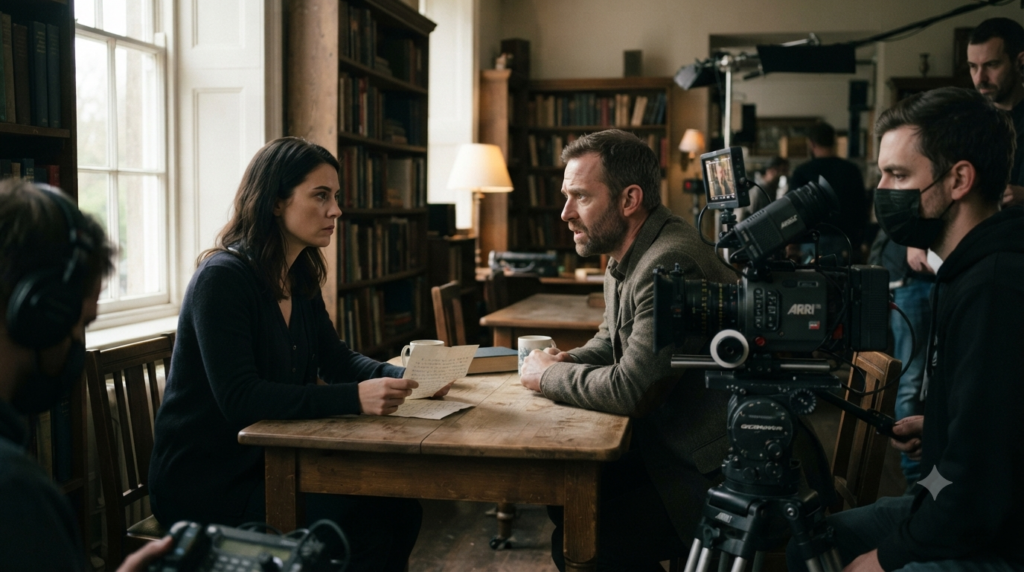
Shot Reverse Shot: Dialogue, Eyelines and Reaction Cuts
Shot reverse shot lets a film move between people in a conversation while keeping their shared space clear. One face holds a question; the next reveals how the other person takes it. The real craft lies in choosing whose reaction matters, not cutting every time someone speaks.
A fictional exchange at a library table shows how opposing camera views, matching looks and a carefully held silence can change the meaning of the same dialogue.
What Is Shot Reverse Shot?
Shot reverse shot is a filmmaking and editing pattern that cuts between complementary views of characters or subjects, often during dialogue. One angle shows a person looking toward someone off screen. The reverse angle shows the other side of that exchange. Consistent screen positions and eyelines help viewers connect the two images.
It belongs to the language of continuity editing, but it does more than maintain geography. A cut can shift our attention from a spoken sentence to the face absorbing it. The City University of New York’s media-studies teaching resource describes the convention through alternating character views and matching eyelines.
Shot Reverse Shot at a Glance
- Shot: An angle on one participant, often a medium shot or close-up.
- Reverse: A complementary angle showing the other participant or what draws their attention.
- Eyelines: Looks that fit the positions viewers understand from the scene.
- Coverage: Different recorded views an editor can choose among later.
- Reaction: A look or pause that may matter more than the spoken line.
- Key limit: Neither two simultaneous cameras nor one cut per line is required.
A Fictional Conversation, Seen from Opposing Views
Picture a quiet library room. Asha sits at the left side of a table, while Dev sits opposite her. A folded letter lies between them. Asha knows Dev has kept a secret, but she has not decided whether to confront him.
Here is their invented dialogue. Asha asks, “Did you tell her?” Dev replies, “I was going to.” She says, “She already knows.” Dev looks at the letter but says nothing. Asha finally asks, “Then why is this still here?”
Those lines could play in a single wide view. Yet a shot reverse shot arrangement lets the editor decide when we study each face. The exchange becomes less about passing words back and forth and more about who understands the truth first.
The shot order that changes the scene
- Two-shot: Both characters and the letter share the frame, establishing their positions.
- Asha’s angle: She asks the first question while looking toward screen right.
- Dev’s reverse: He answers, then glances down before completing his thought.
- Asha’s close-up: Dev’s voice continues over her face as she realises he is hiding something.
- Dev’s close-up: We watch him remain silent after Asha says the other person knows.
- Letter insert: A brief view of the folded paper gives the silence an object.
- Two-shot: The scene returns to both people for the final question.
This is one possible edit, not a fixed recipe. Crucially, the camera stays on Asha during part of Dev’s dialogue. The editor uses that overlap to show a listener thinking, rather than merely displaying the current speaker.
How Eyelines Make Shot Reverse Shot Feel Connected
Eyelines tell viewers where a character directs their attention. If Asha sits screen left and faces Dev on her right, her closer view can show her looking toward screen right. A matching reverse may show Dev looking toward screen left. Their gazes then suggest a shared table even when neither shot contains both actors.
Eye direction alone is not enough. Camera height and the characters’ positions also shape the match. If Dev stands while Asha remains seated, she may look slightly upward while he looks down. A generic left-right pairing would miss that vertical relationship.
An eyeline match can also describe a separate edit: someone looks, and the next shot shows what caught their eye. In dialogue coverage, the related task is keeping the speakers’ looks compatible across their reverse angles. Adobe’s guide to reverse shots connects this practice to staging, screen space and the camera axis.
What the 180-Degree Guideline Actually Protects
Imagine an invisible line running between Asha and Dev. For conventional dialogue continuity, place the camera setups on the same side of that line. This usually preserves their left-right relationship across the two closer views.
From one side, Asha may appear to look right and Dev left. Cross the axis for only one angle, however, and both might seem to face the same screen direction. The audience may briefly lose track of where each person sits.
The 180-degree guideline is not a ban on creative changes. A visible camera move, a new wide view or a character crossing the room can reset the screen map. Deliberately crossing the line may also create discomfort. The MIT-hosted film lexicon explains the axis as part of conventional spatial continuity, while real scenes can depart from that convention for a reason.
Does Shot Reverse Shot Require Two Cameras?
No. Shot reverse shot describes a relationship between views, not a required number of cameras on set. A crew can record Asha’s side, move one camera, record Dev’s side and join the takes in editing. Two cameras may suit some productions, but they are not a condition of the technique.
The educational film charity Into Film states this plainly in its Master the Camera filmmaking guide. One camera can capture separate directions during repeated performances. Editors can then build what appears to be one flowing conversation.
That approach creates a practical challenge: the letter, posture and timing should remain compatible between takes. The actors also need to react during the other person’s lines. Otherwise, a silent close-up may give the editor little to work with.
Why Editors Do Not Cut at Every Spoken Line
Dialogue is not a tennis match that demands a new view with each reply. If the editor always shows the person speaking, the exchange may become predictable. Holding on the listener can reveal doubt, recognition, disbelief or a decision that words alone conceal.
Return to Asha’s question. Dev says, “I was going to,” but Asha’s expression changes before his sentence ends. Showing her reaction may give the audience the decisive information. A cut to Dev on the next syllable would lose that moment.
Shot reverse shot works through selective attention. Sometimes a long hold on Dev lets silence grow tense. Sometimes the editor stays wide because neither character wants to look at the other. The pattern offers choices rather than an automatic alternation rule.
Reaction Shots: The Listener Can Carry the Meaning
A reaction shot shows what someone does in response to another person or event. It may include a glance, a smile, a stiff jaw or an unmoving face. In shot reverse shot, reactions often become the emotional centre because the audience reads them beside the dialogue.
Consider two versions of Dev’s silence. In one edit, the camera stays on Dev as he stares at the letter. He may seem guilty.
In another, the picture moves to Asha watching him. Her steady gaze may suggest she has already reached a verdict. The line readings need not change.
That difference is an editorial interpretation, not an emotion guaranteed by any shot size. A close-up gives us access to detail. The actor’s performance, surrounding shots and sound determine what those details mean.
How Blocking Shapes the Reverse Angles
Blocking means arranging where performers stand, sit and move during a scene. The actors’ actual positions set the eyeline targets that the camera must respect. A change in blocking can therefore alter which views connect cleanly.
Suppose Dev pushes his chair back and walks toward a window. Their old table axis no longer describes the whole interaction. The filmmaker may use a wider shot to show his move before shifting into new close-ups. This helps viewers update their mental map.
Movieshala’s film blocking guide explains the distinct job of staging actors and rehearsing movement. Blocking plans the physical action, while shot reverse shot organises complementary views of that action. Neither technique replaces the other.
Camera Coverage: Wide Shots, Singles and Over-the-Shoulder Views
Coverage means recording alternative views that an editor may use to shape the scene. A dialogue exchange might include a master shot, individual close-ups, medium shots and over-the-shoulder framings. The right mix depends on performance, pace and the story’s needs.
| View | What it shows | Editorial use |
|---|---|---|
| Two-shot or master | Both people and shared space | Establishes position; resets geography |
| Single | One person’s face and body | Focuses on words or a reaction |
| Over-the-shoulder | One person past another’s shoulder | Reinforces their physical connection |
| Insert | Letter, hand or other key detail | Reveals an object affecting the exchange |
Over-the-shoulder shots are common, not compulsory. Two clean singles can carry the same exchange. Likewise, an insert of the letter is useful only if the paper matters. Unmotivated extra angles can interrupt a delicate performance.
Shot Reverse Shot Versus Other Editing Techniques
The term is easy to confuse with other kinds of cuts. Shot reverse shot names a pattern between related views. Continuity editing names the broader goal of keeping time and space understandable. A reaction shot describes what an individual image shows.
A point-of-view shot aims to present what a character sees from their visual position. A reverse shot need not be a literal first-person view. Many reverse angles place the camera beside a person, not inside their eyes.
A match on action continues one movement across a cut, such as Dev reaching for the letter in a wide shot and completing the reach in close-up. A graphic match links shots through similar shapes or compositions, such as a circular clock face cutting to a round window. Neither requires the opposing views that define shot reverse shot.
A J-cut may bring in Dev’s voice before the picture switches to him. An L-cut may keep his voice playing after we return to Asha. Those are sound-to-picture timing choices. They can work alongside shot reverse shot, but they do not define it.
Plan and Film a Shot Reverse Shot Scene
Start with the scene’s emotional question, then choose the views that will answer it. For Asha and Dev, the important event is Asha recognising the truth. That suggests collecting a strong listener close-up rather than filming dialogue alone.
- Mark positions: Place both actors and the letter, then identify their likely gaze directions.
- Establish the axis: Sketch the line between them and choose compatible camera positions.
- Record a wide take: Capture the exchange so the editor has a clear spatial reference.
- Record Asha’s angle: Include her listening and reacting during Dev’s dialogue.
- Record Dev’s reverse: Keep his gaze and the letter’s position consistent with the first setup.
- Check transitions: Compare adjacent takes for gaze height, object placement and performance timing.
- Capture useful detail: Film the letter only if it helps tell the scene’s story.
It is possible to capture a workable scene with fewer setups. More coverage gives options, but each additional view costs effort. Choose angles for a clear reason rather than collecting them by habit.
Edit the Same Dialogue Two Different Ways
This simple experiment reveals how the technique shapes meaning. First, assemble the library conversation by cutting to whoever speaks. Keep the wide opening and use close-ups for each reply. Note where the exchange feels mechanical.
Now make a second edit. Hold Asha’s face over Dev’s excuse, delay the return cut, and let his silence play without interruption. Restore the two-shot only when Asha asks about the letter. The same words may now suggest that she has understood the situation earlier.
Watch both versions without sound, then listen without watching. The picture-only test reveals who controls our attention. The sound-only test reveals how much of the mood comes from delivery and pauses. Finally, review both together and refine the cuts.
Common Shot Reverse Shot Mistakes
Opposing views that seem to face the same way
Check camera positions against the axis and compare screen direction. If both faces look off the same side, a wider view might restore their relationship. Do not change an angle blindly, since an intentional axis change may serve the scene.
Cutting to the speaker too soon
Try leaving the camera on the listener after a new line begins. This can reveal the impact of what the audience hears. Cut when the next face adds information, not just when a voice changes.
Missing reactions or inconsistent performances
Give both actors space to listen during each take. Otherwise, the editor may have clean dialogue but no believable response. Also compare hand placement and the letter’s position before combining takes.
Overusing close-ups
If every sentence gets a tight face shot, viewers may forget the relationship between the people. Return to a two-shot when distance or posture matters. The wider frame can tell us something the faces cannot.
When Not to Use the Pattern
Sometimes keeping both people in one frame is more revealing than separating them. A two-shot can expose distance, shared body language or an awkward refusal to look across the table. A long take may also sustain tension without an editor directing each glance.
Alternatively, a filmmaker might deliberately break the expected screen relationship to show confusion. Such choices work best when the audience has enough context to recognise the shift. Clarity is often useful, but it is not the only artistic goal.
Choose shot reverse shot when separate viewpoints help the audience read attention and response. Choose another approach when physical interaction, duration or uncertainty matters more than alternating faces.
The Bottom Line
Shot reverse shot gives filmmakers a flexible way to shape conversation through opposing views. Matching eyelines keeps the exchange grounded, while reaction shots reveal what the dialogue does to each person. One camera can capture both sides during separate takes, and the edit need not switch on every line.
For a useful first exercise, film a short disagreement and produce two edits: one speaker-led, one reaction-led. The difference will teach more than memorising a fixed sequence.
Shot Reverse Shot: Frequently Asked Questions
What is shot reverse shot in simple terms?
It is a pattern of cutting between complementary views of people or subjects. In conversations, it often shows one person looking toward the other and then reverses the angle. The arrangement helps viewers follow both speech and response.
Is shot reverse shot the same as over-the-shoulder filming?
No. An over-the-shoulder view is one possible framing inside the pattern. Editors can also alternate clean singles or other compatible angles. The key relationship is between the opposing views, not the presence of a foreground shoulder.
Do you need two cameras for shot reverse shot?
No. One camera can record separate sides over repeated takes. The editor joins those views later. Two cameras can be useful for some productions, but the technique itself does not demand simultaneous recording.
Must an editor cut after every line of dialogue?
No. A held reaction may tell the audience more than a speaking face. Editors can also stay on one character through several lines or return to a wide shot. Cut placement follows story and performance.
How does the 180-degree rule affect reverse shots?
It offers a consistent camera side for preserving characters’ screen positions. Crossing that axis without reorientation can make the exchange harder to follow. However, filmmakers may cross it deliberately or establish a new axis with a clear visual change.
What makes a good eyeline match in dialogue?
The characters’ gaze directions should fit their established positions and heights. For example, a seated person may look up toward someone standing. The audience should understand who looks at whom even when the frame shows only one face.
What is the difference between a reverse shot and a reaction shot?
A reverse shot describes a complementary viewing angle. A reaction shot describes someone responding to something. The same image can serve both functions when the camera reverses to reveal a listener’s expression.
Can you use shot reverse shot with more than two people?
Yes. Editors can link several views within a group conversation. The main challenge becomes making positions and gaze targets clear. A group wide shot can help viewers understand who addresses whom before the closer views begin.