Film Blocking: Actor Positions, Movement and Rehearsal
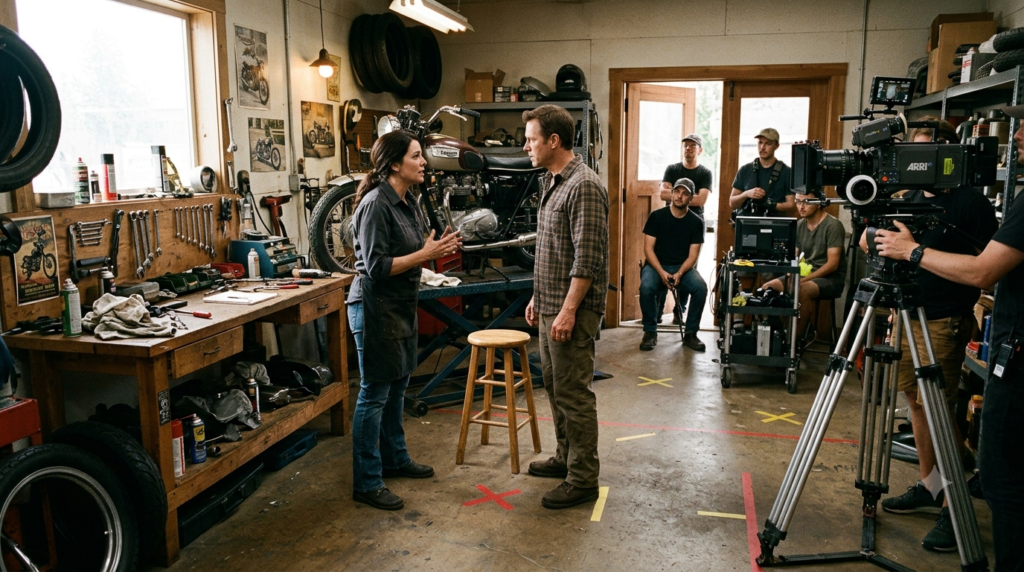
Film blocking decides where actors stand, when they move and how those choices work with the camera. A good plan makes the scene readable while keeping the steps from feeling rehearsed. To see how it works, follow two invented characters through a cramped repair shop, then study the floor plan and rehearsal notes.
What Is Film Blocking?
Film blocking is the planning and rehearsal of actors’ positions, movements and interactions within a scene in relation to the camera. A director shapes that action around the story’s emotional beats, while the cast and camera team test whether it works in the actual space. The result guides filming while leaving space for performance.
The key question in film blocking is not merely where someone stands. Instead, it asks why that person crosses the room at that moment. A character who steps closer may seek trust, exert pressure or simply reach a prop. Their face, timing and the surrounding context decide how viewers read the move.
Filmmaker Steven Bernstein discusses the link between staging, framing and performance in Sony Cine’s account of scene blocking. The position that seems natural to an actor may also need an adjustment for the lens, light or another character’s eyeline.
Film Blocking at a Glance
- Positions: Where performers begin, stop, sit, turn and face during a scene.
- Movement: Their paths, entrances, exits and actions with props.
- Motivation: The dramatic reason a character changes position.
- Rehearsal: A chance to test timing, sightlines, focus and safe routes before recording.
- Camera relationship: The framing and camera positions that make those movements clear.
Think of film blocking as a flexible map, not a dance that must ignore the actor’s instincts. Clear film blocking gives actors starting points while leaving room for small, believable gestures. However, the essential actions still need to match when a scene uses several camera angles.
Why Actor Positions Change the Story
A scene can shift power without changing a line of dialogue. One character sits while the other stands. A pause by the door can make an ordinary goodbye uneasy. Moving away from a shared table might signal a loss of trust.
Yet those interpretations are not universal rules. If the standing character seems frightened, height may suggest exposure rather than control. The director must judge blocking together with performance, shot size and sound.
Film blocking also controls what viewers know through distance. For example, two people sharing a frame can show their reactions at once. When one walks behind a shelf, the audience may briefly lose access to that person. Therefore, positioning can conceal or reveal information without a cut.
Before choosing a move in film blocking, ask what changes in the character’s aim. The script’s new fact or decision should usually lead the movement, not a wish to make the frame busier.
Film Blocking Floor Plan: An Invented Repair-Shop Scene
Here is a fictional scene, created only to teach film blocking. Anika waits in a small motorcycle repair shop. Rohan enters to return a spare key, but he avoids explaining why he kept it. She wants an answer before he leaves.
The room has a workbench on the north wall, a stool to the west and a door on the east. The clear aisle also lets Rohan leave freely. No real film, production or location inspired this floor plan.
Top-down floor plan: North is at the top and east is on the right. However, the grid is a simple teaching sketch, not a scale drawing. A1 and A2 mark Anika’s positions; R1 and R2 mark Rohan’s. C1 and C2 are possible stationary camera setups, not a camera travel path.
| West | Centre-left | Centre-right | East |
|---|---|---|---|
| North wall | Workbench + key | R2: Rohan stops | North wall |
| A1: Anika at stool | A2: Anika stops | Clear aisle | R1: Rohan at door |
| Open floor | Open floor | Clear exit path | Doorway |
| C1: wide camera | C2: closer camera | Crew space | South wall |
Read the plan as two linked paths: Rohan travels from R1 to R2, while Anika moves from A1 to A2. The film blocking marks describe endpoints, not exact footsteps. The performers work out a natural route during rehearsal, then the crew checks it for space and safety.
Four beats make the movement meaningful
- Arrival: Rohan stands at R1, near the east door. Meanwhile, Anika remains at A1. Their separation makes his reluctance visible.
- Disclosure: Rohan moves to R2 and puts the key on the bench. The prop draws attention to the missing explanation.
- Challenge: Anika steps to A2 after asking why he kept the key. She closes some distance without blocking the exit.
- Decision: Rohan looks toward the open doorway but stays beside the bench. His stillness now carries the final beat because the earlier moves set up that choice.
Notice how little travel this film blocking plan needs. Two short moves and a pause tell viewers who wants to leave and who needs the conversation to continue. Adding a nervous walk around the entire room might weaken that contrast.
How the Floor Plan Becomes a Shot
The film blocking plan tells the team where things are, but it does not show the finished frame. Set camera C1 in the south-west area for a wider view. This position can establish the door, stool, workbench and both people in one image.
C2 suggests a closer view from the same general side of the room. The cinematographer must still test the actual lens and sightline. A marked point on paper cannot guarantee that a face stays visible after a turn.
Now consider how film blocking handles the key. If the wide shot hides it behind Rohan’s body, a modest change in his stopping position may solve the problem. Alternatively, the team can plan an insert of the key landing on the bench. Film blocking therefore shapes coverage, but it does not prescribe every edit.
The Movieshala guide to film production design explains how set layout and props support on-screen action. In this scene, the bench is not just decoration. Its location creates the reason for Rohan’s cross.
How to Rehearse Film Blocking Before a Take
Start with the actors’ understanding of the scene, then test the movement in the real space. The aim of film blocking rehearsal is to discover useful behaviour and give the crew clear reference points. Some directors begin privately with performers, while others involve the cinematographer from the start.
- Read for intention. Identify what each character wants at the start, what changes and what they decide by the end.
- Walk the scene loosely. Let performers try natural routes before fixing their final positions. Watch for movement without a clear reason.
- Set the broad positions. Agree on entrances, major crosses, prop actions and stopping points. Keep the exit and crew paths clear.
- Check the camera view. The director and cinematographer test framing, eyelines, obstacles and the line of action.
- Share the blocking with departments. Camera, lighting, sound, art and continuity staff note what they must support.
- Mark and rehearse again. Use simple floor marks where repeatable stops help focus or lighting. Then run a camera rehearsal.
- Adjust and record. Fix what feels forced, check the reset and shoot when the performance and technical plan agree.
The New York Film Academy’s five-stage explanation groups a shoot into blocking, lighting, camera rehearsal, adjustments and recording. That sequence is a practical framework, not an unbreakable rule for every set.
What is a stopping rehearsal?
A stopping rehearsal walks through agreed actions while the crew notes important positions. The actors pause where the camera or lighting team needs a reliable reference. Marks can help focus and repeatability, but they should not turn a conversation into visible target-hitting.
For the repair shop, the crew may mark R2 beside the workbench and A2 by the open aisle. They also record where the spare key lands, because film blocking includes actions with props. Later, when the team changes to C2, those notes help keep the scene consistent.
Film Blocking vs Camera Movement and Storyboards
Film blocking, camera movement and storyboards overlap, but they answer different planning questions. Actor blocking maps performer positions and actions. Camera movement describes how the camera changes its viewpoint during a shot. A storyboard pictures selected frames or moments before production.
| Planning tool | Main question | Repair-shop example |
|---|---|---|
| Actor blocking | Who moves where and why? | Rohan walks from door to bench. |
| Camera blocking | Where does the camera work relative to action? | C1 shows both characters and the key. |
| Camera movement | How does the camera travel or turn during a shot? | A pan follows Rohan toward the bench. |
| Storyboard | What will planned frames look like? | Draw the wide view, then the key close-up. |
| Shot list | Which setups and views must the crew capture? | Wide two-shot, key insert and reaction. |
Some crews use the word blocking for the whole arrangement of actors and cameras. That is valid filmmaking language. Yet moving the performer and moving the camera remain separate choices. A stationary camera can film complex actor blocking, while a moving camera can circle an actor who never changes position.
Adobe’s storyboarding explanation describes drawings that communicate planned screen images. A floor plan instead maps the space from above. For a practical companion, see Movieshala’s storyboard and shot-planning guide. Storyboards may borrow blocking notes, but neither document replaces the other.
How Blocking Affects Eyelines and Continuity
Film blocking must help viewers understand where characters stand across different shots. In the repair shop, Rohan looks from the workbench toward Anika. If a reverse angle suddenly makes both people appear to look the same way, the conversation may feel spatially confused.
The 180-degree guideline helps keep left-right relationships stable by favouring camera positions on one side of an axis. It is not a ban on crossing that line. A clear camera move or wider reorientation can establish a new screen relationship.
Matching a gesture also matters. If Rohan sets down the key in the wide shot, the insert must show a compatible stage of that action. The script supervisor can record the hand used, key position and timing.
For a deeper look at eyelines, the axis and action matches, see Movieshala’s continuity editing guide. Good film blocking gives the editor coherent material, although the final cut still needs careful decisions.
Who Decides the Movement on Set?
The director leads the scene’s meaning and works with the actors on performance. The director of photography, or cinematographer, plans how the action will read through the camera. However, crew structures and collaboration styles vary between productions.
Assistant directors coordinate time and people. Camera assistants consider focus and marks. The sound team checks whether movement causes unwanted noise or makes dialogue hard to record. The art and props teams protect the layout and object positions.
Continuity staff track changes between takes and angles. On a small shoot, one person may cover several functions, so it helps to name who owns each note. Movieshala’s guide to film crew roles separates those responsibilities.
A useful film blocking handoff is simple: the director agrees on the emotional beat, the cast demonstrates the move, and each department explains what might interfere. The team then adjusts the plan together.
Three Ways to Change the Same Scene
Return to the invented repair shop. Keep the dialogue and prop unchanged, but change one movement choice. Each version asks the audience to read the relationship differently. These are possible effects, not guaranteed reactions.
- Version A, restrained: Anika stays at A1 while Rohan puts down the key. Her refusal to approach can suggest distance or disbelief.
- Version B, confrontational: Anika moves to A2 during the question. The reduced distance may raise the pressure without an argument.
- Version C, uncertain: Anika starts toward A2, then stops halfway. The unfinished move may reveal doubt about pursuing an answer.
This film blocking exercise reveals an important limit of neat floor plans. They record decisions after exploration, but the most revealing choice may come from a hesitation that no diagram predicted. Preserve discoveries that help the scene, then update the marks.
Film Blocking Mistakes That Cost a Scene
Movement for its own sake: Repeated pacing can make actors look busy without developing the story. Remove a cross if nothing changes when the character moves.
Designing only for the wide shot: A turn may hide an actor’s eyes in the closer view. Test the important frame before locking the position.
Ignoring the room: A route may collide with furniture, cables or a boom microphone. Clear hazards and revise the path rather than asking people to squeeze through.
Over-marking every gesture: Exact floor marks help focus, but excessive precision can flatten performance. Hold the crucial stops steady and leave room for ordinary human behaviour.
Forgetting the reset: A key, chair or coat may shift between takes. Take a reference photo and give each reset task an owner, since film blocking relies on consistent actions across takes.
Confusing drawings with proof: A storyboard can look elegant while the location remains unworkable. Walk the physical scene before promising that a shot is possible.
A Low-Budget Film Blocking Exercise
You can practise film blocking with two performers, a table, a door and a phone camera. Write a short exchange with one change in intention. For example, one person brings an object, while the other decides whether to accept it.
- Draw a top-down map with the door, table, performers and one camera position.
- Mark the first and final actor positions, then add only the moves the story needs.
- Run the scene once without recording. Ask both actors why they move.
- Record a wide version and check whether the action reads without close-ups.
- Try one changed position, then compare how the relationship feels.
- Review sound, eyelines, clear walking paths and prop continuity before a second take.
There is no guaranteed best film blocking arrangement. The point is to see how a physical choice changes meaning and whether the crew can repeat it safely. Keep the version that serves the characters rather than the neatest diagram.
The Bottom Line
Useful film blocking begins with a character’s intention and ends with a scene the audience can follow. The floor plan keeps positions clear, while rehearsal discovers the movement between them. Camera planning, storyboards and continuity notes support that work without becoming the same thing.
For your next short scene, mark only the entrance, the meaningful cross and the final stop. Then test the result in a wide shot before adding camera moves or close-ups.
Film Blocking: Frequently Asked Questions
What does blocking mean in film?
Blocking means planning where actors stand, move, face and interact during a scene. These choices work in relation to the camera and help communicate the story. A rehearsal then tests whether the movements feel natural.
Who is responsible for blocking a scene?
The director normally leads the creative decisions, working with actors and the cinematographer. Camera, sound, art and continuity departments then help make the plan workable. Responsibilities may overlap on a small production.
Is blocking the same as camera movement?
No. Actor blocking tracks performer positions and actions, while camera movement describes a pan, track or other change of viewpoint. Camera blocking can include both, so the terms sometimes appear together on set.
Is a floor plan the same as a storyboard?
No. A floor plan shows the room from above and maps positions or paths. A storyboard shows planned screen images in sequence. They work together, but they answer different questions.
Do actors have to hit exact marks?
Not for every gesture. Marks can help with repeatable stopping points, focus and lighting. However, directors may allow flexibility when slight changes make the performance more convincing.
Can you block a scene without a storyboard?
Yes. A director can work from the script, a simple floor plan and a live rehearsal. Complex action may benefit from storyboards, but a rough planning method can suit a small dialogue scene.
Why does blocking matter for editing?
It sets up where actors and objects appear across camera angles. As a result, clear movement and consistent eyelines give the editor shots that can join smoothly. Poor continuity may become hard to hide later.
What should you do when planned blocking fails?
First identify whether the problem involves performance, framing, safety or a blocked path. Then simplify the move, adjust the camera or rearrange movable props with the team. Rehearse the revised version before recording again.