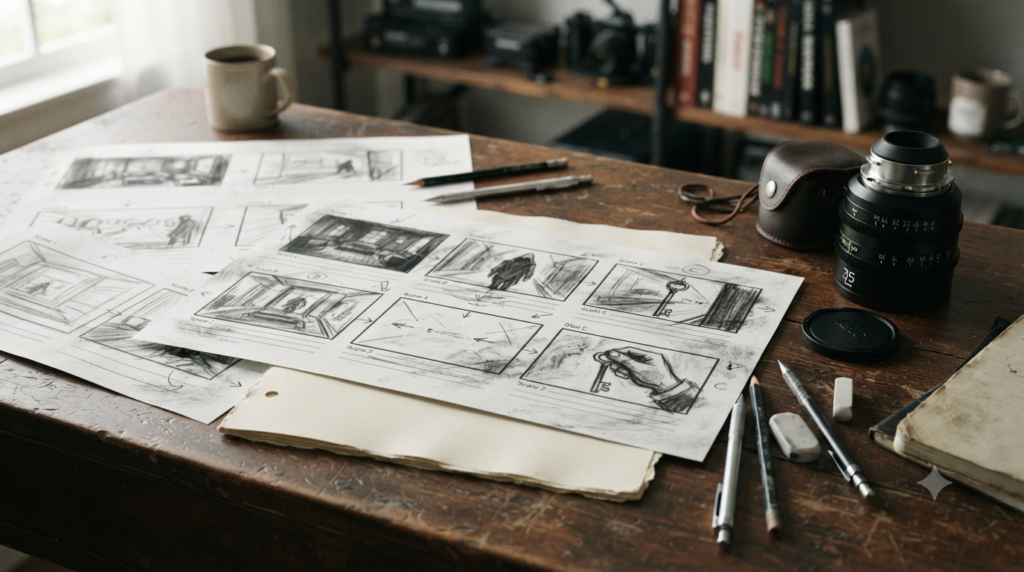
Film Storyboard: From Script to Shot Planning
A film storyboard turns a written scene into a sequence of planned camera views before the crew starts filming. Each panel tests what the audience will see, where attention will move and how one shot might lead into another. The drawings in a film storyboard can be rough. The decisions behind them need to be clear.
A screenplay tells the crew what happens. A film storyboard asks a more visual question: what should the camera reveal, and in what order? The film storyboard becomes especially useful when a scene contains several characters, a crucial prop or a movement that must match across cuts.
The Visual Plan at a Glance
- Purpose: Plan shots through images before the production commits to camera setups.
- Core parts: Numbered panels, framing, subject positions, action and movement notes.
- Main benefit: Give directors and departments a shared way to discuss visual choices.
- Not the same as: A screenplay, written shot list or timed animatic.
- Practical starting point: Sketch one short scene with a clear beginning, turning point and reaction.
The Academy Museum of Motion Pictures describes the storyboard as a way to see a script through a camera lens. Its exhibition text highlights frames, movement and shot progression. The point is not to make attractive drawings. It is to make storytelling choices visible.
What Is a Film Storyboard?
A film storyboard is an ordered set of drawn or assembled images showing planned views of a scene. The panels suggest composition, shot size, movement and visual sequence. Crew members use them to discuss what must appear on screen and how separate shots may work together. The boards remain a plan, not a guarantee of the final edit.
Think of a comic strip that serves a film crew rather than a reader. Both use panels, yet a storyboard centres on the camera. It may show where an actor stands, how a door enters frame or why a close-up follows a wide shot.
The Academy’s Margaret Herrick Library feature on Star Trek: First Contact offers an archival example. Its production notebooks held scripts, schedules, memos and storyboards together. That context matters: a film storyboard belongs to a wider production process, not an isolated art exercise.
What Belongs in a Film Storyboard Panel?
A useful film storyboard panel shows the view the camera needs, plus enough notes to explain the action. Typically, it identifies a shot, places the subjects within the frame and indicates motion that a still drawing cannot show. Clear labels on a film storyboard matter more than detailed shading, especially during fast production meetings.
- Scene and shot number: Connect the panel to the scene breakdown and shooting plan.
- Frame: Draw a rectangle matching the intended screen shape, if the format is known.
- Composition: Place faces, doors, props and empty space where the audience should see them.
- Action beat: Note the important gesture or change within the view.
- Camera direction: Describe a pan, tilt, push-in or other planned move when relevant.
- Sound or dialogue cue: Add only the cue that affects timing or the visual reveal.
For example, a small arrow in a film storyboard might show a character crossing the room. An arrow along the frame edge might indicate a camera pan. Label the difference, since one symbol should not make two departments guess.
Drawing the frame without drawing every detail
Start with the main shapes: a table, a doorway and two simple figures. Then place the important object where a viewer can recognise it. A rough sketch often exposes a weak composition sooner than a polished image because there is less decoration to hide the problem.
ACMI’s storyboarding lessons teach this with simple drawings, shot sizes and arrows. They also distinguish shots from individual film frames. You do not need to draw every moment of an actor’s movement to make a practical board.
Framing: What Will the Audience Notice?
Framing decides how much of the space and action a viewer can see. A wide shot may explain a room, while a close-up directs attention to a face or object. When planning a film storyboard, select each view for the information it adds. An attractive angle is not enough if it hides the story’s turning point.
Imagine a fictional archive room. Asha enters, takes a blue folder from a desk and hears a bell. Through the glass partition, she notices a shadow. The scene has no real-film source; it is an invented teaching example.
A wide view first establishes the desk, door and glass partition. A medium shot then shows Asha’s hand reaching toward the folder. An insert makes the folder important without needing extra dialogue. Finally, a reaction close-up tells us the bell has changed her plan.
Wide, medium, close-up and insert shots
Wide shot: Shows the room’s layout and the route between key points. Medium shot: Balances a person’s action with nearby space. Close-up: Highlights an expression or small decision. Insert: Isolates a story-critical object, such as the folder’s label or a turning key.
These labels are useful shorthand, but shot sizes vary with the project and lens. Ask what viewers need to know at that moment. If an insert merely repeats what the audience already understands, the film storyboard may not need it.
Camera Moves and Actor Blocking
A film storyboard can suggest both actor movement and camera movement, but the two are not interchangeable. Blocking describes where performers go and what they do. Camera movement changes the viewpoint. A good board separates those actions so camera, direction and art teams can test whether the space actually allows the plan.
Suppose Asha crosses left to right toward the archive desk. The camera could remain still as she moves. Alternatively, it might pan with her, or track alongside her. Each choice changes what the viewer notices about the room and the person following her.
Use short notes such as “Asha exits frame right” or “camera pans right to reveal glass.” Add directional arrows only when their meaning is obvious. For a difficult move, draw the starting and ending composition as separate key panels within one planned shot.
Do panels show cuts or camera moves?
A new panel often signals a new shot, although a complex moving shot may need several key drawings. Therefore, panels are not a fixed count of edits. The director and editor can later change the sequence, while the storyboard keeps the intended visual development clear for the crew.
A Fictional Six-Panel Scene, Shot by Shot
Here is a film storyboard for the invented archive scene. It deliberately combines shot purpose, geography and the cut to the next view. The plan assumes the desk remains screen right and the glass partition sits beyond it. Those decisions give the following shots a consistent spatial reference.
| Panel | Planned view | Action and visual purpose |
|---|---|---|
| 1 | Wide shot | Asha enters from screen left; desk and glass establish the room. |
| 2 | Medium shot | She approaches the desk and reaches with her right hand. |
| 3 | Insert | Her fingers lift the blue folder; the action completes across the cut. |
| 4 | Medium close-up | A bell rings; Asha stops and looks toward the glass. |
| 5 | Over-shoulder view | A shadow appears beyond the partition in her sightline. |
| 6 | Close-up | Asha holds the folder tighter, changing the scene’s mood. |
In this film storyboard, the first panel answers “Where are we?” Panel three answers “What matters?” Panel five answers “What has Asha seen?” As a result, the sequence creates a simple chain of questions rather than six unrelated attractive images.
There is also a practical test. Panel two begins a right-hand reach; panel three must continue the same gesture. If the hand changes or the folder jumps across the desk, the cut may feel wrong. The storyboard catches that risk before filming, although the crew must still maintain continuity on set.
How to Make a Film Storyboard from a Script
To make a film storyboard, first identify the scene’s important changes. Decide what viewers need to see at each moment, then choose frames that reveal those facts in a clear order. Draw rough panels, add action and camera notes, and review the sequence with the people who must shoot it.
- Read for story beats. Mark the entrance, discovery, decision and reaction. Separate what the script states from what the camera must communicate.
- Map the room. Draw a simple overhead plan of doors, actors and major props. Then choose a consistent viewing side for related shots.
- Select essential coverage. Pick a readable wide view, useful closer views and any insert that carries new information.
- Sketch panels in viewing order. Stick figures are fine if subject size and placement remain clear.
- Label action and movement. Distinguish a walk from a pan, and write where a move starts or stops.
- Check adjacent shots. Compare screen direction, hand use, prop position and the moment when action continues across a cut.
- Review with departments. Ask what needs a set change, camera rig, extra light or alternate angle.
- Revise the plan. Remove repeated views, replace confusing transitions and update shot numbers after changes.
Do not treat this order as an unbreakable rule. A director might begin with location photographs, or a cinematographer might sketch camera placement first. The aim is a film storyboard the crew can understand, not perfect compliance with one template.
Film Storyboard vs Script, Shot List and Animatic
These documents solve related but different problems. A screenplay describes the scene through action and dialogue. A shot list records planned camera setups in words. A film storyboard visualises selected views, while an animatic places board images in a rough timed sequence, often with temporary sound.
| Tool | Main question | Typical form |
|---|---|---|
| Screenplay | What happens and what is said? | Written scenes and dialogue |
| Shot list | What images must we capture? | Numbered shot descriptions |
| Storyboard | What might each planned view look like? | Ordered panels and notes |
| Animatic | How might these views play over time? | Timed panels, sometimes with sound |
A shot list can describe “close-up: Asha notices the shadow.” The corresponding panel can show her eyeline and the glass in the background. An animatic then tests how long that look lasts before the next image arrives.
ACMI’s teaching material moves from boards to an animatic and asks students to add timing. That step can reveal awkward pauses, rushed reveals or a missing reaction. Still, an animatic is a rough timing study rather than a promise about the finished cut.
How Storyboards Support Visual Continuity
Visual continuity means viewers can track space, movement and action as the camera changes position. A film storyboard helps by showing adjacent views before shooting begins. It can flag an unexpected reversal, a missing eyeline or an action that will be difficult to match. It cannot replace detailed records during filming.
For the archive scene, imagine that Asha walks toward screen right in the wide shot. If the next angle suddenly sends her toward screen left without a clear turn, viewers may think she has reversed direction. The plan should explain any change through camera placement or a visible reorientation.
Likewise, the reach toward the folder needs compatible hand positions across panels. The editor can refine timing after filming, but cannot rely on the board to create a matching gesture the crew never captured.
Movieshala’s guide to continuity editing and screen direction explains the cutting principles in more depth. The useful division is simple: storyboards anticipate possible edits, while editing works with the footage that actually exists.
How Crew Departments Use the Boards
A film storyboard gives several departments a shared reference, although each team reads it differently. The director checks story emphasis. The cinematographer considers angle, movement and lighting. The assistant directors consider scheduling, while production design checks sightlines, entrances and objects that must appear in frame.
A storyboard artist may translate the director’s ideas into panels, but smaller shoots often use sketches from the director or camera team. Neither a job title nor a polished drawing guarantees that every shot will work on location.
For the archive example, the art department must know whether the glass partition exists and where the desk can sit. Camera must know whether the over-shoulder view has enough space. The direction team checks whether Asha’s movements fit the planned setup.
Movieshala’s film crew roles explainer details these handoffs. Its production design guide adds how sets, props and sightlines shape the images that a storyboard proposes.
What Beginners Get Wrong About Storyboards
The first mistake is treating drawing skill as the main obstacle. A simple film storyboard can be useful when it communicates framing and action without ambiguity. Elaborate art can be less helpful if it leaves the camera position or sequence unclear.
- One panel for every second: Usually unnecessary. Draw meaningful changes and add key positions for long moves.
- Only close-ups: Without an establishing view, the audience may lose the room’s geography.
- Arrows without labels: A mark that could mean actor movement or camera movement creates confusion.
- Ignoring the cut: Two strong individual images can still connect badly when movement or eyelines clash.
- Treating boards as orders: Locations, actors and safety needs can force better alternatives during the shoot.
Another common film storyboard mistake is drawing shots without testing the location. If a wall blocks the planned reverse angle, the crew needs another framing or an altered set. Identifying that problem early is more useful than decorating every panel.
Which Scenes Benefit Most from Storyboards?
Storyboards earn their place when the visual order is hard to explain with words alone. A reveal, choreographed movement, complex transition or effects shot benefits from shared images. Simple coverage of a conversation may need only a clear shot list and floor plan, depending on the director’s working style.
The Academy’s archived Star Trek: First Contact boards illustrate planning around a complex action sequence. They show why production documents can travel together: visual ideas affect scheduling, equipment and coordination. The Academy example is historical evidence of one production workflow, not a rule for every film.
For a low-budget scene, focus on the handful of shots where a wrong choice would be costly. This keeps the film storyboard lean. If plans change, update both the panels and the shot list so the crew is not working from conflicting versions.
A Simple Test Before Taking the Boards to Set
Lay the panels in order and hide their explanatory captions. Can someone unfamiliar with the script follow the key action? If not, the images may be missing a location cue, important gesture or reaction. Then restore the captions and ask the camera and art teams what the plan leaves uncertain.
Next, read the shots aloud while moving a finger from panel to panel. Check whether each new view gives the audience something new. Finally, compare the storyboard with the location layout. A practical plan should survive questions about space, movement and timing.
No storyboard can guarantee that a shoot will follow it exactly. Weather, performance, permissions and equipment may change the plan. The fallback is to protect the scene’s essential story beats and redesign the shots together, rather than chasing a drawing that no longer fits reality.
The Bottom Line
A film storyboard is valuable because it turns private ideas into visible choices that several departments can test. Begin with the scene’s story beats, not detailed artwork. Check framing, movement and the transitions between views. Then carry an updated plan to the shoot while leaving room for better discoveries on set.
Film Storyboard: Frequently Asked Questions
What is the purpose of a film storyboard?
Its main purpose is to show a proposed visual sequence before filming. Panels help the team discuss camera views, movements and story emphasis. They also expose missing or confusing shots early.
Does every film need a storyboard?
No. Some films use extensive boards, while others rely more on shot lists, floor plans and rehearsals. The need depends on the complexity of the scene and the director’s process.
How many panels should a storyboard have?
There is no fixed number. Use enough panels to explain the key shots and changes in action. A long camera move might need several key drawings, while a simple shot may need only one.
Can I make a storyboard if I cannot draw?
Yes. Stick figures, simple shapes and clear labels can communicate the plan. Aim for readable positions, framing and movement rather than detailed illustration.
What is the difference between a storyboard and shot list?
A storyboard shows proposed shots as pictures, while a shot list names them in writing. They can refer to the same numbered shots. Using both helps the crew connect visual intent with production requirements.
What is the difference between a storyboard and animatic?
A storyboard is an ordered set of still panels. An animatic plays those panels in a timed sequence, sometimes with rough dialogue or sound. Timing can reveal pacing problems that a static page hides.
Who draws storyboards for a film?
A storyboard artist may draw them with the director and cinematographer. On smaller projects, the director or another crew member may make the sketches. The production decides how to divide the work.
Are storyboard shots always used in the final film?
No. The crew may revise angles during production, and the editor may change the order later. A storyboard is a planning tool rather than a locked version of the finished film.