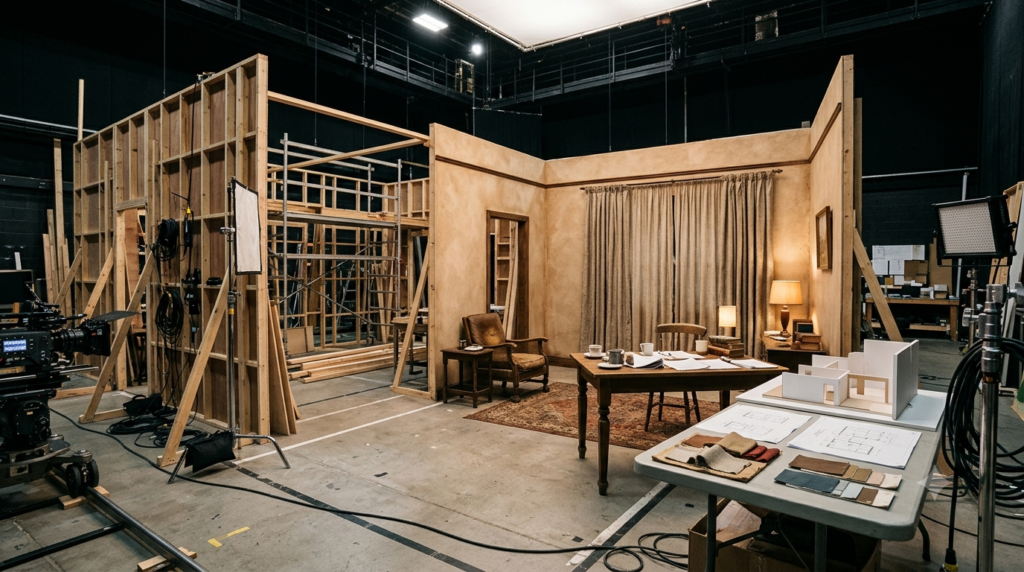
Film Production Design: Sets, Locations and Visual Storytelling
Film production design gives a movie its physical world, from the size of a room to the objects on a table. The best choices reveal who lives there, what has happened and what might happen next. A plain kitchen can feel safe, suspicious or lonely before an actor speaks.
Sets are only part of that work. Real locations, props, colour, texture and camera movement all affect what an audience understands. This guide explains how those choices work together, using clearly invented scenes rather than passing fictional examples off as real productions.
Film Production Design at a Glance
- Purpose: Turn a script’s people, places and conflicts into a convincing visual world.
- Spaces: Shape scale, entrances, sightlines and movement, whether filming on a set or location.
- Objects: Let furnishings and props suggest a character’s habits, history or priorities.
- Colour and texture: Build visual relationships that support the story, rather than fixed emotional formulas.
- Collaboration: Coordinate art, camera, lighting, costume, locations, effects and post-production.
The Academy of Motion Picture Arts and Sciences explores these ideas in its Art Direction: The Visual Language of Film guide. Its lessons connect architecture, decoration, colour and texture to visual meaning. The Academy’s Academy Academy video series also includes production-design segments about shape, colour and story.
What Is Film Production Design?
Film production design is the planning and creation of a screen story’s visual environment. The production designer helps shape its overall look through spaces, sets, locations, decoration, materials and palettes. Working with other departments, the designer makes those choices serve character, action and the camera, rather than decoration alone.
Consider a fictional detective who returns home after losing a case. A room full of half-open boxes, empty shelves and one carefully polished trophy communicates unsettled priorities. The audience starts reading the character’s life before any exposition arrives.
This is why production design differs from simply finding attractive interiors. A lovely room may fail if its doors block an important entrance or its furnishings contradict the character. The Academy’s guide stresses that sets must work from changing camera angles, not just as still pictures.
Film Production Design: Sets and Real Locations
A built set gives filmmakers more control over walls, doors, sightlines and movement. A practical location offers existing architecture, light and lived-in detail, but also brings limits. Film production design can use either approach, or combine both within the same fictional place.
Imagine an invented mystery set in an old coastal hotel. A real corridor might provide worn flooring and convincing depth. The crew could then build a matching guest room with removable walls, so the camera can track a character opening a hidden drawer.
Neither choice is automatically more authentic. What matters is whether the cut between spaces feels consistent and supports the scene. For example, a location may need fresh paint, temporary signs or different furniture before it belongs to the film’s world.
A visually suitable location still needs permission to film. Even an ideal setting may be off-limits without approval from its owner or the responsible authority. Check access and any filming restrictions before committing the schedule. For Telugu productions, Movieshala’s shooting-permissions guide explains why approvals depend on the site and planned activity.
Scale, shape and movement
Large spaces can make a person appear isolated, while tight spaces can restrict movement. Yet those effects depend on framing, performance and context. The Academy guide asks designers to think about volume, depth, perspective and how the camera will travel.
A low doorway may force an actor to duck during a tense entrance. A deep hallway can keep another character visible in the far background. These are story decisions, not merely architectural details, because the layout changes how the audience experiences the action.
How Props and Set Dressing Reveal Character
A prop can carry a clue, while everyday set dressing can quietly explain a person’s life. Film production design often succeeds through a group of small details that feels coherent. The Academy’s guide makes this point through exercises about what room objects tell viewers.
In an invented drama, a teacher’s desk holds neat lesson plans, a broken watch and an unopened moving notice. The plans suggest routine; the watch hints at neglect; the notice suggests a coming change. No single object needs a close-up, unless the script makes it important.
A useful distinction helps here. Set decoration generally concerns the furnishings and background objects that establish a space. The props team commonly handles objects actors use or carry. Responsibilities can overlap, especially on smaller shoots, so the departments agree on ownership and continuity.
Give an important object a story arc
Suppose a fictional singer hides a concert ticket inside a cookbook. Early on, the ticket is folded and almost invisible. Later, it sits openly on the dining table after a hard conversation. Its new placement signals a decision without needing a line of dialogue.
That change works only if the crew tracks the object between shots. Keep notes on position, condition and handling. A storytelling prop loses force when it jumps around the room by accident, or disappears from a matching angle.
How Film Production Design Uses Colour and Texture
Colour and texture give rooms a visual identity, but they do not carry one fixed meaning. Film production design can repeat, contrast or gradually change materials as characters develop. A faded green wall may suggest age in one story and comfort in another.
Take a fictional family business. Early scenes feature bright tiles, clean glass and crisp cotton. After a financial setback, repairs stop and the same space gains chipped paint, taped cartons and faded fabric. The change feels physical because texture, not a filter alone, tells the story.
The Academy’s guide discusses how colour and fabric palettes can connect surroundings with character. It also notes that colour meanings vary across cultures. Therefore, filmmakers should test associations within their own story instead of declaring red universally dangerous or blue universally sad.
Plan for lighting and the final grade
Paint also rarely looks identical under daylight, warm lamps and coloured film lighting. Shiny materials can also reflect crew or reveal equipment. The designer and cinematographer therefore test surfaces in the light and framing planned for the scene.
Production design chooses the physical colours and materials that enter the lens. Later, colour correction and grading refine the recorded image. A grade cannot reliably replace a missing prop or redesign an unsuitable room. Movieshala’s film colour grading guide explains that separate finishing stage.
A Fictional Scene, Designed Three Ways
The following example is entirely invented. A daughter enters her father’s workshop to ask about a missing letter. The dialogue stays the same, but the set changes what the audience suspects.
| Design choice | Visible details | Possible story effect |
|---|---|---|
| Open and orderly | Clear workbench, daylight, wide doorway | Suggests trust and room for honest talk |
| Crowded and guarded | Stacked cabinets, narrow aisle, locked drawers | Creates obstacles and hints at secrecy |
| Recently disturbed | Clean rectangle in dust, moved chair, torn fabric | Suggests someone searched the room |
These readings are possibilities, not automatic audience reactions. A warm performance could turn the crowded workshop into a place of affection. Equally, an orderly room could feel threatening if someone watches from a dark corner.
So the strongest approach is to decide what the viewer should know at each beat. Then remove details that reveal too much too soon. Here, film production design becomes a form of controlled information: space can answer one question while raising another.
Who Creates a Film’s Visual World?
The production designer leads the overall environment concept, but a film’s look depends on many specialists. ScreenSkills describes the role as leading art-department planning and coordinating sets, construction, decoration and props. The job titles and team size vary with each production.
- Production designer: Develops the visual concept with the director and other heads of department.
- Art director: Helps turn concepts into workable designs, plans, schedules and built spaces.
- Set designer or draughtsperson: Produces drawings and models that construction teams can follow.
- Set decorator: Shapes the furnishings, wall finishes and other visible background details.
- Props master and props team: Organise objects required for action, handling and continuity.
- Locations team: Finds and manages practical places, coordinating with the design and production teams.
A director of photography, costume designer and visual effects supervisor also influence the final result. Their responsibilities remain distinct, even while they work toward a shared look. For the wider department map, see Movieshala’s film crew roles explained article and the ScreenSkills production designer profile.
Film Production Design From Script to Screen
A clear process protects creative ideas from practical surprises. Film production design starts with the story’s needs, not with buying furniture. The exact order changes across projects, but the following sequence gives beginners a sound way to plan a short film.
- Break down the script. List every setting, scene change, period detail and object needed for action. Mark items that must appear again.
- Define the story question. For each location, decide what the audience should feel or notice. Do not start with a fashionable colour palette.
- Gather useful references. Study architecture, materials and ordinary domestic details. Separate researched facts from invented choices.
- Scout or sketch the space. Check entrances, windows, ceiling height, camera paths and places for lights. Photograph both wide views and small surfaces.
- Choose a practical design. Compare a real location, a dressed location and a built set. Factor in time, access, safety and budget.
- Test with the camera team. Shoot sample frames under planned lighting. Check colour clashes, reflections and unwanted modern details.
- Track continuity and changes. Photograph each setup, label key props and note what moves between takes. Review the design as the story develops.
ScreenSkills’ production designer skills checklist supports this emphasis on script analysis, department communication, budgets and planning. It also stresses checking what the agreed design can achieve within real production limits.
Choosing Between a Built Set and a Location
The right choice depends on the scene rather than just the budget, so first study the intended shots. If actors need to move through several rooms, a location may offer useful depth. If walls must move for close camera work, a built section may save trouble later.
For a fictional apartment argument, begin with the shot list. Does the camera need a reverse angle through the kitchen wall? Can sound crews control street noise?
Is there room for lights without putting cables in the actors’ path? These questions help reveal whether the beautiful location is actually usable.
A hybrid solution can work well. Film the exterior and stairwell at a real building, then build a matching apartment interior. However, the team must match doors, windows, surfaces and light direction closely enough for the edit to feel seamless.
Common Mistakes That Weaken a Set
The first mistake is decorating for a single photograph. A film set needs to work in moving shots, so its best-looking corner may be irrelevant. A designer should walk the intended camera route before approving the layout.
Another mistake is using period objects as random decoration. One vintage radio does not make a room believable if everything else feels unrelated. Instead, ask which objects the character would own, repair, discard or keep for sentimental reasons.
Colour can also become a shortcut. A blue wall alone cannot make a scene sad, and a saturated red room cannot guarantee tension. Strong production design works with acting, sound, lighting and editing rather than trying to replace them.
Finally, teams sometimes overlook the unseen side of the set. A narrow access path may slow equipment moves, while a reflective cabinet exposes lights. Resolve those issues during planning because a last-minute fix can damage both continuity and the schedule.
How to Study Production Design While Watching Films
Pick one scene and watch it twice. On the first viewing, follow the plot. On the second, look at where the characters stand, what objects surround them and which surfaces catch the light. Ask what would change if the same dialogue occurred elsewhere.
Then sketch the room from memory, including doors and the likely camera position. Mark three details that communicate character. If you cannot explain why an object belongs there, it might be visual noise rather than useful information.
Try a simple film production design exercise with an invented scene: two friends meet after an argument. Dress one corner as a cheerful café and another as a nearly empty waiting room. Keep the lines and performers unchanged. The contrast shows what the environment contributes without claiming either setting has a universal meaning.
The Bottom Line
Great production design is not measured by how much a set costs or how many props it contains. It gives a story the right physical conditions for meaning to emerge. Start with the script, test the space through the camera and make each visual detail earn its place.
If an audience understands something about a character before the next line arrives, the environment may be doing its job. That is the lasting value of film production design: it makes the setting an active part of the storytelling.
Frequently Asked Questions
What does a production designer do in a film?
A production designer leads the overall concept for the film’s physical visual world. They work with the director and other departments on sets, locations, decoration and materials. On larger productions, specialist teams turn those ideas into finished spaces.
Is production design the same as set design?
No. Set design focuses more narrowly on planning a particular physical setting. Production design considers the wider visual world and how different environments relate to one another. However, responsibilities and job titles may overlap on small productions.
What is the difference between production design and art direction?
In common modern film workflows, the production designer guides the overall look while art directors help deliver practical designs. Older sources sometimes use the terms more broadly. The Academy’s teaching guide reflects that historical usage, so context matters.
Do production designers choose filming locations?
They help assess whether locations suit the script and the film’s intended look. A locations department often handles searching, access and logistics. The final decision involves creative, technical and production needs, rather than the designer acting alone.
How do props help tell a story?
Props can reveal habits, create clues and record change across scenes. A cracked photo frame or freshly repaired chair might suggest a relationship without dialogue. Their placement and continuity matter because the audience follows objects across cuts.
Does colour grading replace production design?
No. Production design creates the spaces, surfaces and physical colours that the camera records. Colour grading adjusts the recorded image later. The grade can refine a visual idea, but it cannot make a missing set detail appear automatically.
Can low-budget films have strong production design?
Yes. A small film can make deliberate choices about locations, furniture and a few significant objects. Clear story priorities usually help more than filling a room with expensive decoration. Test every choice through the actual camera framing.
How can beginners practise production design?
Write a short scene, then design two contrasting spaces for it. Photograph the same action in both settings and compare what the audience learns. Keep sketches, prop lists and continuity photos, since those habits turn an interesting idea into usable filmmaking work.